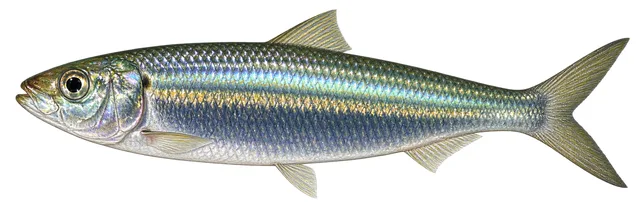
S. aurita went through a large boom in catch population around 1990. However, its numbers have been very stable through the last several years.
S. aurita inhabits warm waters. It is a small, pelagic species that lives in tropical and subtropical waters of the western and eastern Atlantic Ocean, the Pacific Ocean, the Mediterranean, and occasionally, the Black Sea. The gonads start to develop in April and are fully mature one month later. Plankton in spawning regions are full of eggs and larvae from the end of June into September.
Diagnostic features
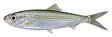
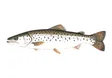
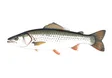
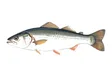
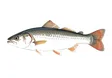
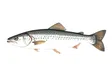
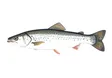
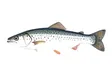
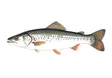
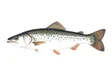
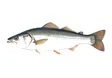
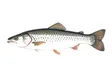
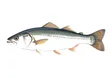
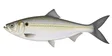
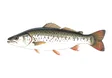
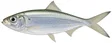
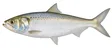
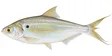
Sardinella aurita has a particularly elongated body, a relatively rounded belly, and a large number of fine gill rakers (up to 160). This is one of the largest Sardinella species, averaging 23 to 28 cm (9.1 to 11.0 in). It has eight pelvic fin rays. It has frontoparietal stripes on the top of its head, a faint golden midlateral line, and a distinctive black spot on the hind border of the gill cover. It is often caught along with Sardinella longiceps, and the two are not easily distinguished.
Habitat
The fish prefer shallower waters around 24 °C (75 °F). It reaches depths of 350 m (1,150 ft). It is a schooling fish that feeds on phytoplankton and zooplankton such as copepods.
Fisheries
Fisheries for this species exist off the West African coast, in the Mediterranean Sea, and along the coasts of Venezuela and Brazil. Fishery numbers in 1983 totaled 1,983,000 tons.
Additional field notes
Round sardinella have regional spawning patterns and seasonal movements that a single calendar cannot capture.
Sources: Sardinella aurita species summary
Upwelling, food, and reproduction
FishBase describes schools approaching the coast and surface during upwelling periods, with deeper occupation below the thermocline in warmer seasons. Schools may rise and disperse near the surface at night. These movements connect the fish with changing water conditions rather than a fixed year-round depth.
Copepods and mysid larvae are important food, while juveniles also consume phytoplankton. Young fish may remain in nursery areas before joining adult stocks offshore.
Reproduction is reported through much of the year in some areas, with pronounced seasonal peaks and sometimes two main spawning periods. The summary specifically reports no spawning in the Black Sea. A spawning month documented in one region should therefore not be used as a range-wide prediction.
Sources: Sardinella aurita species summary
Article text: Wikipedia contributors, Round sardinella (source revision). Licensed under CC BY-SA 4.0. Retrieved 2026-10-11.