Hickory Shad

Alosa mediocris

Clupeidae · freshwater and saltwater and brackish water fish

5 minute read · Species guide

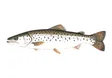
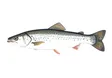
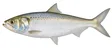
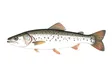
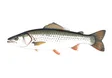
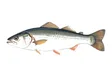
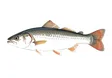
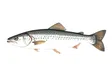
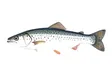
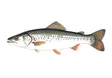
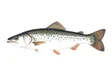
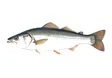
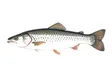
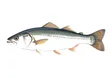
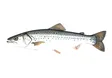
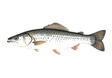
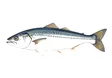
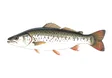
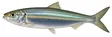
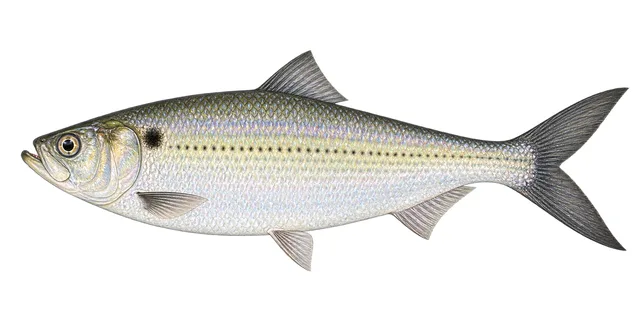
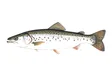
Hickory Shad field guide illustration

About Hickory Shad

The hickory shad (Alosa mediocris), fall herring, mattowacca, freshwater taylor or bonejack is a member of the family Alosidae, ranging along the East Coast of the United States from Florida to the Gulf of Maine. It is an anadromous fish species, meaning that it spawns in freshwater portions of rivers, but spends most of its life at sea. It is subject to fishing, both historic and current, but it is often confused with or simply grouped together with American shad (A. sapidissima) in catch statistics.

Description

Hickory shad are elongate, laterally compressed fish with a tapering cross section. The scales on the belly are serrated. The fish is green-gray on its upper surface, becoming iridescent silver on the sides and white below. The scales bear small dark markings. A humeral spot is present and is frequently followed by a short series of fainter spots. The hickory shad can be distinguished from American shad by its lower jaw, which will project beyond the snout in the hickory shad.

Distribution, habitat, and life history

Hickory shad range from northern Florida to the Gulf of Maine. The largest populations occur in Chesapeake Bay and coastal North Carolina. It is a schooling anadromous species that inhabits marine waters, probably never far from land. Adults enter estuaries and freshwater tributaries from the St. John's River, Florida, to the Patuxent River, Maryland, to spawn during the spring. Their oceanic movements are poorly documented.

Spawning occurs from December to June, earliest in Florida and later with increasing latitude. The slightly adhesive and demersal eggs, about 1 mm in diameter, appear to be dispersed at random over gravel bars in moderate current. After water hardening, the eggs become semibuoyant and develop as they drift along the bottom. Fecundity ranges from 43,000 – 475,000 eggs per female, and although the developmental stages of eggs, larvae, and juveniles have been described, little is known concerning the distribution, ecology, and growth rates of these early life stages.

Hickory shad live to seven years. Both sexes mature starting at 2 years of age and can repeat spawn. Females are larger than males; in Florida, the average female is 37 centimetres (15 in) fork length and the average male is 34 centimetres (13 in) fork length.

Hickory shad are piscivorous, feeding primarily on small fishes, although crustaceans and squid contribute to their diet. One study from Florida showed that their diet on the spawning grounds was almost exclusively fish (97% by weight), but feeding is limited during the freshwater migration and mesenteric fat reserves developed prior to migration are metabolized en route.

Recreational fishery

Hickory shad have a relatively low commercial value, but an increasingly popular recreational fishery exists throughout the mid-Atlantic states. By the late 1980s and early 1990s, hickory shad articles appeared in sport-fishing magazines. Headlines such as "the tough fighting hickory shad swarm near the rock-studded fall line…"and"feast on Rappahannock River hickory shad action" brought attention to the fishery. Subsequently, specialty magazines and sports sections in national newspapers began proclaiming the excitement of hickory shad fishing ("HICKORY SHAD ARE RUNNING!") and the recovery of the fishery. In the two most recent years of a North Carolina creel survey (2004–2005), hickory shad – a fish only present for two months of the year – moved from sixth- to the fourth-most targeted fish by coastal anglers. They are also taken by recreational fishing for use as bait to catch larger fish.

Literature

Most information about this species is contained in federal and state documents and management plans or theses from universities. Federal publications include reports from the Atlantic States Marine Fisheries Commission's (ASMFC) Interstate Fishery Management Plan for Shad and River Herring. Prominent publications by state agencies include reports based on fishery monitoring programs in Connecticut, Pennsylvania and Maryland, North Carolina, South Carolina, Georgia, and Florida. A few publications address coast-wide and/or genus-level stock status and management issues. The U.S. Fish and Wildlife Service published a useful series that includes egg, larvae, and juvenile development descriptions of hickory shad. A recent review of hickory shad in Chesapeake Bay places management of this species in an ecosystem context. Three master of science theses also studied them.

Although hickory shad research has been limited, other clupeids, especially Alosa species in the United States, have received more attention.

Article text: Wikipedia contributors, Hickory shad (source revision). Licensed under CC BY-SA 4.0. Retrieved 2026-10-11.
Diet and feeding

The FishTraits compilation records these diet categories for this species: invertebrates or larval fish; larger animal prey (a source category covering fish, crayfish, crabs, or frogs); fish or frog eggs. These are broad categories, not a claim that every individual consumes every example in a category.

Habitat preferences

Reported habitat associations include medium to large rivers, still-water habitats.

The source records associations with open water. An association indicates reported use, rather than an exclusive requirement.

The species is classified as tolerant of a broad range of salinities. This flag does not specify a salinity range for aquarium care.

Reproduction and parental care

The compilation reports a representative maturity age of 4 years. Its maturity field summarizes mean, median, or modal estimates, usually for females; male estimates can be used when female data are unavailable. It is not a fixed age at which every fish first breeds.

Recorded spawning months are Apr, May for the source’s reporting region (VA). This is a regional calendar, not a range-wide schedule.

Size and recorded longevity

FishTraits reports a maximum total length of 61 centimetres. Some entries use an estimated asymptotic length; this value should not be treated as a certified record catch.

Range

Where it lives

Share of 492 GBIF observation records with a state location, across 15 states.
0%
21.7%
Share of 492 GBIF observation records with a state location, across 15 states.

Habitat

Water and movement

Water
WoRMS records this species in fresh water, brackish water and the sea.
Migration
Migratory
Pattern
  • Diadromous — moves between fresh water and the sea
  • Anadromous — spawns in fresh water, grows at sea

Classification

Taxonomy

Kingdom
Animalia
Phylum
Chordata
Superclass
Actinopterygii
Class
Teleostei
Order
Clupeiformes
Family
Clupeidae
Genus
Alosa
Species
Alosa mediocris
ITIS TSN
161704
WoRMS AphiaID
158668
GBIF key
2412699

Common questions about Hickory Shad

What is the scientific name of Hickory Shad?
The scientific name is Alosa mediocris, in the family Clupeidae. Classification follows ITIS.
Does Hickory Shad live in fresh water or salt water?
WoRMS records this species in fresh water, brackish water and the sea.
Where has Hickory Shad been recorded in the United States?
GBIF has observations in 15 states, with the most records in North Carolina, Maryland, Virginia. The map shows observation records, which do not establish the complete natural range.

Closest relatives

Other Alosa species

Same family

More Clupeidae

Alabama Shad13 states
Alosa alabamaeClupeidaeNativeFreshSaltBrackish
Alewife29 states
Alosa pseudoharengusClupeidaeNative and introducedFreshSaltBrackish
American Gizzard Shad41 states
Dorosoma cepedianumClupeidaeNative and introducedFreshSaltBrackish
American Shad25 states
Alosa sapidissimaClupeidaeNative and introducedFreshSaltBrackish
Atlantic Herring17 states
Clupea harengusClupeidaeNativeSaltBrackish
Atlantic Menhaden19 states
Brevoortia tyrannusClupeidaeNativeSaltBrackish
Atlantic Red Herring15 states
Etrumeus teresClupeidaeNativeSalt
Atlantic Thread Herring13 states
Opisthonema oglinumClupeidaeNativeSalt
Blueback Herring21 states
Alosa aestivalisClupeidaeNative and introducedFreshSaltBrackish
Bluestripe Herring2 states
Herklotsichthys quadrimaculatusClupeidaeIntroducedFreshSaltBrackish
Dwarf Herring2 states
Jenkinsia lamprotaeniaClupeidaeNativeSalt
False Herring3 states
Harengula clupeolaClupeidaeNativeSaltBrackish
Finescale Menhaden4 states
Brevoortia gunteriClupeidaeNativeSaltBrackish
Florida Round Herring1 states
Jenkinsia stoliferaClupeidaeNativeSalt
Gulf Menhaden8 states
Brevoortia patronusClupeidaeNativeSalt
Marquesan Sardinella1 states
Sardinella marquesensisClupeidaeIntroducedSalt
Middling Thread Herring1 states
Opisthonema medirastreClupeidaeNativeSalt
Pacific Herring4 states
Clupea pallasiiClupeidaeNativeFreshSaltBrackish
Pacific Sardine5 states
Sardinops sagaxClupeidaeNativeSalt
Redear Herring5 states
Harengula humeralisClupeidaeNativeSalt
Round Sardinella12 states
Sardinella auritaClupeidaeNativeSaltBrackish
Scaled Sardine10 states
Harengula jaguanaClupeidaeNativeSaltBrackish
Skipjack Shad24 states
Alosa chrysochlorisClupeidaeNative and introducedFreshSaltBrackish
Threadfin Shad30 states
Dorosoma petenenseClupeidaeNative and introducedFreshSaltBrackish

All 26 species in Clupeidae