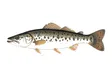
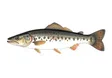
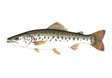
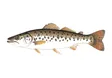
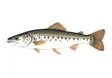
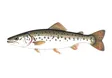
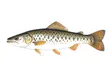
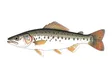
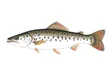
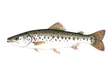
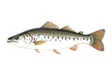
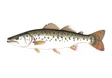
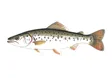
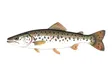
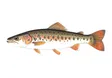
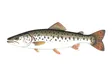
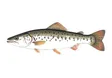
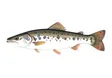
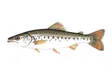
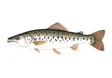
These species profiles show how members of the group differ. Their biology describes each named species, rather than every fish in the group.
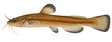
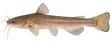
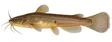
The tadpole madtom (Noturus gyrinus) is a species of fish in the family Ictaluridae. It is native to Canada and the United States.
Description
An adult tadpole madtom is typically 2–3 inches (50–80 mm), however they have been recorded at a length of 5 inches (130 mm). The tadpole madtom has a dark brown back with a lighter brown color on their sides and a yellow or white stomach. The pelvic and pectoral fins of adults are heavily covered in melanophores responsible for pigmentation, and the dorsal and anal fins contain fewer melanophores. There are also bands of melanophores on both the upper and lower jaws creating a dark horizontal streak along the side. Chin barbels vary from white to being lightly covered with melanophores. The tadpole madtom possess dark nasal and maxillary barbels and white mandibular barbels. Their adipose fin is completely connected to their large and round caudal fin, and their pectoral fin is not serrated. They possess 6–7 gill rakers; 6–7 dorsal rays; 15–18 anal rays; 7–9 pectoral rays; and 8–10 pelvic rays. The anal fin is of moderate length, but decreases with increasing body length. The tadpole madtoms also possess two pectoral spines through which an anti-predatory venom is transmitted. They have a terminal mouth with numerous small and sharp cardiform teeth. The teeth exist in numerous broad bands across the upper and lower jaw.
Range and habitat
The tadpole madtom is found in parts of the U.S. and Canada. In Canada it is native to Manitoba, Ontario, Quebec, and Saskatchewan, and can be found in the Assiniboine, Saskatchewan, Souris, Red, English, Winnipeg, and Nelson rivers. The tadpole madtom's range in the United States is extensive, ranging from Texas to Florida and north along the Atlantic coast to New York. It can be found in the Mississippi River valley as well as the Great Lakes basin. In Minnesota it is present in all adjacent drainage systems to the Red River basin. In North Dakota it can be found in the Missouri river drainage. In South Dakota it is present in the eastern tributaries to the Missouri River, including the James River, as well as the Minnesota and Big Sioux river drainages. The tadpole madtom lives in areas with little to no current. They typically inhabit swamps and marshes, as well as lakes and slow moving streams and rivers 0.1–1.5 meters deep and 12–24 meters wide. They also prefer habitats with turbid water; a soft mud, sand or gravel bottom; and thick vegetation to use for crypsis.
Diet
The tadpole madtom is an invertivore, planktivore, but also feeds on particulate. A Common food source for the tadpole madtom are immature insects and small crustaceans such as cladocera, ostracods, hyalella, and chironomids. Another popular food source is small crustaceans such as amphipods and isopods. Smaller fish feed more on small crustaceans while large fish tend to consume large prey such as worms and grass shrimp. Researchers in Wisconsin recorded the stomach contents of numerous tadpole madtoms and found an average diet consisting of 44% insects, 28.3% small crustaceans, 18.3% oligochaetes, 5.9% plants, 3% silt and debris, 0.1% snails, and 0.1% algae.
 Read the full species guide.
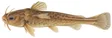
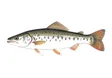
Noturus insignis (margined madtom) is a small species of North American catfish belonging to the family Ictaluridae.
Description
The margined madtom is yellow to dark gray on the upper side of the body, and a pale shade on the underside. It is slimmer than other members of the family Ictaluridae. It has a square tail and lacks the rays of other tadpole madtoms. The dorsal fin and anal fins are rounded, the chin barbels are pale, and all the other barbels are dark. They are sized from about 10 cm to 13 cm.
Distribution and habitat
The species ranges from Lake Ontario drainages southward to Georgia. Margined madtoms inhabit clear-water streams, taking shelter among rocks, gravel, and boulders. Its eggs are laid in large quantities, and are guarded by the male parent.
 Read the full species guide.
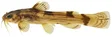
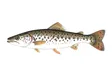
The freckled madtom (Noturus nocturnus) a species of freshwater madtom (catfish) found in the eastern United States. The freckled madtom is a benthic feeder mostly of invertebrates and usually inhabits waters that are medium to large in size, living mostly in riffle areas that have mostly clear waters and rocky bottoms. Its spawning season occurs from spring to early summer in riffle areas, and sexual maturation occurs after two years.
Geographic distribution
The freckled madtom is a freshwater species found across the eastern United States; it is common across most of its range. This range includes the Mississippi River basin and tributaries of the Gulf of Mexico in Alabama, Mississippi, Louisiana, and Texas. This species is also found in the lower Ohio River basin in Kentucky, Indiana, and Illinois. Other areas it is found include Oklahoma, southeastern Iowa, central Kansas, Arkansas, Georgia, and western Tennessee. Latitudinally it is found mostly between 41 and 30°N. This range has been identified since at least 1980; the current distribution is similar to the historical one, though some small extensions have been driven north, possibly as a result of global warming. This species is not known to travel often, especially over long distances. Further, its distribution is not entirely known due to its small population sizes and tendency to be easily misidentified. Freckled madtoms are often misidentified as bullheads or other catfish.
Further, the freckled madtom is said to be an intolerant species that sometimes disappears after a disturbance. These individuals are fluvial specialists, meaning they are specialized to a particular habitat, theirs being fast-moving riffle habitats. Human litter may be a potential disturbance to the species; young and breeding adult male individuals have often been found in beverage cans and other human-created debris. It may be difficult to determine range expansion, though, because of its small population sizes in certain areas, including central Oklahoma. However, freckled madtom distributions may have extended slightly as water quality in certain regions has improved.
Ecology
The freckled madtom is known to inhabit fast-moving and permanently moving streams that are medium to large in size. The streams usually contain rocky bottoms. Further, this species is sometimes found in the vicinity of undercut banks near masses of sticks and roots.
The freckled madtom is primarily an invertivore (feeding on invertebrates). It uses ambush tactics in benthic regions largely at night to feed. It notably consumes insect larvae, including mayfly, black fly, caddisfly, and midge larvae. It also occasionally eats crustaceans. Though it is largely an invertivore, it has also been known to occasionally eat other fish. In southern Mississippi, evidence was found of freckled madtoms feeding on the smaller speckled madtom (N. leptacanthus). To aid in devouring victims, this catfish has venom glands along smooth spines on the pectoral and dorsal fins.
Life history
The maximum reported size of the freckled madtom is 15 cm (5.9 in). One source lists the average size as 4.6 cm (1.8 in), and another source lists an average size range between 5 and 13.5 cm (2.0 and 5.3 in) long.
The maximum age reported is 4.0 to 4.5 years. Males become sexually mature by 2 years, most females by their second summer if not sooner, and polygamy is common among this species, as well as other Noturus species. Females produce an average of around 100 eggs per summer. The oocytes mature by late May to early July, and males guard the nests usually by late June. Optimal water temperature surrounding the nests is 25 °C (77 °F). Nests have been found under flat rocks, though still in the same fast-moving riffle areas this species inhabits.
 Read the full species guide.