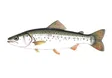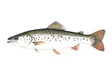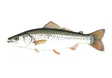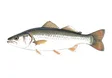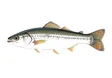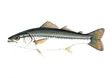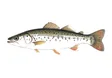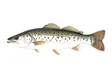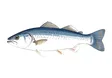
Blackside Dace

Chrosomus cumberlandensis

Leuciscidae · freshwater water fish

3 minute read · Species guide

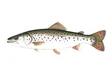
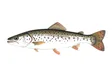
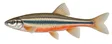
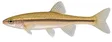
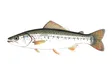
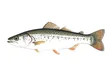
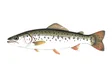
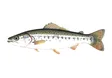
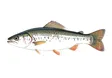
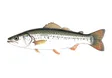
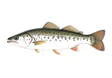
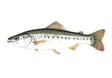
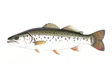
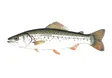
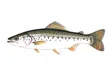
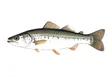
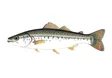
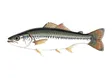
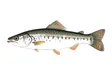
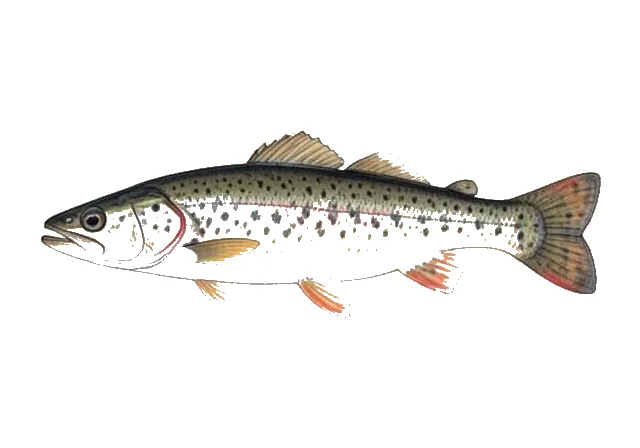
Blackside Dace field guide illustration

About Blackside Dace

The blackside dace (Chrosomus cumberlandensis) is a species of ray-finned fish in the family Leuciscidae. It is endemic to the Cumberland River drainage in Kentucky and Tennessee as well as the Powell River drainage in Virginia in the United States. It is a federally listed threatened species.

Description

This fish is 50 to 65 millimetres (2.0 to 2.6 in) in length. It is olive green in color with black speckling and a black stripe. During the breeding season in April through July the stripe becomes a deeper black, there are red areas on the upper parts, and the fins become yellow.

Ecology

This fish is found in 105 streams in Kentucky and Tennessee, but many of these populations are very small, with under 10 individuals. The species has been found in western Virginia, but these populations may have been introduced by people or represent undescribed species.

The fish lives in cool, clear streams with rocky substrates and overhanging vegetation. It is schooling and lives under banks and rock formations. Other fish in the habitat include the common creek chub (Semotilus atromaculatus), white sucker (Catostomus commersoni), stoneroller (Campostoma anomalum), and stripetail darter (Etheostoma kennicotti). The dace eats algae and sometimes insects. It lives 2–3 years and becomes sexually mature in its first year. The female lays an average of 1540 eggs.

Population threats

The species is threatened by the loss and degradation of its habitat. The rocky riverbed substrates in which it spawns are degraded by erosion and sedimentation, which are increased by human activities such as runoff pipes from septic tanks, and trash being dumped into streams. Several populations have been extirpated by these processes.

In 2007 a large scale die-off of aquatic life, including blackside dace, occurred in the Acorn Fork in Kentucky. Scientists from the U.S. Geological Survey and the U.S. Fish and Wildlife Service concluded that the most likely cause was a spill of hydraulic fracturing fluid from nearby natural gas wells. The results of a joint study indicated that the spill caused a spike in acidity, as well as toxic concentrations of heavy metals.

Additional field notes

Blackside dace use sheltered parts of small rocky streams within the upper Cumberland drainage.

Sources: Chrosomus cumberlandensis species summary

Cover, food, and markings

FishBase places adults in rocky headwater and creek pools, often alongside undercut banks, large rocks, or accumulated detritus. These are specific cover features to distinguish from the broad statement that the species lives in streams. Its food includes both attached algae and immature aquatic insects.

The species account describes two dusky side stripes that converge near the tail base. In large males these can become a broad black band. Breeding coloration includes bright red below the body and behind the gill cover, yellow fins, and silvery areas at the pectoral and pelvic fin bases. A brightly colored male therefore need not resemble a plain fish outside the breeding condition.

Sources: Chrosomus cumberlandensis species summary

Guide sources

Research reviewed 2026-10-19.

Article text: Wikipedia contributors, Blackside dace (source revision). Licensed under CC BY-SA 4.0. Retrieved 2026-10-11.
Range

Where it lives

Share of 84 GBIF observation records with a state location, across 2 states. The orange dots are USGS stream-survey sites where this species was caught.
0%
97.6%
Share of 84 GBIF observation records with a state location, across 2 states. The orange dots are USGS stream-survey sites where this species was caught.

A blank area on the dot layer usually means nobody sampled there, not that the fish is absent. Turn on “every survey site” to see where the survey looked.

Share of records by state

The USGS stream survey caught it at 48 of its sites, in 4 states. That survey and the GBIF records are two different counts of two different things, so the site keeps them apart.

Habitat

Water and movement

Water
WoRMS records this species in fresh water.
Migration
Not migratory

Classification

Taxonomy

Kingdom
Animalia
Phylum
Chordata
Superclass
Actinopterygii
Class
Teleostei
Order
Cypriniformes
Genus
Chrosomus
Species
Chrosomus cumberlandensis
ITIS TSN
913992
WoRMS AphiaID
1012646
GBIF key
2365380

Common questions about Blackside Dace

What is the scientific name of Blackside Dace?
The scientific name is Chrosomus cumberlandensis, in the family Leuciscidae. Classification follows ITIS.
Does Blackside Dace live in fresh water or salt water?
WoRMS records this species in fresh water.
Where has Blackside Dace been recorded in the United States?
GBIF has observations in 2 states, with the most records in Kentucky, Tennessee. The map shows observation records, which do not establish the complete natural range.

Closest relatives

Other Chrosomus species

Same family

More Leuciscidae

Alabama Shiner4 states
Cyprinella callistiaLeuciscidaeNativeFresh
Allegheny Pearl Dace19 states
Margariscus margaritaLeuciscidaeNative and introducedFresh
Altamaha Shiner1 states
Cyprinella xaenuraLeuciscidaeNativeFresh
Alvord Chub2 states
Siphateles alvordensisLeuciscidaeNativeFresh
Apalachee Shiner3 states
Pteronotropis grandipinnisLeuciscidaeNativeFresh
Arkansas River Shiner5 states
Notropis girardiLeuciscidaeNative and introducedFresh
Arroyo Chub1 states
Gila orcuttiiLeuciscidaeNative and introducedFresh
Bandfin Shiner5 states
Luxilus zonistiusLeuciscidaeNative and introducedFresh
Bannerfin Shiner5 states
Cyprinella leedsiLeuciscidaeNativeFresh
Beautiful Shiner3 states
Cyprinella formosaLeuciscidaeNativeFresh
Bedrock Shiner3 states
Notropis rupestrisLeuciscidaeNativeFresh
Bigeye Chub25 states
Hybopsis amblopsLeuciscidaeNative and introducedFresh
Bigeye Shiner17 states
Notropis boopsLeuciscidaeNative and introducedFresh
Bigmouth Chub3 states
Nocomis platyrhynchusLeuciscidaeNativeFresh
Bigmouth Shiner21 states
Notropis dorsalisLeuciscidaeNative and introducedFresh
Blackchin Shiner13 states
Notropis heterodonLeuciscidaeNativeFresh
Blackmouth Shiner3 states
Notropis melanostomusLeuciscidaeNativeFresh
Blacknose Shiner21 states
Notropis heterolepisLeuciscidaeNative and introducedFresh
Blackspot Shiner5 states
Notropis atrocaudalisLeuciscidaeNativeFresh
Blacktail Shiner14 states
Cyprinella venustaLeuciscidaeNative and introducedFresh
Blacktip Shiner4 states
Lythrurus atrapiculusLeuciscidaeNative and introducedFresh
Bleeding Shiner8 states
Luxilus zonatusLeuciscidaeNativeFresh
Blotched Chub6 states
Erimystax insignisLeuciscidaeNativeFresh
Blue Chub3 states
Gila coeruleaLeuciscidaeNative and introducedFresh

All 267 species in Leuciscidae