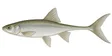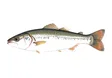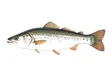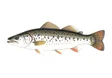
Moapa Dace

Gila coriacea

Leuciscidae · freshwater water fish

2 minute read · Species guide

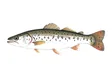
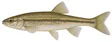
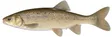
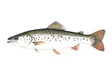
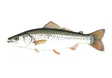
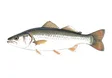
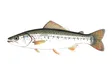
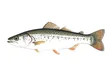
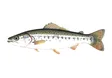
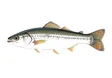
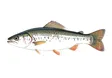
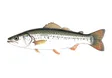
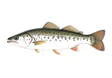
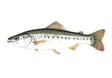
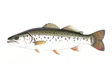
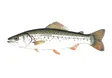
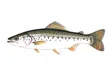
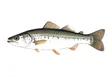
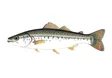
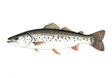
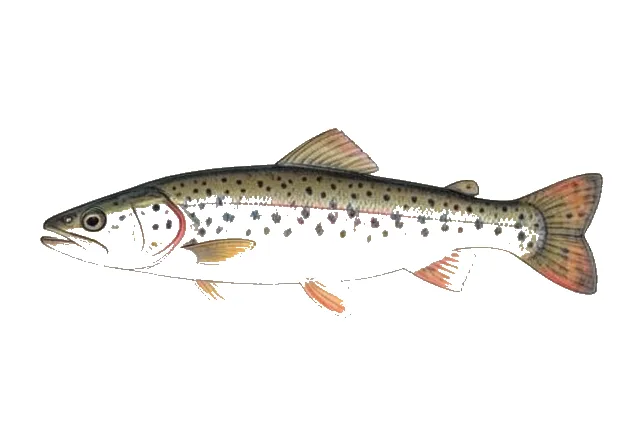
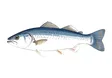
Moapa Dace field guide illustration

About Moapa Dace

The moapa dace (Gila coriacea) is a species of freshwater ray-finned fish belonging to the family Leuciscidae, which includes the daces, chubs, Eurasian minnows and related species. This is a rare fish found in southern Nevada, United States, found only in the upper parts of the Muddy (formerly Moapa) River, and in the warm springs that give rise to the river.

A small fish, with a maximum recorded length of 9 cm (3.5 in), its scales are small and embedded in the skin, resulting in a noticeably leathery texture (thus the species epithet, derived from Latin coriaceus "leathery"). General body shape is standard for daces, with a vaguely conical head.

Moapa dace require warm water, and can survive in a temperature range of 67 to 93 °F (19 to 34 °C). They inhabit waters with abundant algae and shade over gravel, sand and mud, and have an omnivorous diet. Their reproduction cycle peaks in spring and is the lowest in fall, occurring in headwater tributaries. Spawning occurs within 150 m (490 ft) of headwaters springs, in water temperatures of 30–32 °C (86–90 °F). The Moapa Dace usually reproduce in areas where there are overhead instream cover and the water velocity is around 0.11 to 0.17 metres per second (0.36 to 0.56 ft/s). The entire habitat of this species consists of less than 10 square kilometres (3.9 sq mi) within Clark County, Nevada.

Moapa dace were federally listed as endangered in 1967. The International Union for Conservation of Nature assessed them as vulnerable in 1986 and 1988 on its Red List. In 1994, a fire at the Moapa National Wildlife Refuge triggered a population decline, and by 1996 the species had been classified as critically endangered. Additional threats to this species include loss of habitat due to resort development, the introduction of non-native fish species, and capping or depletion of spring-fed headwaters.

The Moapa National Wildlife Refuge was established solely to protect this species, and was the first National Wildlife Refuge created for the purpose of protecting an endangered fish species. Since then, researchers have created artificial streams mimicking the optimal conditions described above in hopes of spurring an increase in population. When analyzing the effects of stress on the fish, stressed fish experienced a high mortality rate of around 70% overall while the unstressed group of fish experienced around a 1.15% mortality rate per month.

Article text: Wikipedia contributors, Moapa dace (source revision). Licensed under CC BY-SA 4.0. Retrieved 2026-10-11.
Native range

Endemic to headwaters of Moapa (Muddy) River, Clark County, Nevada (U.S. Fish and Wildlife Service 1983a; Page and Burr 1991).

Introduction history

This species was intentionally stocked for the purpose of preserving an endangered species.

Range

Where it lives

Share of 32 GBIF observation records with a state location, across 1 states.
0%
100%
Share of 32 GBIF observation records with a state location, across 1 states.

Share of records by state

Habitat

Water and movement

Water
WoRMS records this species in fresh water.
USGS NAS habitat
Freshwater
US status
Native transplant — native to part of the United States, moved to other waters inside it.

Classification

Taxonomy

Kingdom
Animalia
Phylum
Chordata
Superclass
Actinopterygii
Class
Teleostei
Order
Cypriniformes
Genus
Gila
Species
Gila coriacea
ITIS TSN
1199067
WoRMS AphiaID
1805553
GBIF key
11541826

Common questions about Moapa Dace

What is the scientific name of Moapa Dace?
The scientific name is Gila coriacea, in the family Leuciscidae. Classification follows ITIS.
Does Moapa Dace live in fresh water or salt water?
WoRMS records this species in fresh water.
Where has Moapa Dace been recorded in the United States?
GBIF has observations in 1 states, with the most records in Nevada. The map shows observation records, which do not establish the complete natural range.

Closest relatives

Other Gila species

Same family

More Leuciscidae

Alabama Shiner4 states
Cyprinella callistiaLeuciscidaeNativeFresh
Allegheny Pearl Dace19 states
Margariscus margaritaLeuciscidaeNative and introducedFresh
Altamaha Shiner1 states
Cyprinella xaenuraLeuciscidaeNativeFresh
Alvord Chub2 states
Siphateles alvordensisLeuciscidaeNativeFresh
Apalachee Shiner3 states
Pteronotropis grandipinnisLeuciscidaeNativeFresh
Arkansas River Shiner5 states
Notropis girardiLeuciscidaeNative and introducedFresh
Arroyo Chub1 states
Gila orcuttiiLeuciscidaeNative and introducedFresh
Bandfin Shiner5 states
Luxilus zonistiusLeuciscidaeNative and introducedFresh
Bannerfin Shiner5 states
Cyprinella leedsiLeuciscidaeNativeFresh
Beautiful Shiner3 states
Cyprinella formosaLeuciscidaeNativeFresh
Bedrock Shiner3 states
Notropis rupestrisLeuciscidaeNativeFresh
Bigeye Chub25 states
Hybopsis amblopsLeuciscidaeNative and introducedFresh
Bigeye Shiner17 states
Notropis boopsLeuciscidaeNative and introducedFresh
Bigmouth Chub3 states
Nocomis platyrhynchusLeuciscidaeNativeFresh
Bigmouth Shiner21 states
Notropis dorsalisLeuciscidaeNative and introducedFresh
Blackchin Shiner13 states
Notropis heterodonLeuciscidaeNativeFresh
Blackmouth Shiner3 states
Notropis melanostomusLeuciscidaeNativeFresh
Blacknose Shiner21 states
Notropis heterolepisLeuciscidaeNative and introducedFresh
Blackside Dace2 states
Chrosomus cumberlandensisLeuciscidaeNativeFresh
Blackspot Shiner5 states
Notropis atrocaudalisLeuciscidaeNativeFresh
Blacktail Shiner14 states
Cyprinella venustaLeuciscidaeNative and introducedFresh
Blacktip Shiner4 states
Lythrurus atrapiculusLeuciscidaeNative and introducedFresh
Bleeding Shiner8 states
Luxilus zonatusLeuciscidaeNativeFresh
Blotched Chub6 states
Erimystax insignisLeuciscidaeNativeFresh

All 267 species in Leuciscidae