Allegheny Pearl Dace

Margariscus margarita

Leuciscidae · freshwater water fish

6 minute read · Species guide

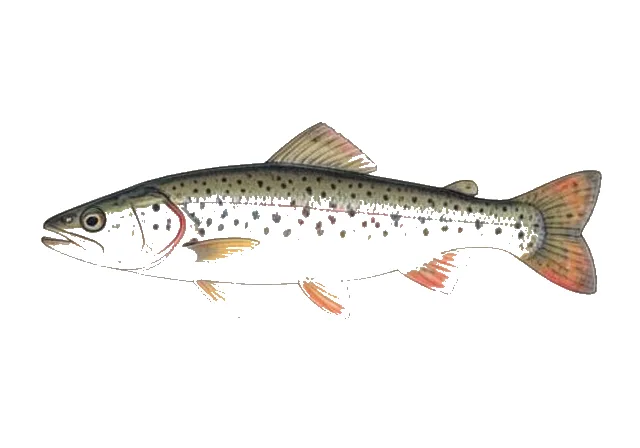
Allegheny Pearl Dace field guide illustration

About Allegheny Pearl Dace

The Allegheny Pearl Dace (Margariscus margarita) is a species of freshwater ray-finned fish in the class Teleostei. It belongs to the order Cypriniformes, family Leuciscidae and subfamily Plagopterinae. It is a demersal freshwater fish with a dark green back and silvery body. This species is omnivorous, consuming algae and arthropods. M. margarita's range spans southern Canada and the northern United States.

Description

M. margarita is a bottom-dwelling freshwater fish that can reach 76-102 mm in length. The maximum age M. margarita has been recorded to reach is four years. Its body is long, with small eyes and a small mouth. There are eight rays in each of the dorsal, anal, and pelvic fins. The dorsal side is dark green, with silvery flanks and a grey or white ventral side. Between late autumn and summer, males may have a brilliant orange-red stripe on the flanks, below the lateral line. This species is omnivorous: its diet comprises algae, insect larvae, as well as arthropods, such as chironomids and water fleas. M. margarita is often confused with the Northern Pearl Dace (Margariscus nachtriebi). Other fish that get confused for M. margarita are the blacknose dace and longnose dace. M. margarita has a barbel in front of the end of the maxillary instead of having a maxillary barbel that is terminal, like the blacknose and longnose dace. Finescale and redbelly daces do not have a lateral line that goes all the way to the end of the tail. These fish also vary in scale sizes.

Distribution and habitat

This species inhabits North America and Southern Canada and can be found in the Mississippi River, Hudson Bay, and the Great Lakes. M. margarita inhabits lakes, ponds, and rivers usually over a sandy or gravelly substrate. Studies have found this fish to inhabit parts of Wyoming, USA, in grassland and prairie ecosystems. One study found that the population in Wyoming was steady. It feeds by sight, so the waters it inhabits are generally clear streams and bog drainage systems. They prefer cool water with minimal turbidity. During spawning, they live in water as cold as 60.8°F.

One study examined the catch per unit effort of M. margarita and found that its population was easier to sample than those of other minnows. Over their seven-year study, they found a minimum of around 3,000 pearl dace minnows per year. The authors of the study hypothesized that any changes in the average number of pearl dace caught in the minnow trap could have been attributed to personality differences. More specifically, fish with less fear were probably caught more frequently than ones with more fear. This study helped scientists understand how to improve monitoring of fish population sizes.

Biology and life history

M. margarita spawns in the spring in calm water, 45-60 cm deep over silt or gravel areas. This species typically reaches sexual maturity at one year and has short reproductive cycles. Beginning in April, males develop a bright red line along their bodies during spawning. In South Dakota, M. margarita has been found to reproduce successfully in beaver ponds. M. margarita living in Isle Royale, Michigan, has been hypothesized to have diverged due to being separated from the regular population.

Conservation status

Margariscus margarita is not considered endangered federally in the United States, and the IUCN Red List classifies the Allegheny Pearl Dace as a species of least concern. However, in several states, it is considered locally endangered or threatened. The species is now uncommon in the Great Plains region, having declined since the region's settlement by European colonists.

M. margarita is threatened primarily by habitat destruction and alteration, as well as by introduced species. Human activities such as reservoir construction, groundwater pumping, stream diversions, and channelization contribute to habitat loss. The introduction of exotic species such as bass, pike, or trout has an especially detrimental effect on this species. M. margarita is also caught for use as bait, which may further contribute to its decline.

Although populations are generally considered stable, studies have highlighted that the over-pumping of water threatens their habitat, and the potential for an introduction of stronger predators gives opportunity for the population to face a decline in numbers. Another factor contributing to their declining numbers in some states is habitat development. As humans construct more waterfront properties, their habitat becomes increasingly altered, which leads to an increase in local extinction rates.

Relationship to humans

In Manitoba, M. margarita has been heavily used as live bait and is a large prey source for game fish. It has been caught by placing beef liver inside minnow traps. Fly fishers have documented catching it on dry flies while attempting to catch trout. Studies have also used M. margarita to understand how fish respond to living in environments contaminated by pollutants. One study found that the livers of these fish accumulated more fat after they were exposed to diesel fuel. These fish also reacted by spawning later than normal.

Article text: Wikipedia contributors, Allegheny pearl dace (source revision). Licensed under CC BY-SA 4.0. Retrieved 2026-10-11.

Diet and feeding

The FishTraits compilation records these diet categories for this species: algae or phytoplankton; detritus or unidentified plant material; invertebrates or larval fish; larger animal prey (a source category covering fish, crayfish, crabs, or frogs). These are broad categories, not a claim that every individual consumes every example in a category.

Reported feeding positions include bottom feeding and surface or water-column feeding. The compilation combines published observations; diets can vary with age, locality, and available food.

Habitat preferences

Reported habitat associations include streams and small rivers, creeks.

The source records associations with muck, clay or silt, sand, gravel, cobble, boulders, bedrock, vegetation. An association indicates reported use, rather than an exclusive requirement.

Reproduction and parental care

The compilation reports a representative maturity age of 2 years. Its maturity field summarizes mean, median, or modal estimates, usually for females; male estimates can be used when female data are unavailable. It is not a fixed age at which every fish first breeds.

Recorded spawning months are Apr, May for the source’s reporting region (VA). This is a regional calendar, not a range-wide schedule.

The reproductive-guild classification includes spawning on open substrates without guarding the brood.

Size and recorded longevity

FishTraits reports a maximum total length of 16 centimetres. Some entries use an estimated asymptotic length; this value should not be treated as a certified record catch.

Recorded longevity in the compilation is 4 years. Wild observations were preferred, but captive records were accepted where wild records were unavailable, and unspecified records were assumed wild. The value is not a guaranteed wild lifespan or an aquarium life expectancy.

Identification and appearance

Scott and Crossman (1973), Becker (1983), Smith (1985), Page and Burr (1991); another name is Semotilus margarita. Two subspecies are currently recognized, M. m. margarita in the Allegheny region, and M. m. nachtriebi in the rest of the range (Page and Burr 1991).

Native range

Atlantic, Hudson Bay, Great Lakes, and Mississippi River basins in southern Canada and northern United States from Atlantic Coast to southern Northern Territories, eastern British Columbia, and Montana; south to Virginia, Michigan, Wisconsin, and Iowa. Isolated population in upper Missouri River basin, South Dakota, Nebraska, and Wyoming (Page and Burr 1991).

Introduction history

Unknown. Possible bait bucket release.

Range

Where it lives

Share of 1,686 GBIF observation records with a state location, across 19 states. The orange dots are USGS stream-survey sites where this species was caught.
0%
25.1%
Share of 1,686 GBIF observation records with a state location, across 19 states. The orange dots are USGS stream-survey sites where this species was caught.

A blank area on the dot layer usually means nobody sampled there, not that the fish is absent. Turn on “every survey site” to see where the survey looked.

The USGS stream survey caught it at 457 of its sites, in 12 states. That survey and the GBIF records are two different counts of two different things, so the site keeps them apart.

Habitat

Water and movement

Water
WoRMS records this species in fresh water.
USGS NAS habitat
Freshwater
US status
Native transplant — native to part of the United States, moved to other waters inside it.
Migration
Not migratory

Classification

Taxonomy

Kingdom
Animalia
Phylum
Chordata
Superclass
Actinopterygii
Class
Teleostei
Order
Cypriniformes
Genus
Margariscus
Species
Margariscus margarita
ITIS TSN
163873
WoRMS AphiaID
567534
GBIF key
2360894
Outside the US
ITIS also files it in Canada.

Common questions about Allegheny Pearl Dace

What is the scientific name of Allegheny Pearl Dace?
The scientific name is Margariscus margarita, in the family Leuciscidae. Classification follows ITIS.
Does Allegheny Pearl Dace live in fresh water or salt water?
WoRMS records this species in fresh water.
Where has Allegheny Pearl Dace been recorded in the United States?
GBIF has observations in 19 states, with the most records in Minnesota, New York, Michigan. The map shows observation records, which do not establish the complete natural range.

Closest relatives

Other Margariscus species

Same family

More Leuciscidae

Alabama Shiner4 states
Cyprinella callistiaLeuciscidaeNativeFresh
Altamaha Shiner1 states
Cyprinella xaenuraLeuciscidaeNativeFresh
Alvord Chub2 states
Siphateles alvordensisLeuciscidaeNativeFresh
Apalachee Shiner3 states
Pteronotropis grandipinnisLeuciscidaeNativeFresh
Arkansas River Shiner5 states
Notropis girardiLeuciscidaeNative and introducedFresh
Arroyo Chub1 states
Gila orcuttiiLeuciscidaeNative and introducedFresh
Bandfin Shiner5 states
Luxilus zonistiusLeuciscidaeNative and introducedFresh
Bannerfin Shiner5 states
Cyprinella leedsiLeuciscidaeNativeFresh
Beautiful Shiner3 states
Cyprinella formosaLeuciscidaeNativeFresh
Bedrock Shiner3 states
Notropis rupestrisLeuciscidaeNativeFresh
Bigeye Chub25 states
Hybopsis amblopsLeuciscidaeNative and introducedFresh
Bigeye Shiner17 states
Notropis boopsLeuciscidaeNative and introducedFresh
Bigmouth Chub3 states
Nocomis platyrhynchusLeuciscidaeNativeFresh
Bigmouth Shiner21 states
Notropis dorsalisLeuciscidaeNative and introducedFresh
Blackchin Shiner13 states
Notropis heterodonLeuciscidaeNativeFresh
Blackmouth Shiner3 states
Notropis melanostomusLeuciscidaeNativeFresh
Blacknose Shiner21 states
Notropis heterolepisLeuciscidaeNative and introducedFresh
Blackside Dace2 states
Chrosomus cumberlandensisLeuciscidaeNativeFresh
Blackspot Shiner5 states
Notropis atrocaudalisLeuciscidaeNativeFresh
Blacktail Shiner14 states
Cyprinella venustaLeuciscidaeNative and introducedFresh
Blacktip Shiner4 states
Lythrurus atrapiculusLeuciscidaeNative and introducedFresh
Bleeding Shiner8 states
Luxilus zonatusLeuciscidaeNativeFresh
Blotched Chub6 states
Erimystax insignisLeuciscidaeNativeFresh
Blue Chub3 states
Gila coeruleaLeuciscidaeNative and introducedFresh

All 267 species in Leuciscidae