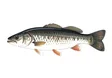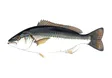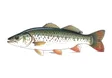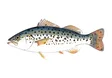
Shadow Bass

Ambloplites ariommus

Centrarchidae · freshwater water fish

6 minute read · Species guide

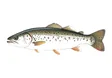
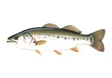
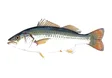
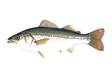
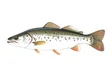
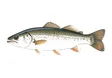
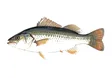
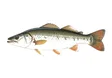
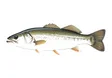
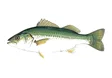
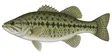
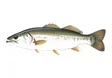
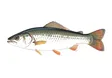
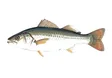
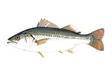
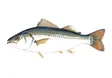
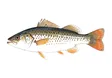
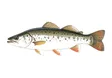
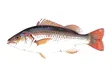
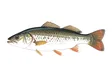
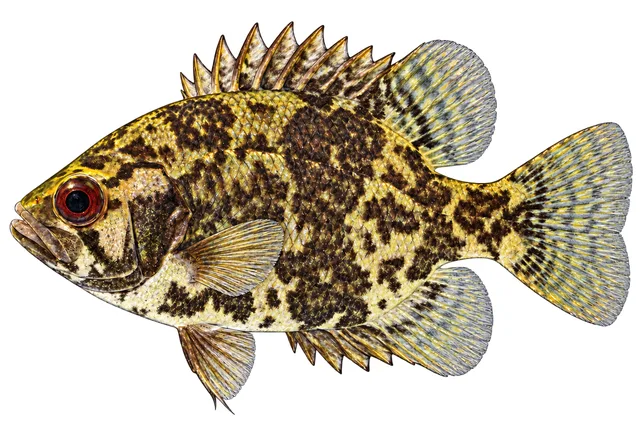
Shadow Bass field guide illustration

About Shadow Bass

The shadow bass (Ambloplites ariommus) is a species of freshwater fish in the sunfish family (Centrarchidae) of order Centrarchiformes. It is endemic to southeastern United States.

Description

The shadow bass has a lateral line containing 36 to 42 scales. There are 11 spines and 11 to 12 soft rays in the dorsal fin while the anal fin contains six or seven spines and 10 to 11 soft rays. It has a large mouth with the maxilla at the level of the center of its eye. They are olive to light brown in color and there are frequently two to four dark brown vertical bands and blotches along their flanks. The dorsal, anal and caudal fins are usually transparent to light yellow and are mottled with black and gray. The iris is reddish, and the pupil is deep blue. There is a black band which runs from beneath the eye onto the gill cover. The spots on the scales of the shadow bass are triangular while the similar rock bass (Ambloplites rupestris) has rectangular spots on its scales. The shadow bass is a medium-sized sunfish which has an average standard length of around 10.16 centimeters (4.00 in) and a maximum length of 30.48 centimeters (12.00 in) and weight of 0.45 kilograms (0.99 lb). Females normally live longer than the males but the males are faster growing and grow larger.

Geographic distribution

The shadow bass's native range includes the southeastern United States from the Apalachicola River drainage in Georgia to the lower Mississippi basin in Louisiana. Two isolated populations reported in the St. Francis, Black Arkansas Red, and upper Ouachita River drainages in Missouri and Arkansas in the Ozark regions may either not represent this species or are hybrids with Ambloplites rupestris. In Tennessee, the shadow bass can be found in most drainages south of the Tennessee River. Other river drainages that shadow bass inhabit are Blackwater and Chattahoochee Rivers in southern Georgia and northern Florida. The apparent absence of shadow bass in Black Belt streams is probably the result of low stream flow and poor water-quality conditions during the late summer when temperatures are high. Channelization is a possible factor in the distribution of the shadow bass in Mississippi River systems, but no difference in the distribution of shadow bass was found.

Ecology

The shadow bass is a freshwater fish that inhabits a climate range of 38 to 29°N in the United States. It prefers slow-flowing water over substrates of silt-free mud, sand, gravel, and pebbles. Brushy and vegetated pools are preferred microhabitat in most streams. Undercut banks and woody debris in small to medium-sized rivers and streams are also preferred habitat. The quantitative diet of shadow bass consists mostly of small invertebrates, mainly crayfish when less than three inches; after three inches, they can begin feeding on small fish species such as darters, madtoms, and minnows. The main predator and competitor of the shadow bass is the smallmouth bass which inhabits the same microhabitat. Research on the introduction of rainbow trout (Oncorhynchus mykiss) in shadow bass habitat to measure competition between the species, the data showed no effect on shadow bass populations. Factors by humans that might attribute to population decline of the shadow bass channelization, sedimentation from logging, and habitat encroachment.

Life history

Shadow bass normally spawn from January to August, spawning season being determined by water temperature and so by location to some extent too. Spawning is earlier in southern Alabama or southern Georgia as the water is warmer in these regions, while fish found at higher latitudes typically spawn later when the water reached the ideal spawning temperature of 17–21 °C (63–70 °F). The breeding males show obvious darkening to the membranes of the pelvic and anal fins while these remain yellow or white in the females. Sexual maturity is attained at a year old and a mature female may lay 1,300 eggs in a spawning season, although after cold winters fewer, larger eggs are laid and this means that spawn hatching rates are not affected by temperature. This strategy of laying a smaller number of larger eggs after colder winters or a larger number of smaller eggs after milder winters ensures that the population of shadow bass has a consistent recruitment rate.

Taxonomy and etymology

The shadow bass is a member of the centrarchids or sunfish family and is closely related to the rock bass Ambloplites rupestris along with one more related species occurring naturally. The shadow bass was previously considered to be a subspecies of the rock bass (A. rupestris). It was first formally described in 1936 by Peter Viosca Jr. with the type locality given as Little Bogue Falaya Creek, three miles north of Covington, Louisiana. The generic name is derived from Greek and is a compound of ambloo meaning "blunt"and oplites meaning"shield", while the specific name means "large-eyed".

Management

Through its range even for the two isolated populations, the shadow bass is not listed as being in any danger, and the shadow bass is federally listed as G5 secure, while the IUCN classify its status as Least Concern. Current management for the shadow bass in the rivers in Mississippi was to protects pools and prevent sediment pollution in areas of shadow bass populations. In most places, shadow bass are not considered a game fish and receive little management attention. In Missouri, however, where shadow bass has a demand in the game fish market, biologists are conducting population studies using mark and recapture methods and information for anglers to provide data to determine what, if any, angling restrictions need to apply to shadow bass fishing.

Angling

The IGFA all tackle world record for the shadow bass stands at 0.82 kg (1 lb 13 oz) caught from the Spring River in Arkansas.

Article text: Wikipedia contributors, Shadow bass (source revision). Licensed under CC BY-SA 4.0. Retrieved 2026-10-11.
Diet and feeding

The FishTraits compilation records these diet categories for this species: invertebrates or larval fish; larger animal prey (a source category covering fish, crayfish, crabs, or frogs). These are broad categories, not a claim that every individual consumes every example in a category.

Reported feeding positions include bottom feeding and surface or water-column feeding. The compilation combines published observations; diets can vary with age, locality, and available food.

Habitat preferences

Reported habitat associations include streams and small rivers.

The source records associations with muck, clay or silt, sand, gravel, vegetation, organic debris, large woody material. An association indicates reported use, rather than an exclusive requirement.

Reproduction and parental care

The compilation reports a representative maturity age of 3 years. Its maturity field summarizes mean, median, or modal estimates, usually for females; male estimates can be used when female data are unavailable. It is not a fixed age at which every fish first breeds.

Recorded spawning months are Apr, May, Jun, Jul, Aug for the source’s reporting region (MS). This is a regional calendar, not a range-wide schedule.

The reproductive-guild classification includes guarding eggs or young at a spawning substrate or nest.

Size and recorded longevity

FishTraits reports a maximum total length of 30.5 centimetres. Some entries use an estimated asymptotic length; this value should not be treated as a certified record catch.

Recorded longevity in the compilation is 8 years. Wild observations were preferred, but captive records were accepted where wild records were unavailable, and unspecified records were assumed wild. The value is not a guaranteed wild lifespan or an aquarium life expectancy.

Record fish

State records in 2 states

  • Arkansas1 lb., 12 oz.

    Spring River · 07/05/1999 · James E. Baker, W. Monroe, LA · rod and reel

  • Georgia0 lb, 10 oz

    Flint River · June 1, 2016 · Kristen Brown

Each figure is the state agency’s own certified record. The site holds record tables for 11 states so far, so a state missing here has not been read yet. It is not a state where this fish holds no record.

Range

Where it lives

Share of 2,291 GBIF observation records with a state location, across 11 states. The orange dots are USGS stream-survey sites where this species was caught.
0%
32.9%
Share of 2,291 GBIF observation records with a state location, across 11 states. The orange dots are USGS stream-survey sites where this species was caught.

A blank area on the dot layer usually means nobody sampled there, not that the fish is absent. Turn on “every survey site” to see where the survey looked.

The USGS stream survey caught it at 256 of its sites, in 9 states. That survey and the GBIF records are two different counts of two different things, so the site keeps them apart.

Habitat

Water and movement

Water
WoRMS records this species in fresh water.
Migration
Undetermined
Pattern
Disagreement
3 published references do not agree on the pattern: Non-migratory, Potamodromous. The site shows every assignment rather than picking one.

Classification

Taxonomy

Kingdom
Animalia
Phylum
Chordata
Superclass
Actinopterygii
Class
Teleostei
Order
Perciformes
Genus
Ambloplites
Species
Ambloplites ariommus
ITIS TSN
168099
WoRMS AphiaID
1015145
GBIF key
2394517

Common questions about Shadow Bass

What is the scientific name of Shadow Bass?
The scientific name is Ambloplites ariommus, in the family Centrarchidae. Classification follows ITIS.
Does Shadow Bass live in fresh water or salt water?
WoRMS records this species in fresh water.
Where has Shadow Bass been recorded in the United States?
GBIF has observations in 11 states, with the most records in Alabama, Florida, Mississippi. The map shows observation records, which do not establish the complete natural range.

Closest relatives

Other Ambloplites species

Same family

More Centrarchidae

Alabama Bass11 states
Micropterus henshalliCentrarchidaeNative and introducedFresh
Banded Sunfish15 states
Enneacanthus obesusCentrarchidaeNativeFresh
Bantam Sunfish12 states
Lepomis symmetricusCentrarchidaeNativeFresh
Black Crappie49 states
Pomoxis nigromaculatusCentrarchidaeNative and introducedFresh
Blackbanded Sunfish8 states
Enneacanthus chaetodonCentrarchidaeNativeFresh
Bluegill49 states
Lepomis macrochirusCentrarchidaeNative and introducedFresh
Bluespotted Sunfish14 states
Enneacanthus gloriosusCentrarchidaeNative and introducedFresh
Cahaba Bass1 states
Micropterus cahabaeCentrarchidaeNativeFresh
Chattahoochee Bass2 states
Micropterus chattahoochaeCentrarchidaeNativeFresh
Dollar Sunfish18 states
Lepomis marginatusCentrarchidaeNativeFresh
Flier18 states
Centrarchus macropterusCentrarchidaeNativeFresh
Florida Largemouth Bass9 states
Micropterus floridanusCentrarchidaeNative and introducedFresh
Green Sunfish46 states
Lepomis cyanellusCentrarchidaeNative and introducedFresh
Guadalupe Bass2 states
Micropterus treculiiCentrarchidaeNative and introducedFresh
Largemouth Bass48 states
Micropterus salmoidesCentrarchidaeNative and introducedFresh
Lepomis solis7 states
CentrarchidaeNative
Longear Sunfish31 states
Lepomis megalotisCentrarchidaeNative and introducedFresh
Mud Sunfish11 states
Acantharchus pomotisCentrarchidaeNativeFresh
Northern Sunfish8 states
Lepomis peltastesCentrarchidaeNativeFresh
Orangespotted Sunfish27 states
Lepomis humilisCentrarchidaeNative and introducedFresh
Ozark Bass3 states
Ambloplites constellatusCentrarchidaeNativeFresh
Pumpkinseed46 states
Lepomis gibbosusCentrarchidaeNative and introducedFreshBrackish
Redbreast Sunfish29 states
Lepomis auritusCentrarchidaeNative and introducedFresh
Redear Sunfish37 states
Lepomis microlophusCentrarchidaeNative and introducedFresh

All 40 species in Centrarchidae