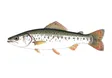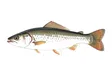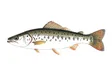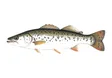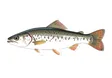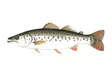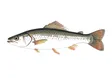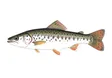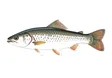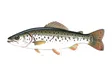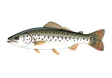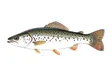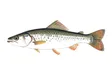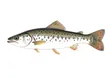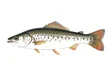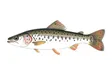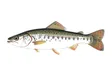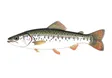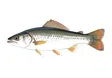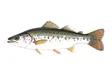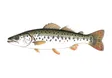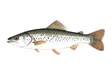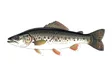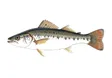
Blackside Darter

Percina maculata

Percidae · freshwater water fish

4 minute read · Species guide

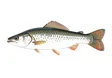
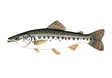
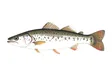
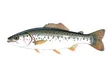
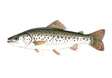
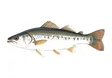
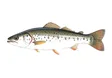
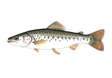
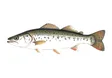
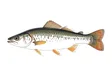
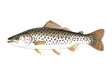
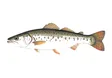
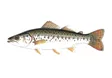
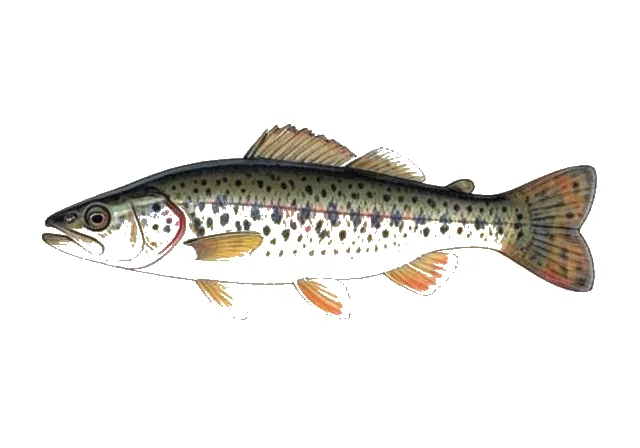
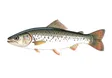
Blackside Darter field guide illustration

About Blackside Darter

Percina maculata, the blackside darter, is a species of freshwater ray-finned fish, a darter from the subfamily Etheostomatinae, part of the family Percidae, which also contains the perches, ruffes and pikeperches. It is a widespread inhabitant of streams and rivers in the Mississippi River watershed. Like other darters it prefers rocky riffles and sandy runs, but is tolerant of pools and still water as well. It is one of the 324 fish species found in Tennessee.

Physical characteristics

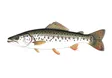
The Blackside darter is easily distinguishable by its olive coloration. The Blackside darter tends to have darker colors, primarily dark browns, olives and blacks, with occasional white parts. A prominent feature on the fish is a strip along the sides made up of 6–9 black spots. Black spots can also be found below the eyes and on the caudal fin. On average Blacksides are around two or three inches in length but have the potential for sizes of 4 inches. The Blackside darter has two dorsal fins and a rounded caudal fin. The first dorsal fin has spinous rays while the second has soft rays. The mouth of the Blackside darter is in a terminal position, which means the mouth opens at the anterior side of the snout.

Habitat and Geographic distribution

Blackside darter is found in areas of small to medium-sized rivers and streams, that are clean and free of most pollution. The areas they are found will have slower current and have spaces to hide like roots and natural debris. These fish are widespread in the United States and can be found in the Hudson Bay, Mississippi River basin, and the Gulf drainages from Mobile Bay in Alabama to the Calcasieu River in Louisiana. They have also been found in the Minnesota river basin, Whetstone Creek, Big Sioux basin, Pipestone, and other areas around the Great Lakes. They were present in the Big Sandy drainage in the early 1900s, but have not been found recently in any Virginia drainages.

Reproduction

Spawning season for Blacksides starts in spring, starting around April and lasting to late June or early July. The fish start by moving up stream then they spawn over sand and gravel around slow riffles, and then bury the eggs. The parents provide no additional care for eggs or young. The young are born and will mature by the age of one or two, living up to five years.

Diet

The Blackside darter mainly feeds on insects, like mayflies and midge larve but has also been known to ingest other small fish and plant material. Blackside darters will also eat small crustaceans and other small aquatic animals.

Conservation

Since the Blackside darter lives in clean streams it can be detrimental if anything alters its habitat. Garbage and pollution can wipe out populations of Blacksides if the change is too sudden and is persistent in their home. Although overall they are in no real threat, and as a species are doing well.

Etymology of scientific name

Percina is the Latin diminutive for perch, and maculata is from the Latin word maculatus meaning "spotted".

Article text: Wikipedia contributors, Percina maculata (source revision). Licensed under CC BY-SA 4.0. Retrieved 2026-10-11.
Diet and feeding

The FishTraits compilation records these diet categories for this species: invertebrates or larval fish; larger animal prey (a source category covering fish, crayfish, crabs, or frogs); fish or frog eggs. These are broad categories, not a claim that every individual consumes every example in a category.
Reported feeding positions include bottom feeding and surface or water-column feeding. The compilation combines published observations; diets can vary with age, locality, and available food.

Habitat preferences

Reported habitat associations include medium to large rivers, streams and small rivers.

The source records associations with clay or silt, sand, gravel, cobble. An association indicates reported use, rather than an exclusive requirement.

Reproduction and parental care

The compilation reports a representative maturity age of 1.5 years. Its maturity field summarizes mean, median, or modal estimates, usually for females; male estimates can be used when female data are unavailable. It is not a fixed age at which every fish first breeds.

Recorded spawning months are Apr, May, Jun for the source’s reporting region (WI). This is a regional calendar, not a range-wide schedule.

The reproductive-guild classification includes hiding a brood without subsequent guarding.

Size and recorded longevity

FishTraits reports a maximum total length of 11 centimetres. Some entries use an estimated asymptotic length; this value should not be treated as a certified record catch.

Recorded longevity in the compilation is 4 years. Wild observations were preferred, but captive records were accepted where wild records were unavailable, and unspecified records were assumed wild. The value is not a guaranteed wild lifespan or an aquarium life expectancy.

Native range

Great Lakes, Hudson Bay, and Mississippi River basins from southern Ontario and New York to southeastern Saskatchewan and south to Louisiana; Gulf drainages from Mobile Bay, Alabama to Calcasieu River, Louisiana (Page and Burr 1991). Populations in North Carolina have been described as P. gymnocephala.

Introduction history

Unknown; possible bait bucket release; although Becker (1983) reported it is not a bait fish.

Range

Where it lives

Share of 7,299 GBIF observation records with a state location, across 28 states. The orange dots are USGS stream-survey sites where this species was caught.
0%
14.6%
Share of 7,299 GBIF observation records with a state location, across 28 states. The orange dots are USGS stream-survey sites where this species was caught.

A blank area on the dot layer usually means nobody sampled there, not that the fish is absent. Turn on “every survey site” to see where the survey looked.

The USGS stream survey caught it at 2,684 of its sites, in 22 states. That survey and the GBIF records are two different counts of two different things, so the site keeps them apart.

Habitat

Water and movement

Water
WoRMS records this species in fresh water.
USGS NAS habitat
Freshwater
US status
Native transplant — native to part of the United States, moved to other waters inside it.
Migration
Migratory
Pattern

Classification

Taxonomy

Kingdom
Animalia
Phylum
Chordata
Superclass
Actinopterygii
Class
Teleostei
Order
Perciformes
Family
Percidae
Genus
Percina
Species
Percina maculata
ITIS TSN
168488
WoRMS AphiaID
954586
GBIF key
2382061
Outside the US
ITIS also files it in Canada.

Common questions about Blackside Darter

What is the scientific name of Blackside Darter?
The scientific name is Percina maculata, in the family Percidae. Classification follows ITIS.
Does Blackside Darter live in fresh water or salt water?
WoRMS records this species in fresh water.
Where has Blackside Darter been recorded in the United States?
GBIF has observations in 28 states, with the most records in Illinois, Ohio, Wyoming. The map shows observation records, which do not establish the complete natural range.

Closest relatives

Other Percina species

Same family

More Percidae

All 229 species in Percidae