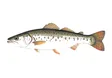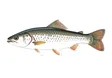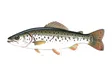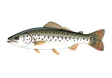
Blackbanded Darter

Percina nigrofasciata

Percidae · freshwater water fish

4 minute read · Species guide

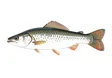
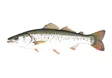
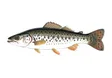
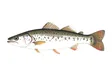
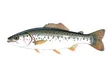
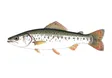
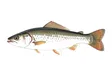
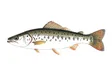
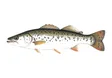
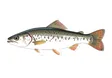
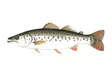
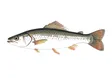
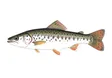
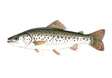
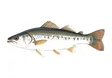
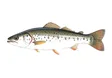
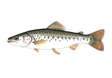
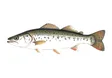
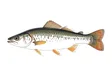
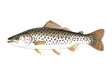
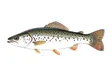
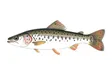
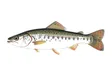
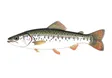
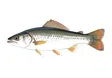
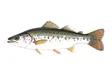
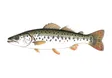
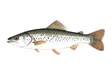
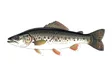
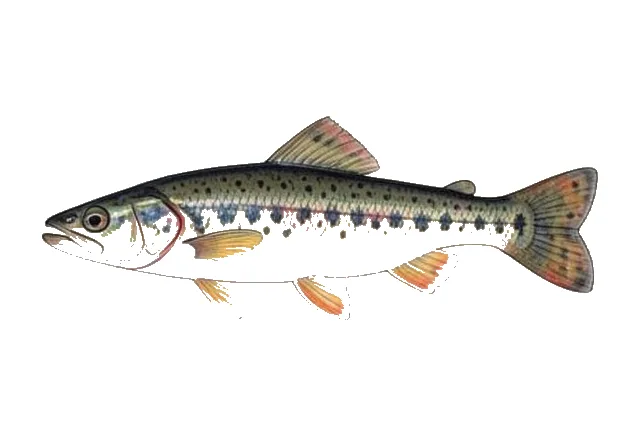
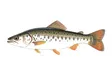
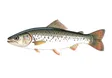
Blackbanded Darter field guide illustration

About Blackbanded Darter

The blackbanded darter (Percina nigrofasciata) is a species of freshwater ray-finned fish in the subfamily Etheostomatinae. It is in the family Percidae, which includes the perches, ruffes and pikeperches. It is endemic to the river systems of the Southeastern United States, and occupy headwaters to medium-sized rivers over a sandy or gravelly substrate, often associated with aquatic vegetation. Its color varies depending on the different habitats in which it lives. It feeds on small insect larvae and is itself preyed on by larger fish. It spawns between February and June depending on locality. It is generally a common fish throughout most of its range.

Description

The coloration of the blackbanded darter is variable, often changing to camouflage with the nearby substrate. Breeding males develop a greenish blue coloration during mating season. The blackbanded darter can be confused with the dusky darter (Percina sciera).

Distribution

The blackbanded darter inhabits many river systems in the United States. They are found in the Gulf of Mexico drainage in the southeastern United States (Tennessee, Georgia, Florida, Mississippi, Alabama, and Louisiana). They can be found in the Choctawhatchee in Florida west to the western Mississippi River tributaries in Louisiana. The Halloween darter (Percina crypta) occurs sympatrically with the blackbanded darter throughout the Chattahoochee River.

Habitat and ecology

The blackbanded darter is found in headwaters to medium-sized rivers over gravel and sand substrates. Blackbanded darters tend to live in intermediate microhabitat that has more erosional substrata and greater variety of depth. Blackbanded darters are insectivores and feed on mayflies, midges, blackflies, caddisflies, or anything that is no larger than 5 mm (0.2 in) long. The primary predators for the blackbanded darter are stonecats, largemouth bass, and other larger freshwater fish species.

Life history

The blackbanded darter spawns between February and June. Spawning occurs in sandy bottoms around a stream channel. The male approaches a female from the rear. Once on the female, he mounts her and beats her with his pelvic fin. The average clutch size for the blackbanded darter depends on the location. In Florida, a clutch size range from 4 to 73 eggs, while in Alabama, the range is from 38 to 250 eggs. In Alabama, the sex ratio of the eggs favors male over females. After the eggs are laid, there is no parental care. The life span of the blackbanded darter is estimated to be around three to four years. The life history of the blackbanded darter depends on geographic variation in environmental condition such as photoperiod and water temperature. Pollution and siltation can cause temperature change of the water which will affect when the darter will spawn.

Management

The blackbanded darter is listed as Least Concern by the IUCN and G5 by NatureServe. It is listed as S3 (Vulnerable) in Tennessee. Localized threats may exist, but no major threats are known.

Article text: Wikipedia contributors, Blackbanded darter (source revision). Licensed under CC BY-SA 4.0. Retrieved 2026-10-11.
Diet and feeding

The FishTraits compilation records these diet categories for this species: invertebrates or larval fish. These are broad categories, not a claim that every individual consumes every example in a category.
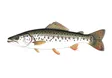
Reported feeding positions include bottom feeding. The compilation combines published observations; diets can vary with age, locality, and available food.

Habitat preferences

Reported habitat associations include streams and small rivers, creeks.

The source records associations with muck, clay or silt, sand, gravel, cobble, vegetation. An association indicates reported use, rather than an exclusive requirement.

Reproduction and parental care

The compilation reports a representative maturity age of 1 years. Its maturity field summarizes mean, median, or modal estimates, usually for females; male estimates can be used when female data are unavailable. It is not a fixed age at which every fish first breeds.

Recorded spawning months are May, Jun for the source’s reporting region (NC). This is a regional calendar, not a range-wide schedule.

The reproductive-guild classification includes hiding a brood without subsequent guarding.

Size and recorded longevity

FishTraits reports a maximum total length of 11 centimetres. Some entries use an estimated asymptotic length; this value should not be treated as a certified record catch.

Recorded longevity in the compilation is 2.5 years. Wild observations were preferred, but captive records were accepted where wild records were unavailable, and unspecified records were assumed wild. The value is not a guaranteed wild lifespan or an aquarium life expectancy.

Native range

Atlantic and Gulf Slope drainages from Edisto River, SC, south into southcentral Florida (almost to Lake Okeechobee) and west to Mississippi River, LA. Absent in St. Marys and Satilla rivers in southeastern Georgia, and rare in Altamaha River, Georgia (Page and Burr 1991).

Habitat and ecology

Primarily insectivorous, consuming ephemeropterans and trichopterans as well as copepods, cladocerans, and other small benthic crustaceans (Boschung and Mayden 2004).

Introduction history

Possible bait release.

Range

Where it lives

Share of 11,666 GBIF observation records with a state location, across 10 states. The orange dots are USGS stream-survey sites where this species was caught.
0%
45.9%
Share of 11,666 GBIF observation records with a state location, across 10 states. The orange dots are USGS stream-survey sites where this species was caught.

A blank area on the dot layer usually means nobody sampled there, not that the fish is absent. Turn on “every survey site” to see where the survey looked.

The USGS stream survey caught it at 581 of its sites, in 8 states. That survey and the GBIF records are two different counts of two different things, so the site keeps them apart.

Habitat

Water and movement

Water
WoRMS records this species in fresh water.
USGS NAS habitat
Freshwater
US status
Native transplant — native to part of the United States, moved to other waters inside it.
Migration
Undetermined

Classification

Taxonomy

Kingdom
Animalia
Phylum
Chordata
Superclass
Actinopterygii
Class
Teleostei
Order
Perciformes
Family
Percidae
Genus
Percina
Species
Percina nigrofasciata
ITIS TSN
168490
WoRMS AphiaID
954585
GBIF key
2382032

Common questions about Blackbanded Darter

What is the scientific name of Blackbanded Darter?
The scientific name is Percina nigrofasciata, in the family Percidae. Classification follows ITIS.
Does Blackbanded Darter live in fresh water or salt water?
WoRMS records this species in fresh water.
Where has Blackbanded Darter been recorded in the United States?
GBIF has observations in 10 states, with the most records in Alabama, Florida, Georgia. The map shows observation records, which do not establish the complete natural range.

Closest relatives

Other Percina species

Same family

More Percidae

All 229 species in Percidae