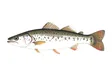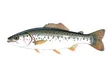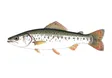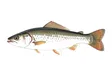
Frecklebelly Darter

Percina stictogaster

Percidae · freshwater water fish

5 minute read · Species guide

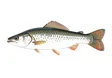
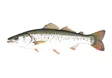
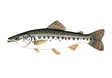
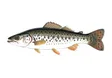
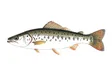
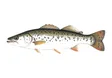
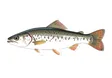
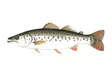
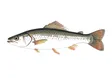
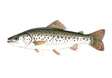
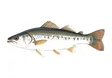
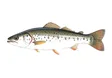
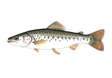
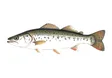
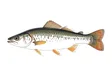
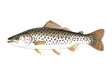
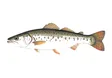
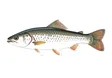
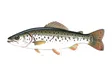
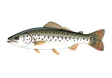
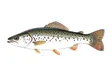
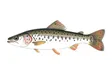
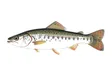
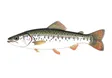
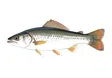
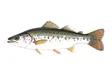
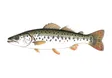
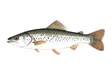
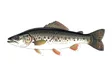
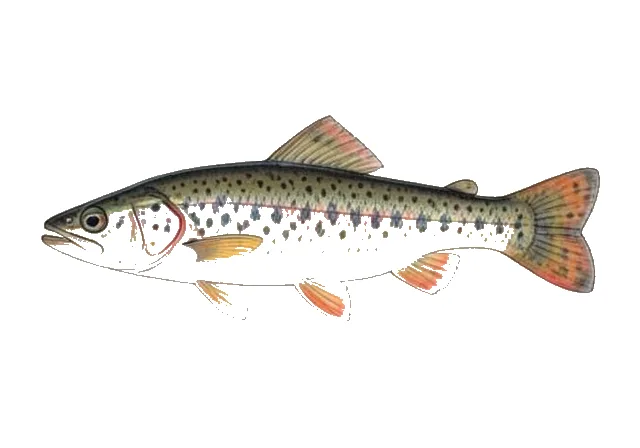
Frecklebelly Darter field guide illustration

About Frecklebelly Darter

The frecklebelly darter (Percina stictogaster) is a species of freshwater ray-finned fish, a darter from the subfamily Etheostomatinae, part of the family Percidae, which also contains the perches, ruffes and pikeperches. It primarily occurs in the upper Kentucky and Green river systems of eastern and central Kentucky and north-central Tennessee, being found mostly in the Cumberland Plateau and Highland Rim regions. The fish gets its name from gets its name from the scattered dark spots on its relatively pale underside. However, a possible more telling characteristic of the species is the systematical arrangement of the spots at the base of the tail as well as the continuous stripes down either side of the back. Total population size is unknown but figured to be relatively large. The frecklebelly darter is a benthic darter that relies on invertebrates as its principal diet. The frecklebelly darter can be found primarily in creeks and small rivers with a moderate gradient and a pool/riffle type flow, and spends most of its time in midwater areas of the stream. The major threats of the frecklebelly darter include decimation through perturbations such as strip mining as well as stream channelization projects. The darter is thought to have a high resilience with minimum population doubling time less than 15 months; it is also believed to have low vulnerability. Frecklebelly darter females contain about 100–300 mature ova depending on size. Fish become mature by age 1. Spawning in this darter species involves egg burial where the male mounts the female and deposits eggs in deep depressions created by receptive females.

Geographic distribution

The frecklebelly darter has a rather small distribution. Found in only two states, Tennessee and Kentucky, the species is endemic to higher elevation streams and reservoirs. found primarily in the Upper Kentucky and upper Green (including Barren River) river systems in eastern and central Kentucky and north-central Tennessee. The darter propagates upland streams of the Cumberland Plateau and central portions of the Highland Rim. Fairly common in Kentucky River drainage (where occurs from Red River upstream and including the South Fork), the darter is uncommon and localized in the Green River drainage. In the Green River, the frecklebelly darter occurs primarily upstream of the confluence of the Little Barren and Green rivers. In the Barren River, it is most common upstream of the confluence of Drakes Creek and the Barren River. The frecklebelly darter is restricted to large tributaries in Tennessee, primarily of the Barren River system in Clay, Macon, and Sumner counties. There is an old record from the Nolin River system, where the species no longer occurs. The frecklebelly darter as well as most other darter species in the area are vulnerable to decimation through perturbations such as strip mining; stream channelization projects threaten available habitat in Tennessee. It is believed that these factors as well as the damming of natural river systems may have extirpated the species from other areas in the southeast. Non-native Invasive fish species could also be a cause of limited distribution.

Ecology

The frecklebelly darter is a benthic fish which inhabits quiet water areas, especially flowing pools, backwater pools, and vegetated riffle margins of clear creeks and small to medium rivers (usually stream orders 3–5). The darter most often swims in midwater than near bottom. Oftentimes it can be found resting on submerged mats of tree roots along bank. In winter the fish may be found in accumulations of dead leaves. Spawning of the species evidently peaks from mid-March through mid- April. The fish is estimated to live about 3 years. The frecklebelly darter does not show any time of migration. The darter feeds on invertebrates which include river snails, hydropsychid caddisfly larvae, midge larvae, and small mayfly nymphs such as baetids. This fish is likely a prey item for almost any piscivorous fish that occur within the darter's range, such as Largemouth Bass, Smallmouth Bass, and other large piscivores. Fish with similar habitat requirements are the greatest competitors to the fish. It seems that this particular species desires cooler water temperatures that come with higher elevations. Many of the regions where the fish exist are suspect to mining operations as well as river damming. Either of these projects could very well be detrimental to the fish species.

Life history

The frecklebelly darter has a poorly studied life history. Spawning of the species evidently peaks from mid-March through mid-April. The fish is estimated to live about three years. Based on length frequency data this species is reproductively mature at age one. Spawning occurs in temperatures of 7 to 16 °C (45 to 61 °F) in areas with strong current and fine gravel. Aquarium observations confirm that this species buries its eggs in a manner similar to other Percina darters. Fertilized eggs are about 2.5 mm in diameter, clear, demersal and slightly adhesive. At 10 °C (50 °F) eggs hatched in 18–25 days. Females of the species are thought to reach sexual maturity at age one and when spawning, lay their eggs in the substrate of the lake or river bed. Males of the species have a semicircular keel on the caudal peduncle that appears to function as a ploughshare which, in conjunction with the long anal fin, delivers spermatozoa to be buried in the substrate. Compared to sympatric darters, early spawning results in relatively large young, which may reduce predation in this relatively pelagic species.

Current management

Like many non-game species, little is known about the frecklebelly darter. The darter is state listed as being in need of management categorized as critically imperiled.

Article text: Wikipedia contributors, Frecklebelly darter (source revision). Licensed under CC BY-SA 4.0. Retrieved 2026-10-11.
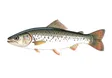
Diet and feeding

The FishTraits compilation records these diet categories for this species: invertebrates or larval fish. These are broad categories, not a claim that every individual consumes every example in a category.
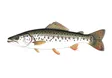
Habitat preferences

Reported habitat associations include medium to large rivers, streams and small rivers, creeks.

The source records associations with clay or silt, sand, vegetation. An association indicates reported use, rather than an exclusive requirement.

Reproduction and parental care

The compilation reports a representative maturity age of 1 years. Its maturity field summarizes mean, median, or modal estimates, usually for females; male estimates can be used when female data are unavailable. It is not a fixed age at which every fish first breeds.

Recorded spawning months are Mar, Apr for the source’s reporting region (TN). This is a regional calendar, not a range-wide schedule.

Size and recorded longevity

FishTraits reports a maximum total length of 8.1 centimetres. Some entries use an estimated asymptotic length; this value should not be treated as a certified record catch.

Range

Where it lives

Share of 215 GBIF observation records with a state location, across 2 states. The orange dots are USGS stream-survey sites where this species was caught.
0%
97.2%
Share of 215 GBIF observation records with a state location, across 2 states. The orange dots are USGS stream-survey sites where this species was caught.

A blank area on the dot layer usually means nobody sampled there, not that the fish is absent. Turn on “every survey site” to see where the survey looked.

Share of records by state

The USGS stream survey caught it at 25 of its sites, in 1 state. That survey and the GBIF records are two different counts of two different things, so the site keeps them apart.

Habitat

Water and movement

Water
WoRMS records this species in fresh water.
Migration
Undetermined

Classification

Taxonomy

Kingdom
Animalia
Phylum
Chordata
Superclass
Actinopterygii
Class
Teleostei
Order
Perciformes
Family
Percidae
Genus
Percina
Species
Percina stictogaster
ITIS TSN
553386
WoRMS AphiaID
1010999
GBIF key
2382064

Common questions about Frecklebelly Darter

What is the scientific name of Frecklebelly Darter?
The scientific name is Percina stictogaster, in the family Percidae. Classification follows ITIS.
Does Frecklebelly Darter live in fresh water or salt water?
WoRMS records this species in fresh water.
Where has Frecklebelly Darter been recorded in the United States?
GBIF has observations in 2 states, with the most records in Kentucky, Tennessee. The map shows observation records, which do not establish the complete natural range.

Closest relatives

Other Percina species

Same family

More Percidae

All 229 species in Percidae