Channel Darter

Percina copelandi

Percidae · freshwater water fish

4 minute read · Species guide

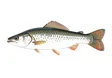
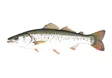
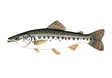
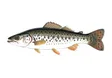
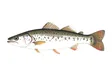
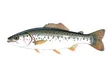
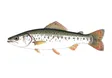
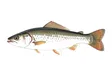
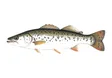
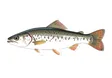
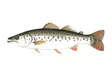
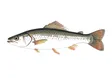
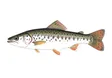
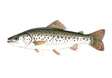
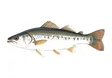
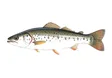
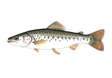
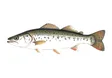
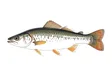
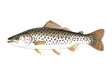
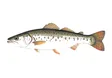
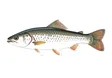
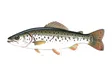
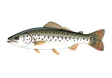
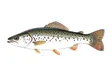
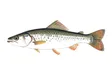
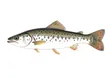
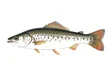
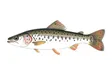
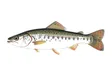
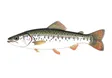
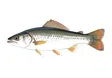
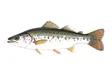
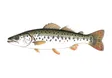
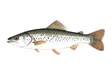
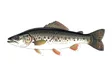
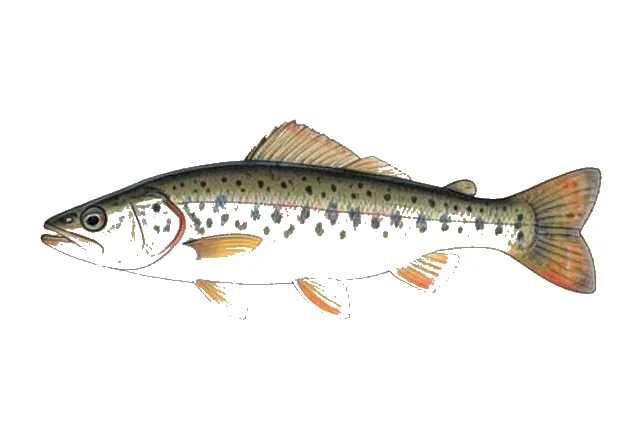
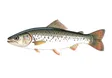
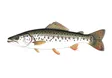
Channel Darter field guide illustration

About Channel Darter

The channel darter (Percina copelandi) is a species of freshwater ray-finned fish, a darter from the subfamily Etheostomatinae, part of the family Percidae, which also contains the perches, ruffes and pikeperches. It is native to North America where it typically occurs in the sandy or gravelly shallows of lakes and in small and medium-sized rivers in riffles over sand, gravel or rock bottoms. It is a small fish ranging from 34 to 72 mm (1.3 to 2.8 in) in length, olive brown with darker speckles and sometimes with a dark spot below the eye and dark blotches along the flank. It feeds mostly on insect larvae and other small invertebrates and breeds in small streams. This species is listed as threatened by the Canadian Species at Risk Act (SARA) but overall it has a wide range and numerous sub-populations and the International Union for Conservation of Nature has rated it as a "least concern species".

Description

This is a small-sized fish between 34 and 61 mm in total length; some specimens as large as 72 mm. It is light sand or olive in colour with brown speckles on its back. A dark spot or bar may be present below the eye and extending onto the snout 8 to 18 brown oblong blotches along the lateral line linked by a thin brown line. The spawning male turns dusky with a blackish head. The fins are clear or lightly speckled and the first spiny dorsal fin usually has 11 rays.

The channel darter most resembles the river darter (Percina shumardi). It can be distinguished from the johnny darter (Etheostoma nigrum) and the tessellated darter (E. olmstedi), which have only one anal spine instead of two. It differs from the blackside darter (P. maculata) in usually having 11 rays on the first spiny dorsal fin instead of 13 to 14.

Distribution

The fish is native to North America, where it has a highly localized distribution. It is uncommon in Canada but disjunct populations can be found in Ontario and Quebec. In Ontario, it is found in Little Rideau Creek, in tributaries of the Bay of Quinte, and in Lakes Erie and St. Clair. Along the Huron-Erie corridor, it has been collected from the St. Clair and Detroit Rivers. In Quebec, it occurs in some tributaries of the St. Lawrence and Ottawa Rivers. In the United States, the channel darter is more common, occurring in the Ohio and lower Mississippi basins.

Habitat and life history

The channel darter prefers pools and riffles of small- to medium-sized rivers, but can also be found in shallow, slow current areas of large rivers. Substrate preferences include sand, gravel or rock. This fish has also been found in lakes along sand and gravel beaches where wave action is gentle and the current slow. Communal spawning occurs in the spring and early summer in upstream areas with moderate to fast current and over fine gravel or small rocks. Males establish breeding territories. Females spawn with successive males and lay 4 to 10 eggs in each nest; 350 to 700 eggs in total. There is no parental care.

Diet

The channel darter is a benthic feeder, consuming insects that live on the substrate such as mayfly and midge larvae. It also eats algae and detritus.

Conservation

In some places this fish is threatened by habitat loss due to sedimentation and deteriorating water quality from agricultural and urban development. In addition, activities which impede or slow water flow during spawning are a threat to the survival of this species. The introduced round goby (Neogobius melanostomus) may also compete with the channel darter for space and resources and is a potential predator of eggs. However, overall the channel darter has a wide range and large total population with many sub-populations, no particular threats have been identified and the International Union for Conservation of Nature has rated it as a "least concern species".

Taxonomy

The channel darter was first formally described as Rheocrypta copelandi in 1877 by the American zoologist David Starr Jordan (1851–1931) with the type locality given as the White River in Indiana, 5 miles north of Indianapolis. Its specific name honors the American zoologist Herbert Edson Copeland (1849–1876).

Article text: Wikipedia contributors, Channel darter (source revision). Licensed under CC BY-SA 4.0. Retrieved 2026-10-11.
Diet and feeding

The FishTraits compilation records these diet categories for this species: invertebrates or larval fish. These are broad categories, not a claim that every individual consumes every example in a category.
Reported feeding positions include bottom feeding. The compilation combines published observations; diets can vary with age, locality, and available food.

Habitat preferences

Reported habitat associations include medium to large rivers, streams and small rivers, still-water habitats.

The source records associations with sand, gravel. An association indicates reported use, rather than an exclusive requirement.

Reproduction and parental care

The compilation reports a representative maturity age of 1 years. Its maturity field summarizes mean, median, or modal estimates, usually for females; male estimates can be used when female data are unavailable. It is not a fixed age at which every fish first breeds.

Recorded spawning months are May, Jun for the source’s reporting region (TN). This is a regional calendar, not a range-wide schedule.

The reproductive-guild classification includes hiding a brood without subsequent guarding.

Size and recorded longevity

FishTraits reports a maximum total length of 7 centimetres. Some entries use an estimated asymptotic length; this value should not be treated as a certified record catch.

Range

Where it lives

Share of 1,927 GBIF observation records with a state location, across 19 states. The orange dots are USGS stream-survey sites where this species was caught.
0%
34.4%
Share of 1,927 GBIF observation records with a state location, across 19 states. The orange dots are USGS stream-survey sites where this species was caught.

A blank area on the dot layer usually means nobody sampled there, not that the fish is absent. Turn on “every survey site” to see where the survey looked.

The USGS stream survey caught it at 158 of its sites, in 9 states. That survey and the GBIF records are two different counts of two different things, so the site keeps them apart.

Habitat

Water and movement

Water
WoRMS records this species in fresh water.
Migration
Migratory
Pattern

Classification

Taxonomy

Kingdom
Animalia
Phylum
Chordata
Superclass
Actinopterygii
Class
Teleostei
Order
Perciformes
Family
Percidae
Genus
Percina
Species
Percina copelandi
ITIS TSN
168480
WoRMS AphiaID
1422313
GBIF key
2382084
Outside the US
ITIS also files it in Canada.

Common questions about Channel Darter

What is the scientific name of Channel Darter?
The scientific name is Percina copelandi, in the family Percidae. Classification follows ITIS.
Does Channel Darter live in fresh water or salt water?
WoRMS records this species in fresh water.
Where has Channel Darter been recorded in the United States?
GBIF has observations in 19 states, with the most records in Oklahoma, Kentucky, Arkansas. The map shows observation records, which do not establish the complete natural range.

Closest relatives

Other Percina species

Same family

More Percidae

All 229 species in Percidae