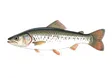
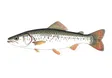
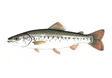
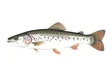
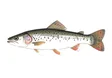
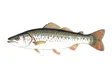
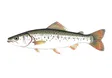
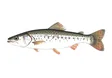
Common names

Types of minnow

32 species carry minnow in an English common name. They sit in 4 families, so the group is a name, not a scientific rank.

About minnow

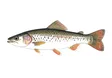
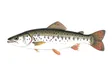
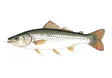
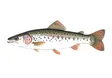
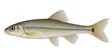
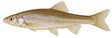
Minnow is the common name for a number of species of small freshwater fish, belonging to several genera of the family Cyprinidae and in particular the subfamily Leuciscinae. They are also known in Ireland as pinkeens.

While the common name can refer to a range of taxa, smaller fish in the subfamily Leusciscinae are considered by anglers to be "true" minnows.

Types of minnow

Bluntnose minnow (Pimephales notatus): The bluntnose minnow is a primary bait fish for Northern America, and has a very high tolerance for variable water qualities, which helps its distribution throughout many regions. The snout of the bluntnose minnow overhangs the mouth, giving it the bluntnose. There is a dark lateral line which stretches from the opercle to the base of the tail, where a large black spot is located. The average size of the adult is approximately 5 cm (2.0 in).

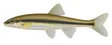
Common shiner (Notropis cornutus): These fish are one of the most common type of bait fish and are almost exclusively stream dwellers. The common shiner can be identified by the nine rays on its anal fin and terminal mouth. This minnow is typically bluish silver on the sides and greenish blue on the back, save for breeding season in which case the male gains a rose colored tail and anal fin. The shiner grows about 5–10 cm (2.0–3.9 in) within one year and reach a size of 13 cm (5.1 in) at adulthood. Notropis potteri is known as the chub shiner.

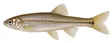
Common emerald shiner (Notropis atherinoides atherinoides): Common emerald shiners are most abundant in the Great Lakes of North America, primarily Lake Erie. The name of the emerald shiner comes from the greenish emerald band that expands from the back of the gill cover to the tail. This type of minnow has a short, rounded snout, the only difference between the common emerald shiner and the silver shiner is that the silver shiner has a longer snout and a larger eye. These fish grow to an average length of about 6 cm. This is one of the most common bait fish used in the Lake Erie region of Ohio and many fishermen hold it over all other bait.

As food

While primarily used for bait, minnows can also be eaten directly by humans. Some Native American cultures have used minnows as food. If minnows are small enough, they can be eaten whole.

Threats and conservation issues

Generally, minnows breed with the slightest rainfall and within a wide temperature range. Contrary to the long-standing presumptions, climate change poses 'negligible' threat to minnows' reproduction. Minnows are also flexible in attaining pre-spawning fitness, which makes them avoid 'skipped spawning' decisions while facing climatic variabilities.
Minnow species in focus

These species profiles show how members of the group differ. Their biology describes each named species, rather than every fish in the group.

Cutlip Minnow

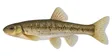
Exoglossum maxillingua (cutlips minnow) is a species of freshwater ray-finned fish belonging to the family Leuciscidae, the shiners, daces and minnows. This is an olive-green medium-sized minnow (average 6 inches) of North America with a distinguishing lower jaw. Isolated from all other minnows by its three-lobed lower jaw with the middle lobe sticking out like a tongue. The range of this species is from the St. Lawrence and Lake Ontario south into Virginia. It is listed as "threatened"in the Canadian province of Ontario, but may never have been common there as this is the most northerly of its range. It is found in running streams and seems to prefer clear, stony pools but not rapids. The distinctive mouth of the cutlips lets it feed on minuscule shellfish which it scrapes from rocks. Although molluscs appear to be its primary food, it also eats insect larvae and diatoms. An interesting feeding behavior of this species is"eye-picking" when food is scarce or competition is high. The Cutlips will pluck out the eyes of conspecifics or other species as a supplement to its regular diet. A nest builder, the cutlips male constructs a nest of stone, some of which are up to 18 inches across. Spawning happens late in spring when the male attempts to crowd females over its nest. The cutlips is not a popular bait species due to its softened coloration but it takes a hook without much difficulty and is favored in some areas as a choice panfish.

Read the full species guide.

Tonguetied Minnow

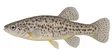
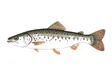
Exoglossum laurae, tonguetied minnow, is a species of freshwater ray-finned fish belonging to the family Leuciscidae, the shiners, daces and minnows. This fish is found in North America.

Description

The color of the fish ranges from dark gray to brown-black, with purple specks located throughout its body and a white belly. The fish ranges from three to five inches long. The minnow is named for its mouth. The lower mouth is only partially covered with its lips, leaving part of the minnow's jaw exposed. The mouth is horizontal and small.

The minnow has eight dorsal fin-rays, seven anal fin-rays, eight pelvic fin-rays and thirteen to seventeen pectoral fin-rays.

Habitat

The minnow lives throughout Ontario and the Northeastern United States. In the state of Ohio, the minnow is only confirmed to inhabit the Great Miami and Little Miami rivers. The Ohio population of Exoglossum laurae, which is separated from more Eastern populations by several hundred miles, is considered a subspecies.

The minnow is unable to live in murky waters and requires a clean rock river bottom. It also requires a forested river bank. The minnow needs somewhat cool water temperatures to survive.

Hunting

The minnow has been categorized as an active hunter of prey, meaning that it will actively leave the safety of natural shelter to hunt prey. The hunting may occur alone or in groups. The primary prey of the minnow is aquatic invertebrates.

Read the full species guide.

Eastern Silvery Minnow
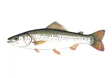
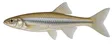
The eastern silvery minnow (Hybognathus regius) is a species of freshwater ray-finned fish belonging to the family Leuciscidae, the shiners, daces and minnows. They are characterized by their lack of barbels. In appearance, they are similar to shiners, but the lower jaw is crescent-shaped rather than U-shaped and there is a secondary loop in the gut, which is sometimes visible through the body wall of preserved specimen.

The eastern silvery minnow has more angulate fins than the other members of the genus Hybognathus. The dorsal margin is more concave. Its scales have a radius of 10–12 mm. It has circuli with sharp angles at the basal corners of the scale. Its head is pointed. They grow to be about 6 inches in length at maximum.

Read the full species guide.

Range

Where minnow live

How many of the 32 species are recorded in each state.
0
18
How many of the 32 species are recorded in each state.

Taxonomy

Families in this group

Species

All 32 minnow species

Blue-fintop Minnow7 states
Lucania goodeiFundulidaeNativeFresh
Bluntnose Minnow38 states
Pimephales notatusLeuciscidaeNative and introducedFresh
Brassy Minnow19 states
Hybognathus hankinsoniLeuciscidaeNative and introducedFresh
Bullhead Minnow24 states
Pimephales vigilaxLeuciscidaeNative and introducedFresh
Cutlip Minnow15 states
Exoglossum maxillinguaLeuciscidaeNative and introducedFresh
Cypress Minnow12 states
Hybognathus hayiLeuciscidaeNativeFresh
Devils River Minnow2 states
Dionda diaboliLeuciscidaeNativeFresh
Eastern Silvery Minnow16 states
Hybognathus regiusLeuciscidaeNative and introducedFresh
Fathead Minnow46 states
Pimephales promelasLeuciscidaeNative and introducedFresh
Fatlips Minnow4 states
Phenacobius crassilabrumLeuciscidaeNativeFresh
Guadalupe Roundnose Minnow1 states
Dionda nigrotaeniataLeuciscidaeNativeFresh
Kanawha Minnow3 states
Phenacobius teretulusLeuciscidaeNativeFresh
Lake Eustis Minnow1 states
Cyprinodon hubbsiCyprinodontidaeNativeFresh
Loach Minnow4 states
Tiaroga cobitisLeuciscidaeNativeFresh
Longjaw Minnow7 states
Ericymba amplamalaLeuciscidaeNative and introducedFresh
Manantial Roundnose Minnow1 states
Dionda argentosaLeuciscidaeNativeFresh
Mississippi Silvery Minnow36 states
Hybognathus nuchalisLeuciscidaeNative and introducedFresh
Nueces Roundnose Minnow1 states
Dionda serenaLeuciscidaeNativeFresh
Ozark Minnow12 states
Notropis nubilusLeuciscidaeNative and introducedFresh
Piketop Minnow3 states
Belonesox belizanusPoeciliidaeIntroducedFreshBrackish
Plains Minnow16 states
Hybognathus placitusLeuciscidaeNative and introducedFreshBrackish
Pugnose Minnow22 states
Opsopoeodus emiliaeLeuciscidaeNativeFresh
Riffle Minnow3 states
Phenacobius catostomusLeuciscidaeNativeFresh
Rio Grande Silvery Minnow2 states
Hybognathus amarusLeuciscidaeNativeFresh
Roundnose Minnow4 states
Dionda episcopaLeuciscidaeNativeFresh
Sheepshead Minnow22 states
Cyprinodon variegatusCyprinodontidaeNative and introducedFreshSaltBrackish
Silverjaw Minnow19 states
Ericymba buccataLeuciscidaeNative and introducedFresh
Slim Minnow7 states
Pimephales tenellusLeuciscidaeNative and introducedFresh
Stargazing Minnow6 states
Phenacobius uranopsLeuciscidaeNativeFresh
Suckermouth Minnow23 states
Phenacobius mirabilisLeuciscidaeNative and introducedFresh
Tonguetied Minnow6 states
Exoglossum lauraeLeuciscidaeNative and introducedFresh
Western Silvery Minnow10 states
Hybognathus argyritisLeuciscidaeNativeFresh