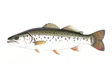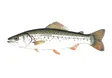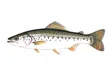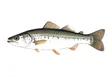
Silverjaw Minnow

Ericymba buccata

Leuciscidae · freshwater water fish

5 minute read · Species guide

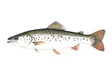
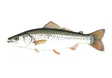
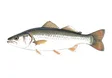
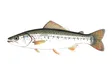
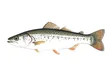
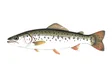
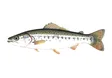
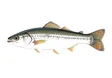
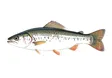
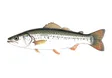
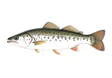
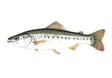
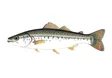
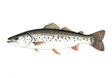
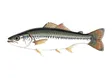
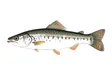
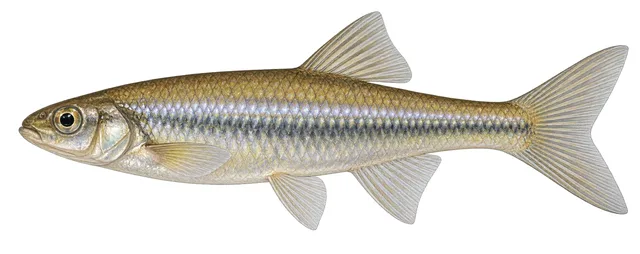
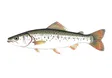
Silverjaw Minnow field guide illustration

About Silverjaw Minnow

The silverjaw minnow (Ericymba buccata) is a species of freshwater ray-finned fish belonging to the family Leuciscidae, the shiners, daces and minnows. With over 300 known species, there are more species of minnows native to North America's fresh waters than any other fish. Minnows can be hard to distinguish because many look alike. All minnows have one dorsal fin, ventral fins near the anus, a lateral line system (in most species), and smooth, round cycloid scales. Their jaws lack teeth, but they have one to three rows of pharyngeal teeth to grind food. Defining physical characteristics such as the number and type of fin rays, type of scales, and pattern of pharyngeal teeth are used to distinguish minnows.

Silverjaw minnows have a head with a flat underside and large silvery-white chambers on the sides that form their complete lateral line system. Since these fish are relatively small, 2–3 inches in length, large numbers can exist in a small area and still find necessary resources. They are native to many streams and rivers in the United States in a disjunct distribution.

Physical description

The silverjaw minnow has a lateral line system with many distinctive silvery-white pores connecting to an internal canal that helps the fish detect prey. One key feature of all minnows is that their dorsal fin has fewer than ten supporting structures, called rays. Silverjaw minnows have eight soft-rays which are thin, flexible membranous structures. Their dorsal fin is over their pelvic region where their ventral fins are located. They are light tan with a dark line on their back and have darkly outlined scales. Another defining feature is the presence of breast scales, which distinguishes them from the longjaw minnow. These fish are edentulous, lacking teeth on their jaws; however, they do have pharyngeal teeth in their throat. Their eyes are nearly atop their heads pointing upward. They have a slightly compressed body with the deepest part by the back of their neck. Their long snout which projects slightly past their subterminal mouth relates to their feeding behaviors as bottom dwelling fishes. Silverjaw minnows grow to be about 2–3 inches in length.

Range/distribution

This species exhibits a disjunct distribution, existing in a northern and southern range in the United States. The northern range extends from eastern Missouri to Maryland, extending north into the southern Great Lakes and south to the Cumberland River Drainage in northern Tennessee. They commonly inhabit the Chesapeake Bay, Ohio River, Mississippi River, and Atlantic Coastal tributaries. The southern range includes areas of Mississippi, Louisiana, Alabama, and Georgia. Major habitats in this range include the Apalachicola River and Pearl River drainage.

Habitat

Silverjaw minnows exist in large schools at the bottom of shallow, freshwater creeks, streams, and small to medium rivers with gravelly or sandy floors. They prefer the continuously moving water of riffles. Typically they inhabit clear waters without silt.

Diet and feeding behavior

The silverjaw minnow is a bottom-feeder that feeds mostly during the day on prey of the order Diptera including chironomids (non-biting midges), ephemeroptera (mayflies), and cladocera (water fleas). They also prey at night due to the low density of prey in the benthos. Their four main feeding behaviors are searching, mouthing, jabbing, and digging. The amount of food available and the behaviors of other individuals in the school influence which behavior is chosen. All behaviors involve skimming the bottom of the water source in search for food. Silverjaw minnows are selective feeders, only feeding on less than 50% of benthos organisms. They determine what food to consume through taste and tactile senses.

Reproduction and life cycle

Silverjaw minnows have a typical life span of three to four years. Eggs hatch between late spring and late summer. Growth of fish in their second and third summers occurs from May or June to the end of July. Growth stops during the fall and winter months due to a slowed metabolic rate. Sexual maturity is obtained late in their first summer or in their second summer. Adults typically spawn in mid-spring, but spawning occurs in July for the previous year's offspring. Eggs are scattered along the bottom substrate.

Importance to humans

The fishing industry economically profits from minnows as a commonly used bait. Minnows are also an important food source for larger game fish prized by fishermen.

Etymology

The silverjaw minnow gets its name from silvery-looking sensory organs along its jaw. The word minnow comes from the ancient Anglo-Saxon word for small, myne. The scientific name, Ericymba buccata comes from the Greek word eri, meaning intensifying, the Greek word cymba, meaning cavity, and the Latin word buccata, meaning cheek.

Article text: Wikipedia contributors, Silverjaw minnow (source revision). Licensed under CC BY-SA 4.0. Retrieved 2026-10-11.
Identification and appearance

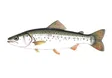
Minnows in the genus Ericymba generally be distinguished from other North American minnows by the presence of a large mouth, ventrally flattened body, and the presence of enlarged infraorbital canals (except in E. dorsalis). This species is most similar to the Longjaw Minnow (E. buccata), and can be distinguished by the presence of scales on the breast (vs. scales absent) and having four infraorbital ossicles (vs. five) (Pera and Armbruster, 2006).

Native range

Atlantic, lower Great Lakes, and Mississippi River drainages from New York, Pennsylvania, and Maryland to eastern Missouri. Absent from Tennessee River drainage and Cumberland River drainage below Cumberland Falls (Lee et al. 1980 et seq.; Page and Burr 1991).

Introduction history

Unknown; possible bait bucket introductions. The Clinch River, Virginia records probably represent one or more introductions form the Big Sandy (Jenkins and Burkhead 1994).

Range

Where it lives

Share of 5,995 GBIF observation records with a state location, across 19 states.
0%
27.3%
Share of 5,995 GBIF observation records with a state location, across 19 states.

Habitat

Water and movement

Water
WoRMS records this species in fresh water.
USGS NAS habitat
Freshwater
US status
Native transplant — native to part of the United States, moved to other waters inside it.

Classification

Taxonomy

Kingdom
Animalia
Phylum
Chordata
Superclass
Actinopterygii
Class
Teleostei
Order
Cypriniformes
Genus
Ericymba
Species
Ericymba buccata
ITIS TSN
163479
WoRMS AphiaID
1010426
GBIF key
2362253

Common questions about Silverjaw Minnow

What is the scientific name of Silverjaw Minnow?
The scientific name is Ericymba buccata, in the family Leuciscidae. Classification follows ITIS.
Does Silverjaw Minnow live in fresh water or salt water?
WoRMS records this species in fresh water.
Where has Silverjaw Minnow been recorded in the United States?
GBIF has observations in 19 states, with the most records in Ohio, Alabama, Illinois. The map shows observation records, which do not establish the complete natural range.

Closest relatives

Other Ericymba species

Same family

More Leuciscidae

Alabama Shiner4 states
Cyprinella callistiaLeuciscidaeNativeFresh
Allegheny Pearl Dace19 states
Margariscus margaritaLeuciscidaeNative and introducedFresh
Altamaha Shiner1 states
Cyprinella xaenuraLeuciscidaeNativeFresh
Alvord Chub2 states
Siphateles alvordensisLeuciscidaeNativeFresh
Apalachee Shiner3 states
Pteronotropis grandipinnisLeuciscidaeNativeFresh
Arkansas River Shiner5 states
Notropis girardiLeuciscidaeNative and introducedFresh
Arroyo Chub1 states
Gila orcuttiiLeuciscidaeNative and introducedFresh
Bandfin Shiner5 states
Luxilus zonistiusLeuciscidaeNative and introducedFresh
Bannerfin Shiner5 states
Cyprinella leedsiLeuciscidaeNativeFresh
Beautiful Shiner3 states
Cyprinella formosaLeuciscidaeNativeFresh
Bedrock Shiner3 states
Notropis rupestrisLeuciscidaeNativeFresh
Bigeye Chub25 states
Hybopsis amblopsLeuciscidaeNative and introducedFresh
Bigeye Shiner17 states
Notropis boopsLeuciscidaeNative and introducedFresh
Bigmouth Chub3 states
Nocomis platyrhynchusLeuciscidaeNativeFresh
Bigmouth Shiner21 states
Notropis dorsalisLeuciscidaeNative and introducedFresh
Blackchin Shiner13 states
Notropis heterodonLeuciscidaeNativeFresh
Blackmouth Shiner3 states
Notropis melanostomusLeuciscidaeNativeFresh
Blacknose Shiner21 states
Notropis heterolepisLeuciscidaeNative and introducedFresh
Blackside Dace2 states
Chrosomus cumberlandensisLeuciscidaeNativeFresh
Blackspot Shiner5 states
Notropis atrocaudalisLeuciscidaeNativeFresh
Blacktail Shiner14 states
Cyprinella venustaLeuciscidaeNative and introducedFresh
Blacktip Shiner4 states
Lythrurus atrapiculusLeuciscidaeNative and introducedFresh
Bleeding Shiner8 states
Luxilus zonatusLeuciscidaeNativeFresh
Blotched Chub6 states
Erimystax insignisLeuciscidaeNativeFresh

All 267 species in Leuciscidae