Ecology
Unlike most poeciliids (which tend to be generalists or micropredators), this is a highly specialized predator, with an extremely flexible upper jaw that enables it to take very large prey items for its size.
Description
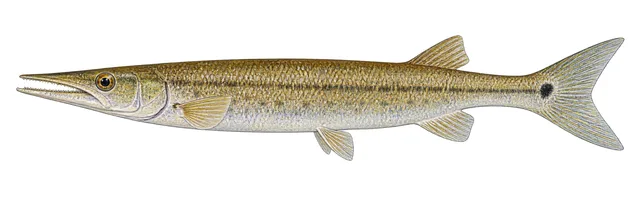
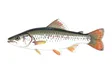
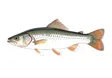
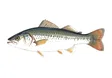
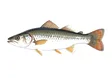
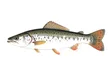
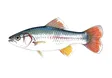
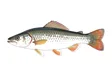
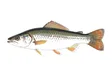
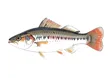
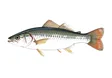
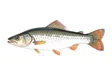
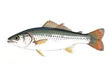
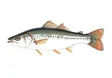
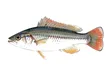
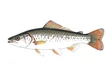
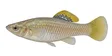
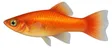
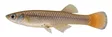
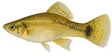
It grows typically to 9.7 cm (3.8 in) total length, exceptionally to 20 cm (7.9 in). It has an elongated appearance with a flat back profile. The lower jaw is longer than the upper, and upturned. The pike topminnow has large eyes and a dorsal fin set far back on the body. It is a light, olive/brown color with light green iridescence and small black spots on the flanks. The belly is a lighter yellowish white. A dark spot is at the base of the caudal fin. They are also a livebearing fish.
In the aquarium
This fish can be found in the aquarium trade, but is not an easy aquarium resident, especially by poeciliid standards.
Article text: Wikipedia contributors, Pike topminnow (source revision). Licensed under CC BY-SA 4.0. Retrieved 2026-10-11.
Diet and feeding
The FishTraits compilation records these diet categories for this species: invertebrates or larval fish; larger animal prey (a source category covering fish, crayfish, crabs, or frogs). These are broad categories, not a claim that every individual consumes every example in a category.
Reported feeding positions include surface or water-column feeding. The compilation combines published observations; diets can vary with age, locality, and available food.
Habitat preferences
Reported habitat associations include streams and small rivers, still-water habitats.
The source records associations with muck, clay or silt, sand, gravel, organic debris. An association indicates reported use, rather than an exclusive requirement.
The species is classified as tolerant of a broad range of salinities. This flag does not specify a salinity range for aquarium care.
Reproduction and parental care
The compilation reports a representative maturity age of 0.5 years. Its maturity field summarizes mean, median, or modal estimates, usually for females; male estimates can be used when female data are unavailable. It is not a fixed age at which every fish first breeds.
Batch or serial spawning has been reported somewhere in the species’ range. This does not establish the same spawning pattern for every population.
Recorded spawning months are Feb, Mar, Apr, May, Jun, Jul, Aug for the source’s reporting region (Zzz). This is a regional calendar, not a range-wide schedule.
Size and recorded longevity
FishTraits reports a maximum total length of 14 centimetres. Some entries use an estimated asymptotic length; this value should not be treated as a certified record catch.
Recorded longevity in the compilation is 2.5 years. Wild observations were preferred, but captive records were accepted where wild records were unavailable, and unspecified records were assumed wild. The value is not a guaranteed wild lifespan or an aquarium life expectancy.
Identification and appearance
The body is dark grey dorsally and fades lighter ventrally. Several rows of black spots occur along the side, and a larger black spot is visible along the caudal peduncle (but is sometimes faded). The pike killifish has long jaws that form a pointed beak (similar to Esox) and contain large teeth. The dorsal-fin origin is well behind the anal-fin origin. The largest species within the family Poeciliidae. From Page and Burr (1991) and Miller et al. (2005).
Native range
The species is native to the Atlantic slope from Veracruz, Mexico south to the Yucatan, Guatemala and Belize, the Atlantic drainages of Honduras and Guatemala, and to Costa Rica (Rosen and Bailey 1963; Reis et al. 2003; Miller et al. 2005).
Habitat and ecology
Most females larger than 75 mm SL and males larger than 55 mm SL are sexually mature. Average brood size is approximately 99, and larger females tend to have larger broods (up to about 320). In south Florida, reproduction continues year-round, and females are able to store viable sperm for several months. Male courtship displays are described by Horth (2004). The young are remarkably precocial; within one day of their birth, they pursue, capture, and eat prey. Adults are primarily piscivorous, and in south Florida eat mosquitofish, mollies, and other pike killifishes as their primary diet. Information from Turner and Snelson (1984) except where noted otherwise.
Introduction history
This species was introduced into south Florida in 1957 when individuals reared for medical research purposes were released into a local canal (Belshe 1961). Those found in Hillsborough County in 1997 were escapees from a nearby ornamental fish farm (Nico, personal communication). The Texas introduction was probably an aquarium release (Howells 1992).
Ecological impacts
Summary of species impacts derived from literature review. Click on an icon to find out more... The pike killifish is a piscivore that has been reported to reduce populations of eastern mosquitofish Gambusia holbrooki and other native poeciliid and cyprinodontoid populations in areas where it has been introduced (Belshe 1961; Courtenay and Meffe 1989; Greenwood 2012), and potentially competing for food resources with juvenile snook. Harms and Turingan (2012) found that pike killifish will consume shrimp in addition to fish, and suggest that this dietary flexibility has contributed to invasion success in south Florida.