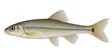
This fish is not to be confused with Alburnoides bipunctatus, which is also known as riffle minnow, but lives in Europe and Asia.
Additional field notes
The riffle minnow has a more specialized outline than many small silvery stream fishes.
Sources: Phenacobius catostomus species summary
Shape and field identification
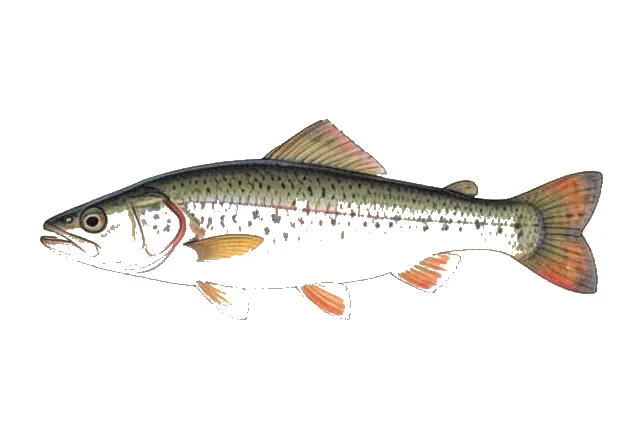
FishBase describes a long, nearly cylindrical body with the eyes positioned high on the head and directed upward. The lips resemble those of the suckermouth minnow, Phenacobius mirabilis. A dusky side stripe lies beneath a silver sheen, with a dark gray-brown back and paler brown upper sides.
The identification account reports 56–69 lateral-line scales and 15–19 scales around the narrow tail base. These counts are reference characters for careful examination, rather than features that can always be judged from a distant photograph. Pairing them with body shape is more informative than relying on color alone.
Sources: Phenacobius catostomus species summary
Guide sources
Research reviewed 2026-10-19.
Article text: Wikipedia contributors, Riffle minnow (source revision). Licensed under CC BY-SA 4.0. Retrieved 2026-10-11.
Diet and feeding
The FishTraits compilation records these diet categories for this species: invertebrates or larval fish. These are broad categories, not a claim that every individual consumes every example in a category.
Reported feeding positions include bottom feeding. The compilation combines published observations; diets can vary with age, locality, and available food.
Habitat preferences
Reported habitat associations include streams and small rivers, creeks.
The source records associations with sand, gravel, cobble. An association indicates reported use, rather than an exclusive requirement.
Reproduction and parental care
The compilation reports a representative maturity age of 1.5 years. Its maturity field summarizes mean, median, or modal estimates, usually for females; male estimates can be used when female data are unavailable. It is not a fixed age at which every fish first breeds.
Batch or serial spawning has been reported somewhere in the species’ range. This does not establish the same spawning pattern for every population.
Recorded spawning months are Apr, May for the source’s reporting region (TN). This is a regional calendar, not a range-wide schedule.
The reproductive-guild classification includes spawning on open substrates without guarding the brood.
Size and recorded longevity
FishTraits reports a maximum total length of 12 centimetres. Some entries use an estimated asymptotic length; this value should not be treated as a certified record catch.
Recorded longevity in the compilation is 4 years. Wild observations were preferred, but captive records were accepted where wild records were unavailable, and unspecified records were assumed wild. The value is not a guaranteed wild lifespan or an aquarium life expectancy.