Brassy Minnow

Hybognathus hankinsoni

Leuciscidae · freshwater water fish

5 minute read · Species guide

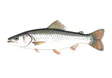
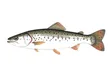
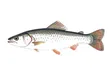
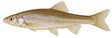
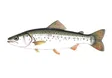
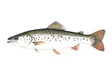
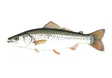
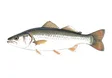
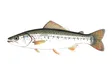
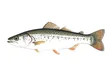
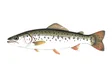
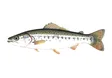
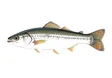
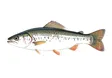
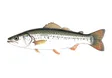
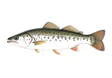
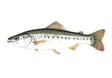
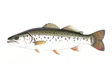
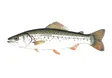
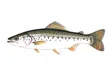
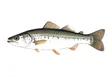
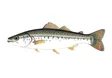
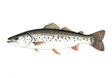
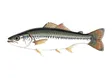
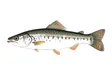
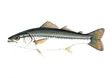
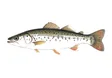
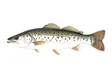
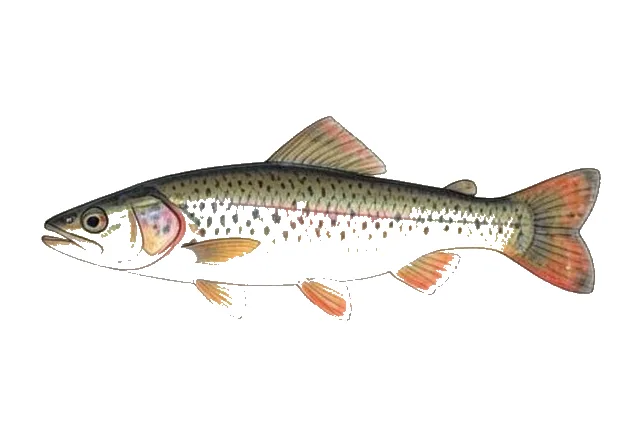
Brassy Minnow field guide illustration

About Brassy Minnow

The brassy minnow (Hybognathus hankinsoni) is a species of freshwater ray-finned fish belonging to the family Leuciscidae, the shiners, daces and minnows. The fish gets its scientific name (Hybognathus hankinsoni) from the Greek word Hybognathus, meaning bulging jaw, and hankinsoni from the American scientist, T.L. Hankinson. It is commonly found throughout the northern United States and Canada.

Physical description

The brassy minnow is typically 4–7.5 cm long and weighs 0.7-4 g. It can be identified by its brassy side coloration, cream underbelly and olive green back. It has larger than usual leptoid(bony ridge) scales. and dark stripe that runs from its gill cover to its tail. Hybognathus hansinkoni have a small dorsal fin with a rounded tip, and two pelvic fins that lie behind the dorsal fin in the abdominal position. Female brassy minnows tend to be larger than the males. Additionally, brassy minnows have a small subterminal mouth with a crescent shaped lower jaw, and their caudal (tail) fins are notched.

Distribution

Range extends from the St. Lawrence River and Lake Champlain drainages, throughout the Great Lakes and Northern United States and into Alberta and British Columbia.

Habitat

The brassy minnow typically lives in cool, slow moving streams and creeks that have sand, mud or gravel bottoms overlaid with organic sediment. They are also found in overflow ponds near rivers, boggy lakes, brackish tidal waters, and ditches with weedy bottoms. They live in water with a large range of pH's, and are able to survive at low oxygen levels, displaying high levels of environmental tolerance. The water can be clear or turbid. Brassy minnows appear to do better in habitats with minimal predators, or those that have structure for them to hide in, as they are very susceptible to predation.

Diet habits

Hybognathus hankinsoni are omnivorous eating algae, plankton and aquatic invertebrates that live in the organic sediment or the weeds that grow in their environment. Although omnivorous, the brassy minnow is typically vegetarian, mainly eating the algae, especially diatoms and desmids, found growing in the streams and ponds it inhabits. The minnows feed in schools with peak feeding times around 1–3 pm. Additionally, brassy minnows are first level consumers and are therefore important in the transfer of nutrients to higher trophic levels.

Reproduction and lifecycle

The brassy minnow becomes sexually active at one to two years of age. The fish spawn (biology) during the months of April through July, depending on the location. In the more northerly range of the brassy minnow, they spawn later in the year than in the south part of their range. The spawning time occurs when the water temperature reaches sixteen to seventeen degrees Celsius. They lay their legs on the vegetation and along the bottom of the streams and ponds it inhabits. A female brassy minnow can lay up to 2500 eggs, depending on her size, and usually releases the eggs over the course of a week. The eggs take about 7–10 days to hatch and the larvae grow rapidly for the first months. The brassy minnow lives up to 5 years and spawns annually. The species is considered to be globally secure, and therefore does not have any conservation concerns.

Article text: Wikipedia contributors, Brassy minnow (source revision). Licensed under CC BY-SA 4.0. Retrieved 2026-10-11.
Diet and feeding

The FishTraits compilation records these diet categories for this species: algae or phytoplankton; aquatic or other vascular plants; detritus or unidentified plant material; invertebrates or larval fish. These are broad categories, not a claim that every individual consumes every example in a category.

Reported feeding positions include bottom feeding and surface or water-column feeding. The compilation combines published observations; diets can vary with age, locality, and available food.

Habitat preferences

Reported habitat associations include streams and small rivers, creeks.

The source records associations with muck, clay or silt, sand, gravel, cobble. An association indicates reported use, rather than an exclusive requirement.

Reproduction and parental care

The compilation reports a representative maturity age of 2 years. Its maturity field summarizes mean, median, or modal estimates, usually for females; male estimates can be used when female data are unavailable. It is not a fixed age at which every fish first breeds.

Recorded spawning months are May, Jun for the source’s reporting region (WI). This is a regional calendar, not a range-wide schedule.

The reproductive-guild classification includes spawning on open substrates without guarding the brood.

Size and recorded longevity

FishTraits reports a maximum total length of 9.7 centimetres. Some entries use an estimated asymptotic length; this value should not be treated as a certified record catch.

Recorded longevity in the compilation is 3 years. Wild observations were preferred, but captive records were accepted where wild records were unavailable, and unspecified records were assumed wild. The value is not a guaranteed wild lifespan or an aquarium life expectancy.

Native range

Upper St. Lawrence River and Lake Champlain drainages, Quebec and New York, across Great Lakes, Hudson Bay, and Missouri--upper Mississippi River basins of southern Canada and northern United States south to Kansas; Fraser River system (Pacific Slope), Alberta and British Columbia (Page and Burr 1991).

Introduction history

Smith (1985) suggested that its presence in the Susquehanna River drainage, New York, may have been by way of dispersal through the Chenango Canal. However, this species was not reported from the Susquehanna drainage in a review of the species' distribution by Bailey (1954), and the Chenango Canal has been inactive since the late 1800s. Thus it is more likely due to a bait bucket introduction; Smith (1985) reports that the Brassy Minnow is frequently used as a baitfish. According to Etnier and Starnes (1993), the Tennessee record was based on a single specimen taken in 1973; they considered it a bait bucket introduction. Records in Colorado also may be the result of bait bucket releases. There is no information for means of its introduction into Utah.

Range

Where it lives

Share of 2,424 GBIF observation records with a state location, across 19 states. The orange dots are USGS stream-survey sites where this species was caught.
0%
23.5%
Share of 2,424 GBIF observation records with a state location, across 19 states. The orange dots are USGS stream-survey sites where this species was caught.

A blank area on the dot layer usually means nobody sampled there, not that the fish is absent. Turn on “every survey site” to see where the survey looked.

The USGS stream survey caught it at 944 of its sites, in 14 states. That survey and the GBIF records are two different counts of two different things, so the site keeps them apart.

Habitat

Water and movement

Water
WoRMS records this species in fresh water.
USGS NAS habitat
Freshwater
US status
Native transplant — native to part of the United States, moved to other waters inside it.
Migration
Undetermined

Classification

Taxonomy

Kingdom
Animalia
Phylum
Chordata
Superclass
Actinopterygii
Class
Teleostei
Order
Cypriniformes
Genus
Hybognathus
Species
Hybognathus hankinsoni
ITIS TSN
163363
WoRMS AphiaID
592843
GBIF key
2364394
Outside the US
ITIS also files it in Canada.

Common questions about Brassy Minnow

What is the scientific name of Brassy Minnow?
The scientific name is Hybognathus hankinsoni, in the family Leuciscidae. Classification follows ITIS.
Does Brassy Minnow live in fresh water or salt water?
WoRMS records this species in fresh water.
Where has Brassy Minnow been recorded in the United States?
GBIF has observations in 19 states, with the most records in Iowa, Minnesota, Nebraska. The map shows observation records, which do not establish the complete natural range.

Closest relatives

Other Hybognathus species

Same family

More Leuciscidae

Alabama Shiner4 states
Cyprinella callistiaLeuciscidaeNativeFresh
Allegheny Pearl Dace19 states
Margariscus margaritaLeuciscidaeNative and introducedFresh
Altamaha Shiner1 states
Cyprinella xaenuraLeuciscidaeNativeFresh
Alvord Chub2 states
Siphateles alvordensisLeuciscidaeNativeFresh
Apalachee Shiner3 states
Pteronotropis grandipinnisLeuciscidaeNativeFresh
Arkansas River Shiner5 states
Notropis girardiLeuciscidaeNative and introducedFresh
Arroyo Chub1 states
Gila orcuttiiLeuciscidaeNative and introducedFresh
Bandfin Shiner5 states
Luxilus zonistiusLeuciscidaeNative and introducedFresh
Bannerfin Shiner5 states
Cyprinella leedsiLeuciscidaeNativeFresh
Beautiful Shiner3 states
Cyprinella formosaLeuciscidaeNativeFresh
Bedrock Shiner3 states
Notropis rupestrisLeuciscidaeNativeFresh
Bigeye Chub25 states
Hybopsis amblopsLeuciscidaeNative and introducedFresh
Bigeye Shiner17 states
Notropis boopsLeuciscidaeNative and introducedFresh
Bigmouth Chub3 states
Nocomis platyrhynchusLeuciscidaeNativeFresh
Bigmouth Shiner21 states
Notropis dorsalisLeuciscidaeNative and introducedFresh
Blackchin Shiner13 states
Notropis heterodonLeuciscidaeNativeFresh
Blackmouth Shiner3 states
Notropis melanostomusLeuciscidaeNativeFresh
Blacknose Shiner21 states
Notropis heterolepisLeuciscidaeNative and introducedFresh
Blackside Dace2 states
Chrosomus cumberlandensisLeuciscidaeNativeFresh
Blackspot Shiner5 states
Notropis atrocaudalisLeuciscidaeNativeFresh
Blacktail Shiner14 states
Cyprinella venustaLeuciscidaeNative and introducedFresh
Blacktip Shiner4 states
Lythrurus atrapiculusLeuciscidaeNative and introducedFresh
Bleeding Shiner8 states
Luxilus zonatusLeuciscidaeNativeFresh
Blotched Chub6 states
Erimystax insignisLeuciscidaeNativeFresh

All 267 species in Leuciscidae