Sheepshead Minnow

Cyprinodon variegatus

Cyprinodontidae · freshwater and saltwater and brackish water fish

8 minute read · Species guide

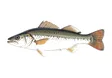
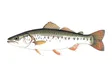
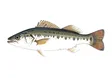
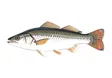
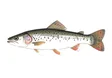
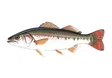
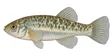
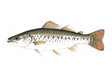
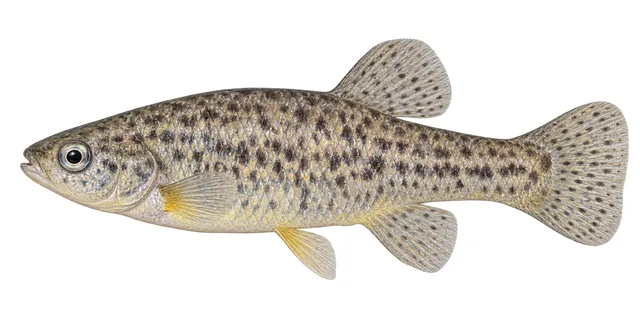
Sheepshead Minnow field guide illustration

About Sheepshead Minnow

The sheepshead minnow (Cyprinodon variegatus), also known as sheepshead pupfish, is a species of ray-finned fish in the family Cyprinodontidae, the pupfishes. It is found in salt marsh and estuary environments and is native to the eastern coasts of North and Central America.

Description

The sheepshead minnow is a deep-bodied fish; its body, exclusive of its tail, is nearly half as deep as it is long. The length of the fish averages 30 mm (1.2 in); it ranges to a maximum of 75 mm (3 in). It is laterally compressed with flat sides, an arched back and a small head with a flattened top. The small mouth is at the end of the snout and the teeth are large and wedge-shaped with three cusps. The pectoral fins are large and extend past the origins of the small pelvic fins. The origin of the anal fin hardly overlaps the trailing edge of the dorsal fin. The caudal peduncle is thick and the caudal fin is truncated and square-ended. The arrangement of the fins, the deep body and the tri-cuspid teeth help to distinguish this fish from the mummichog (Fundulus heteroclitus), which is found in the same habitats. The body is covered by large, circular scales, the ones on the cheeks and the top of the head and a single scale just above the pectoral fin being the largest. The male is generally larger and more deep-bodied than the female, with larger dorsal, pelvic and anal fins.

The color of the sheepshead minnow is olive green above and yellowish below. Juveniles have irregular transverse dark bars and the females keep these as they mature, while the males lose theirs. The dorsal fin is dark while the pectoral, pelvic and anal fins are orange. During the breeding season the male becomes very colorful with steel blue upper parts in front of the dorsal fin, lustrous green upper parts behind and deep salmon-pink underparts.

Distribution and habitat

The sheepshead minnow is native to the eastern coast of the United States. Its range extends from Cape Cod southwards to the Yucatan peninsula in Mexico, also the West Indies. It is found in brackish water in bays, inlets, lagoons, saltmarshes and similar locations with little wave action and sandy or muddy bottoms. It is tolerant of wide variations in salinity and is also found in hypersaline conditions.

Behavior

The sheepshead minnow is an omnivore, eating both animal and vegetable matter. Its diet mainly consists of detritus, microalgae, crustacean larvae and other small invertebrates. Males are aggressive and will attack fish larger than itself, slashing its prey with its sharp teeth and devouring it when it is subdued. Breeding takes place in shallow water between April and September, the males competing fiercely for the females. A few eggs are spawned at a time, and these are fertilised by the males which grasp the females with their fins. The eggs clump together and sink to the seabed, connected by sticky threads. They hatch after five or six days. During the winter, this fish burrows into the soft substrate and remains dormant.

Uses

The sheepshead minnow is commonly kept as an aquarium fish. It is easy to breed in captivity and is used as a forage fish in mariculture.

Status

The sheepshead minnow has a wide range and a large total population, divided up into a number of subpopulations. The total number of individuals seems stable and no particular threats to the fish have been identified, so the IUCN has listed it as being of "Least concern". The sheepshead minnow is a eurytolerant fish able to withstand extreme temperatures and live in a wide range of environments. This species acclimates to different temperatures partly by altering the activity of enzymatic antioxidants in the body such as catalase, superoxide dismutase, and glutathione peroxidase. All of these enzyme antioxidants were altered within the fish's white muscle at extreme hot or cold temperatures in the lab, which may be one reason the fish showed no increase in lipid peroxidation damage. Although sheepshead minnows appear able to deal with oxidative stress caused by temperature extremes, they may be less adapted to cope with microplastics in their environment. Researchers found that when microplastics were ingested by the sheepshead minnow they decreased the fish's swimming behavior and caused changes in the expression of genes related to oxidative stress, immune responses, and apoptosis.

Article text: Wikipedia contributors, Sheepshead minnow (source revision). Licensed under CC BY-SA 4.0. Retrieved 2026-10-11.
Diet and feeding

The FishTraits compilation records these diet categories for this species: algae or phytoplankton; detritus or unidentified plant material; invertebrates or larval fish. These are broad categories, not a claim that every individual consumes every example in a category.

Reported feeding positions include bottom feeding. The compilation combines published observations; diets can vary with age, locality, and available food.

Habitat preferences

Reported habitat associations include still-water habitats.

The source records associations with sand, vegetation. An association indicates reported use, rather than an exclusive requirement.

The species is classified as tolerant of a broad range of salinities. This flag does not specify a salinity range for aquarium care.

Reproduction and parental care

The compilation reports a representative maturity age of 1 years. Its maturity field summarizes mean, median, or modal estimates, usually for females; male estimates can be used when female data are unavailable. It is not a fixed age at which every fish first breeds.

Recorded spawning months are Apr, May, Jun, Jul, Aug, Sep, Oct for the source’s reporting region (AL). This is a regional calendar, not a range-wide schedule.

Size and recorded longevity

FishTraits reports a maximum total length of 9 centimetres. Some entries use an estimated asymptotic length; this value should not be treated as a certified record catch.

Recorded longevity in the compilation is 3 years. Wild observations were preferred, but captive records were accepted where wild records were unavailable, and unspecified records were assumed wild. The value is not a guaranteed wild lifespan or an aquarium life expectancy.

Native range

Coastal waters from Massachusetts to northeastern Mexico. Also in West Indies (Page and Burr 1991).

Introduction history

Initial introductions were presumably the result of bait-bucket releases (Stevenson and Buchanan 1973; Kennedy 1977). The species was first found in Lake Balmorhea in the 1960s (Stevenson and Buchanan 1973) and in Leon Creek in the 1970s (Kennedy 1977). Hubbs (1980) suggested that its appearance in Leon Creek may have resulted from a water change that took place at a highway bridge crossing during the transport of live bait from the Gulf Coast to the Pacific Coast. Kennedy (1977) suggested that it was probably introduced by local fishermen or bait dealers. The species first appeared in the Pecos River proper between 1980 and 1984 (Echelle and Connor 1989). Wilde and Echelle (1992) believed that Lake Balmorhea could have been the source of C. variegatus introduced into Leon Creek or the Pecos River proper; however, the researchers could not rule out the possibility that the species was introduced into these waters from elsewhere. Based on results of their electrophoretic study of fish taken from the Pecos River proper, Wilde and Echelle (1992) suggested that hybrids are widespread as a result of intradrainage dispersal and artificial transport of hybrids rather than multiple introductions of C. variegatus. Their data also suggested that the initial introduction of this species into the Pecos River probably occurred in the vicinity of Pecos, Reeves County, Texas, and hybrids subsequently dispersed both up- and down stream. However, recent research suggests that Red Bluff Reservoir was the original site of introduction (Childs et al. 1996). This species was not found in subsequent collections in Washington state concluding this introduction failed to produce a breeding population (Greenfield and Grinols 1965).

Ecological impacts

Introduced Cyprinodon variegatus are known to hybridize with other native Cyprinodon species, including the endangered Commanche Springs pupfish C. elegans (Stevenson and Buchanan 1973), the Pecos pupfish C. pecosensis (Echelle and Connor 1989; Wilde and Echelle 1992, 1997; Childs et al. 1996; Echelle et al. 1997), and the endangered Leon Springs pupfish C. bovinus (Minckley et al. 1991; Echelle and Echelle 1997). Hubbs et al. (1991) stated that C. pecosensis is nearly extirpated in Texas due to introgressive hybridization with introduced C. variegatus. Wilde and Echelle (1992) reported that hybrids between introduced C. variegatus and Pecos pupfish C. pecosensis have replaced endemic Pecos pupfish in a 430-km stretch of the Pecos River and have dispersed into downstream areas well outside the recorded range of Pecos pupfish. They concluded that hybridization with C. variegatus had reduced the range of the Pecos pupfish by 60 percent. Because the appearance of C. variegatus was likely the result of a bait bucket introduction involving few individuals, it serves as an example that a small number of individuals can have a dramatic effect on another species (Echelle and Connor 1989). Introduction of C. variegatus into a spring-fed watercourse of Diamond Y Draw in the 1970s rapidly led to extensive hybridization with the endemic C. bovinus and local genetic swamping of the native species (Hubbs 1980; Minckley et al. 1991). The hybrids were eradicated and the native species was restored to the area (Hubbs 1980). Subsequently, however, C. variegatus was again introduced to the area, and this led to genetic introgression of the entire wild population of C. bovinus (Echelle and Echelle 1997). In contrast to the high levels of genetic introgression resulting from introductions of C. variegatus into the ranges of the other two species of pupfish endemic to the Pecos River drainage, Echelle and Echelle (1994) found little evidence of genetic introgression after more than two decades of contact between C. elegans and C. variegatus.

Range

Where it lives

Share of 59,519 GBIF observation records with a state location, across 22 states.
0%
92.3%
Share of 59,519 GBIF observation records with a state location, across 22 states.

Habitat

Water and movement

Water
WoRMS records this species in fresh water, brackish water and the sea.
USGS NAS habitat
Brackish;Marine
US status
Native transplant — native to part of the United States, moved to other waters inside it.
Migration
Not migratory

Classification

Taxonomy

Kingdom
Animalia
Phylum
Chordata
Superclass
Actinopterygii
Class
Teleostei
Order
Cyprinodontiformes
Genus
Cyprinodon
Species
Cyprinodon variegatus
ITIS TSN
165631
WoRMS AphiaID
159285
GBIF key
4284440

Common questions about Sheepshead Minnow

What is the scientific name of Sheepshead Minnow?
The scientific name is Cyprinodon variegatus, in the family Cyprinodontidae. Classification follows ITIS.
Does Sheepshead Minnow live in fresh water or salt water?
WoRMS records this species in fresh water, brackish water and the sea.
Where has Sheepshead Minnow been recorded in the United States?
GBIF has observations in 22 states, with the most records in Texas, Florida, Louisiana. The map shows observation records, which do not establish the complete natural range.

Closest relatives

Other Cyprinodon species

Same family

More Cyprinodontidae