Bluntnose Minnow

Pimephales notatus

Leuciscidae · freshwater water fish

6 minute read · Species guide

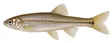
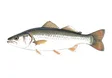
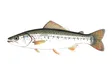
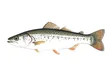
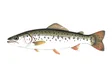
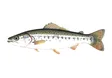
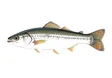
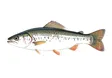
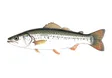
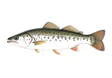
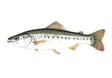
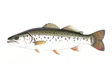
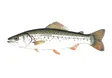
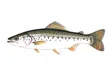
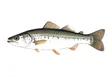
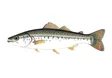
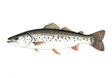
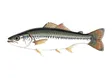
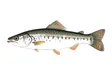
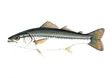
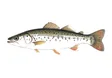
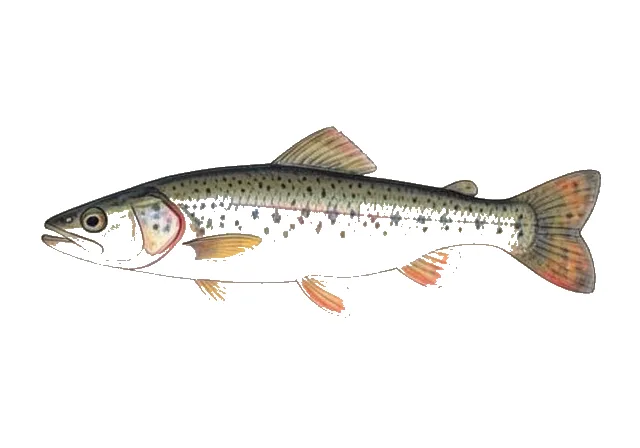
Bluntnose Minnow field guide illustration

About Bluntnose Minnow

The bluntnose minnow (Pimephales notatus) is a species of freshwater ray-finned fish belonging to the family Leuciscidae, the shiners, daces and minnows. Its natural geographic range extends from the Great Lakes south along the Mississippi River basin to Louisiana, and east across the Midwestern United States to New York State. The bluntnose is very ubiquitous, and may be the most common freshwater fish in the Eastern U.S.

Description

Bluntnose minnows are commonly 6.5 cm (2.6 in) long, with a maximum length of 11 cm (4.3 in). On the first two or three dorsal rays are dark pigmented spots. The scales between the head and the dorsal fin are noted to be smaller than the rest of the scales on the body. They have a rounded head and a terminal mouth, although the snout hangs a little bit over the mouth. The dark coloring on the edges of the scales cause a cross-hatched look along the body. The scales on these fish are cycloid scales, a type of leptoid scale. It is possible to find the age of a fish from the rings on the scales. The lateral line of a bluntnose minnow runs from its head to tail, ending in a black spot that makes them distinguishable from the fathead minnow. These minnows have a pale olive upper body (above the lateral line) and a silvery lower body (below the lateral line), with silvery-blue scales near the lateral line.

Distribution

The bluntnose minnow can be found in North America, in the Hudson Bay and Mississippi River basins from southern Quebec to southern Manitoba, Canada to Louisiana, United States. They are also found from the Saint Lawrence River in Quebec to the Roanoke River on the east coast of United States. There are also many non-indigenous populations found in Connecticut, Georgia, Maryland, Massachusetts, New York, Ohio, South Dakota, Utah, Virginia, West Virginia, and Michigan, thought to have been introduced by bait bucket release or stock contamination. Bluntnose minnows are thought to be the most abundant freshwater fish in the eastern part of the country.

Habitat

Bluntnose minnows can be found in lakes, rivers, ponds and streams, showing a preference for shallow, clear water with a sandy bottom. Their habitats range from headwater bogs, swamps, and springs to rivers, ponds, and lakes. Sometimes, up to a dozen species of minnows can be found in a single stream of moderate size. They can be found swimming in large groups or alone.

Diet

These fish prefer to feed on aquatic insects, algae, diatoms, aquatic insect larvae, and small crustaceans called entomostracans. Occasionally they will eat fish eggs or small fish.

Life cycle

Bluntnose minnows spawn from early spring to midsummer, depending on their habitat. They attach their eggs under stones in depressions they have dug. During the mating season, the heads of the males will become darker and their bodies bluish. They also develop three rows of nuptial tubercles (bumps) on their heads. Eggs hatch in eight to fourteen days.

Etymology

The genus name Pimephales means fat head, the specific epithet notatus means marked or spotted.

Article text: Wikipedia contributors, Bluntnose minnow (source revision). Licensed under CC BY-SA 4.0. Retrieved 2026-10-11.
Diet and feeding

The FishTraits compilation records these diet categories for this species: algae or phytoplankton; detritus or unidentified plant material; invertebrates or larval fish. These are broad categories, not a claim that every individual consumes every example in a category.

Reported feeding positions include bottom feeding and surface or water-column feeding. The compilation combines published observations; diets can vary with age, locality, and available food.

Habitat preferences

Reported habitat associations include medium to large rivers, streams and small rivers, creeks, still-water habitats.

The source records associations with clay or silt, sand, gravel, cobble, boulders, bedrock, vegetation. An association indicates reported use, rather than an exclusive requirement.

Reproduction and parental care

The compilation reports a representative maturity age of 1 years. Its maturity field summarizes mean, median, or modal estimates, usually for females; male estimates can be used when female data are unavailable. It is not a fixed age at which every fish first breeds.

Batch or serial spawning has been reported somewhere in the species’ range. This does not establish the same spawning pattern for every population.

Recorded spawning months are May, Jun, Jul, Aug for the source’s reporting region (NC). This is a regional calendar, not a range-wide schedule.

The reproductive-guild classification includes guarding eggs or young at a spawning substrate or nest.

Size and recorded longevity

FishTraits reports a maximum total length of 11 centimetres. Some entries use an estimated asymptotic length; this value should not be treated as a certified record catch.

Recorded longevity in the compilation is 3.5 years. Wild observations were preferred, but captive records were accepted where wild records were unavailable, and unspecified records were assumed wild. The value is not a guaranteed wild lifespan or an aquarium life expectancy.

Native range

Great Lakes, Hudson Bay (Red River), and Mississippi River basins from southern Quebec to southern Manitoba, and south to Louisiana; Atlantic Slope from St. Lawrence River, Quebec, to Roanoke River, Virginia (absent from most of New England); Gulf Slope from Mobile Bay drainage, Alabama, to Mississippi River (Page and Burr 1991).

Introduction history

This species has been transplanted commonly by bait bucket release and sometimes stocked as a forage fish or introduced by way of stock contamination. As indicated by Whitworth (1996), Pimephales notatus was introduced to a small stream in the Housatonic River drainage and that population was probably the source for other populations that have become established in other sites in the Housatonic drainage. Walters (1997) noted that the occurrence of this species in the middle section of the Conasauga River, Georgia, during the 1980s was probably the result of bait bucket introduction. Probably a bait bucket release in Massachusetts, it was first found in the Housatonic in 1979 and first noticed in Quabbin Reservoir in the early 1980s (Hartel 1992; Hartel et al. 1996). Trautman (1981) reported that, in addition to being propagated by bait dealers, Pimephales notatus was propagated and stocked throughout Ohio after 1925 by the state conservation department. He added that millions were seined annually from Ohio streams and sold and used as bait. Sigler and Sigler (1987) noted that it was introduced to Williard Bay Reservoir, Utah in 1982, but they did not provide additional details. Jenkins and Burkhead (1994) provided details on introductions, and possible introductions, for drainages associated with the state of Virginia. The presence of Pimephales notatus in the Potomac River drainage probably resulted from stockings, naturalization, and rapid spread. The first known record for the Potomac River drainage was from a Shenandoah River tributary in 1897. It was common to abundant in the lower Potomac by the early 1900s. Jenkins and Burkhead noted that it may have been used as forage in bass and sunfish culture ponds operated in Washington, D.C. by the former U.S. Fish Commission, and the species may have been disseminated with centrarchids. The first known record for the Rappahannock drainage was from 1972. In the James River, the fish was collected above the Blue Ridge in 1928; it may have been introduced with shipments of centrarchids and subsequently dispersed downstream. The first known record from the Roanoke came in 1947, the first from the Dan system (Roanoke drainage) in 1951. Jenkins and Burkhead (1994) interpreted the distribution pattern in the Roanoke proper and Dan systems of the Roanoke drainage to be the result of at least two introductions.

Ecological impacts

Largely unknown. Based on 1989 shorefish samples, Hartel et al. (1996) found it to be the most common minnow in Quabbin Reservoir, Massachusetts. Possibly in reference to native populations, Trautman (1981) noted that the species hybridizes with Pimephales promelas and P. vigilax.

Record fish

The Wisconsin state record

  • Wisconsin0 lbs. 0.4 oz.

    Mukwonago River · Waukesha · 08/01/2019

Each figure is the state agency’s own certified record. The site holds record tables for 11 states so far, so a state missing here has not been read yet. It is not a state where this fish holds no record.

Range

Where it lives

Share of 34,490 GBIF observation records with a state location, across 38 states. The orange dots are USGS stream-survey sites where this species was caught.
0%
14.9%
Share of 34,490 GBIF observation records with a state location, across 38 states. The orange dots are USGS stream-survey sites where this species was caught.

A blank area on the dot layer usually means nobody sampled there, not that the fish is absent. Turn on “every survey site” to see where the survey looked.

The USGS stream survey caught it at 10,288 of its sites, in 32 states. That survey and the GBIF records are two different counts of two different things, so the site keeps them apart.

Habitat

Water and movement

Water
WoRMS records this species in fresh water.
USGS NAS habitat
Freshwater
US status
Native transplant — native to part of the United States, moved to other waters inside it.
Migration
Undetermined
Pattern

Classification

Taxonomy

Kingdom
Animalia
Phylum
Chordata
Superclass
Actinopterygii
Class
Teleostei
Order
Cypriniformes
Genus
Pimephales
Species
Pimephales notatus
ITIS TSN
163516
WoRMS AphiaID
881380
GBIF key
2367736
Outside the US
ITIS also files it in Canada.

Common questions about Bluntnose Minnow

What is the scientific name of Bluntnose Minnow?
The scientific name is Pimephales notatus, in the family Leuciscidae. Classification follows ITIS.
Does Bluntnose Minnow live in fresh water or salt water?
WoRMS records this species in fresh water.
Where has Bluntnose Minnow been recorded in the United States?
GBIF has observations in 38 states, with the most records in Illinois, Ohio, Oklahoma. The map shows observation records, which do not establish the complete natural range.

Closest relatives

Other Pimephales species

Same family

More Leuciscidae

Alabama Shiner4 states
Cyprinella callistiaLeuciscidaeNativeFresh
Allegheny Pearl Dace19 states
Margariscus margaritaLeuciscidaeNative and introducedFresh
Altamaha Shiner1 states
Cyprinella xaenuraLeuciscidaeNativeFresh
Alvord Chub2 states
Siphateles alvordensisLeuciscidaeNativeFresh
Apalachee Shiner3 states
Pteronotropis grandipinnisLeuciscidaeNativeFresh
Arkansas River Shiner5 states
Notropis girardiLeuciscidaeNative and introducedFresh
Arroyo Chub1 states
Gila orcuttiiLeuciscidaeNative and introducedFresh
Bandfin Shiner5 states
Luxilus zonistiusLeuciscidaeNative and introducedFresh
Bannerfin Shiner5 states
Cyprinella leedsiLeuciscidaeNativeFresh
Beautiful Shiner3 states
Cyprinella formosaLeuciscidaeNativeFresh
Bedrock Shiner3 states
Notropis rupestrisLeuciscidaeNativeFresh
Bigeye Chub25 states
Hybopsis amblopsLeuciscidaeNative and introducedFresh
Bigeye Shiner17 states
Notropis boopsLeuciscidaeNative and introducedFresh
Bigmouth Chub3 states
Nocomis platyrhynchusLeuciscidaeNativeFresh
Bigmouth Shiner21 states
Notropis dorsalisLeuciscidaeNative and introducedFresh
Blackchin Shiner13 states
Notropis heterodonLeuciscidaeNativeFresh
Blackmouth Shiner3 states
Notropis melanostomusLeuciscidaeNativeFresh
Blacknose Shiner21 states
Notropis heterolepisLeuciscidaeNative and introducedFresh
Blackside Dace2 states
Chrosomus cumberlandensisLeuciscidaeNativeFresh
Blackspot Shiner5 states
Notropis atrocaudalisLeuciscidaeNativeFresh
Blacktail Shiner14 states
Cyprinella venustaLeuciscidaeNative and introducedFresh
Blacktip Shiner4 states
Lythrurus atrapiculusLeuciscidaeNative and introducedFresh
Bleeding Shiner8 states
Luxilus zonatusLeuciscidaeNativeFresh
Blotched Chub6 states
Erimystax insignisLeuciscidaeNativeFresh

All 267 species in Leuciscidae