Article text: Wikipedia contributors, Exoglossum maxillingua (source revision). Licensed under CC BY-SA 4.0. Retrieved 2026-10-11.
Cutlip Minnow
Exoglossum maxillingua
Leuciscidae · freshwater water fish
4 minute read · Species guide
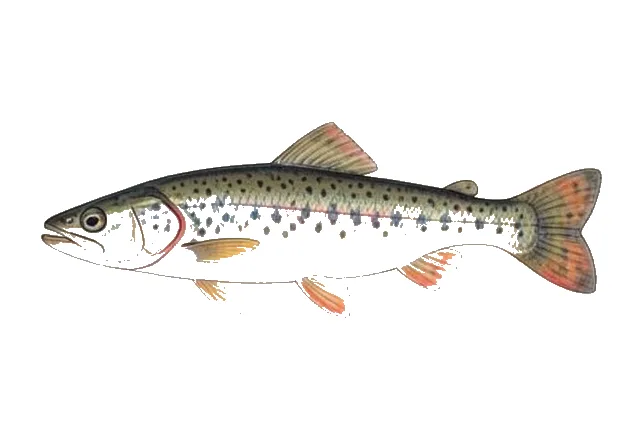
About Cutlip Minnow
Exoglossum maxillingua (cutlips minnow) is a species of freshwater ray-finned fish belonging to the family Leuciscidae, the shiners, daces and minnows. This is an olive-green medium-sized minnow (average 6 inches) of North America with a distinguishing lower jaw. Isolated from all other minnows by its three-lobed lower jaw with the middle lobe sticking out like a tongue. The range of this species is from the St. Lawrence and Lake Ontario south into Virginia. It is listed as "threatened"in the Canadian province of Ontario, but may never have been common there as this is the most northerly of its range. It is found in running streams and seems to prefer clear, stony pools but not rapids. The distinctive mouth of the cutlips lets it feed on minuscule shellfish which it scrapes from rocks. Although molluscs appear to be its primary food, it also eats insect larvae and diatoms. An interesting feeding behavior of this species is"eye-picking" when food is scarce or competition is high. The Cutlips will pluck out the eyes of conspecifics or other species as a supplement to its regular diet. A nest builder, the cutlips male constructs a nest of stone, some of which are up to 18 inches across. Spawning happens late in spring when the male attempts to crowd females over its nest. The cutlips is not a popular bait species due to its softened coloration but it takes a hook without much difficulty and is favored in some areas as a choice panfish.
Diet and feeding
The FishTraits compilation records these diet categories for this species: algae or phytoplankton; detritus or unidentified plant material; invertebrates or larval fish; fish or frog eggs. These are broad categories, not a claim that every individual consumes every example in a category.
Reported feeding positions include bottom feeding and surface or water-column feeding. The compilation combines published observations; diets can vary with age, locality, and available food.
Habitat preferences
Reported habitat associations include medium to large rivers, streams and small rivers, creeks.
The source records associations with gravel, cobble, boulders. An association indicates reported use, rather than an exclusive requirement.
Reproduction and parental care
The compilation reports a representative maturity age of 2 years. Its maturity field summarizes mean, median, or modal estimates, usually for females; male estimates can be used when female data are unavailable. It is not a fixed age at which every fish first breeds.
Recorded spawning months are May for the source’s reporting region (NC). This is a regional calendar, not a range-wide schedule.
The reproductive-guild classification includes guarding eggs or young at a spawning substrate or nest.
Size and recorded longevity
FishTraits reports a maximum total length of 16 centimetres. Some entries use an estimated asymptotic length; this value should not be treated as a certified record catch.
Recorded longevity in the compilation is 4.5 years. Wild observations were preferred, but captive records were accepted where wild records were unavailable, and unspecified records were assumed wild. The value is not a guaranteed wild lifespan or an aquarium life expectancy.
Identification and appearance
Smith (1985); Page and Burr (1991); Jenkins and Burkhead (1994). Exoglossum be distinguished from most other North American cyprinids by the presence of a central bony plate flanked by fleshy lobes on the lower jaw. Exoglossum maxillingua can be distinguished from the Tonguetied Minnow E. laurae by the size and distinctiveness of the fleshy lobes on the lower jaw (much larger and distinct in E. maxillingua) and the absence of barbels at the corner of the mouth (present in E. laurae).
Native range
Atlantic Slope from St. Lawrence River drainage, Quebec, to upper Roanoke River, North Carolina (absent in Connecticut River and other rivers in Northeast); Lake America drainage, Ontario and New York (Page and Burr 1991).
Introduction history
Probable bait bucket release. The first records of this species (and hybrids with E. laurae) in the New drainage are from 1956 from the Walker Creek system, a heavily fished area (Jenkins and Burkhead 1994).
Ecological impacts
Cutlips minnows in the New drainage are known to hybridize with the Tonguetied Minnow E. laurae (Jenkins and Burkhead 1994).
Range
Where it lives
0%
62.6%of mapped records
A blank area on the dot layer usually means nobody sampled there, not that the fish is absent. Turn on “every survey site” to see where the survey looked.
Share of records by state
The USGS stream survey caught it at 876 of its sites, in 12 states. That survey and the GBIF records are two different counts of two different things, so the site keeps them apart.
Habitat
Water and movement
- Water
- WoRMS records this species in fresh water.
- USGS NAS habitat
- Freshwater
- US status
- Native transplant — native to part of the United States, moved to other waters inside it.
- Migration
- Undetermined
Classification
Taxonomy
- Kingdom
- Animalia
- Phylum
- Chordata
- Superclass
- Actinopterygii
- Class
- Teleostei
- Order
- Cypriniformes
- Family
- Leuciscidae
- Genus
- Exoglossum
- Species
- Exoglossum maxillingua
- ITIS TSN
- 163356
- WoRMS AphiaID
- 1026585
- GBIF key
- 2361987
- Outside the US
- ITIS also files it in Canada.
Common questions about Cutlip Minnow
What is the scientific name of Cutlip Minnow?
The scientific name is Exoglossum maxillingua, in the family Leuciscidae. Classification follows ITIS.
Does Cutlip Minnow live in fresh water or salt water?
WoRMS records this species in fresh water.
Where has Cutlip Minnow been recorded in the United States?
GBIF has observations in 15 states, with the most records in New York, Maryland, Virginia. The map shows observation records, which do not establish the complete natural range.
Closest relatives
Other Exoglossum species
Same family
More Leuciscidae

Alabama Shiner4 states
Cyprinella callistiaLeuciscidaeNativeFresh

Allegheny Pearl Dace19 states
Margariscus margaritaLeuciscidaeNative and introducedFresh

Altamaha Shiner1 states
Cyprinella xaenuraLeuciscidaeNativeFresh

Alvord Chub2 states
Siphateles alvordensisLeuciscidaeNativeFresh

Apalachee Shiner3 states
Pteronotropis grandipinnisLeuciscidaeNativeFresh

Arkansas River Shiner5 states
Notropis girardiLeuciscidaeNative and introducedFresh

Arroyo Chub1 states
Gila orcuttiiLeuciscidaeNative and introducedFresh

Bandfin Shiner5 states
Luxilus zonistiusLeuciscidaeNative and introducedFresh

Bannerfin Shiner5 states
Cyprinella leedsiLeuciscidaeNativeFresh

Beautiful Shiner3 states
Cyprinella formosaLeuciscidaeNativeFresh

Bedrock Shiner3 states
Notropis rupestrisLeuciscidaeNativeFresh

Bigeye Chub25 states
Hybopsis amblopsLeuciscidaeNative and introducedFresh

Bigeye Shiner17 states
Notropis boopsLeuciscidaeNative and introducedFresh

Bigmouth Chub3 states
Nocomis platyrhynchusLeuciscidaeNativeFresh

Bigmouth Shiner21 states
Notropis dorsalisLeuciscidaeNative and introducedFresh

Blackchin Shiner13 states
Notropis heterodonLeuciscidaeNativeFresh

Blackmouth Shiner3 states
Notropis melanostomusLeuciscidaeNativeFresh

Blacknose Shiner21 states
Notropis heterolepisLeuciscidaeNative and introducedFresh

Blackside Dace2 states
Chrosomus cumberlandensisLeuciscidaeNativeFresh

Blackspot Shiner5 states
Notropis atrocaudalisLeuciscidaeNativeFresh

Blacktail Shiner14 states
Cyprinella venustaLeuciscidaeNative and introducedFresh

Blacktip Shiner4 states
Lythrurus atrapiculusLeuciscidaeNative and introducedFresh

Bleeding Shiner8 states
Luxilus zonatusLeuciscidaeNativeFresh

Blotched Chub6 states
Erimystax insignisLeuciscidaeNativeFresh