Slenderhead Darter

Percina phoxocephala

Percidae · freshwater water fish

5 minute read · Species guide

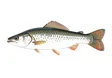
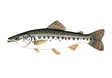
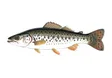
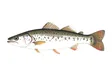
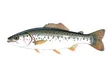
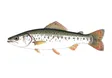
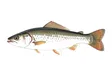
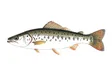
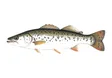
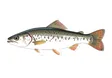
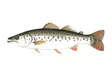
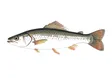
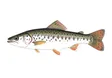
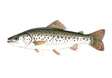
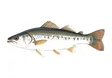
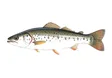
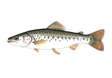
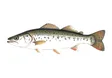
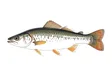
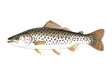
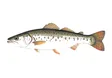
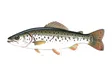
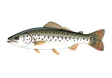
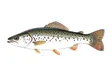
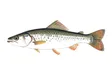
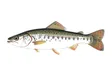
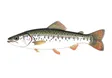
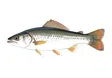
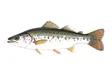
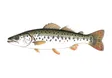
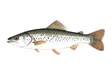
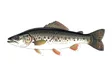
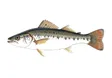
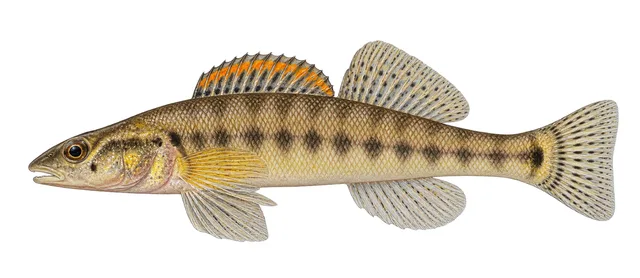
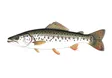
Slenderhead Darter field guide illustration

About Slenderhead Darter

Percina phoxocephala, the slenderhead darter, is a species of freshwater ray-finned fish, a darter from the subfamily Etheostomatinae, part of the family Percidae, which also contains the perches, ruffes and pikeperches. It is found in North America in the central Ohio and Mississippi River basins, to northeastern South Dakota and the Lake Winnebago system in Wisconsin, and as far south as the Red River in eastern Oklahoma and northeast Texas, and as far east as southwest Minnesota and Central Kansas, Found typically in small to medium size rivers. It is a colorful species, with an average length of 6 to 9 centimeters (2.4 to 3.5 in). Males take on a deeper hue during the breeding season. It feeds on insect larvae and other small invertebrates, and spawns between April and June. It is a common fish with a very wide range and the International Union for Conservation of Nature has classified its conservation status as being of "least concern".

Description

Slenderhead darters are typically 6–9 centimeters long, and can reach 10 centimeters at times. They have a pointed snout and a long narrow body. Their mouths are subterminal with the snout projecting only slightly beyond the mouth. Teeth are present on the jaws but are minute. The dorsal side of the body is light brown with 14–22 dark blotches down the center serving as camouflage to potential predators above the darter. The ventral side is cream colored which helps disguise the darter from potential predators below them. They have a row of 11–16 blotches down their sides that are taller than they are wide and connected by a thin lateral stripe. The dorsal fins are distinctly separate with the first dorsal fin containing a dark brown band near the base and an orange band near the outer edge. The second dorsal fin and tail have many small spots often forming rows. The pelvic fins are transparent and are located on the thoracic position and have two spines and 9–10 fin rays. The caudal fin has a square shape and is slightly forked. On breeding males the orange band on the dorsal fin is more intensely colored and thicker. Males also can have a dark dusky coloration to their body which often hides many of the blotches on their back and sides. Slenderheads have small scales and a lateral-line count ranging from 60 to 80. The female breast is naked except for the presence of one or two cternoid scales, the posterior half of the males breast is scaled with the anterior half being naked. Their conservation status is of least concern.

Distribution and habitat

The slenderhead darter is a medium-sized darter and the most widely distributed of the four species assigned to the subgenus Swainia. It is found in North America from the central Ohio and Mississippi River basins, to northeastern South Dakota and the Lake Winnebago system (in Lake Michigan drainage) in Wisconsin, and as far south as the Red River in eastern Oklahoma and northeast Texas. Slenderhead darters are found in areas of relatively shallow water with riffles and a moderate current. They prefer areas over sand and gravel bottoms with little silt. They are bottom dwellers and found in the Benthic zone.

Reproduction

Slenderhead darters spawn between late April and early June. The darters exhibit sexual dimorphism with the males pigmentation darkening in April and peaking during spawning. The first dorsal fin becomes orange and the dorsal rays become outlined in yellow. Older and larger males are darker and able to attract more females. Males are territorial and guard patches of swift flowing water 15–60 centimeters deep. The females will lay their eggs in riffles burying them in sand or gravel. The number of eggs laid ranges from 50 to 1000 with larger females producing more (one-year-olds on average lay 83 eggs and two-year-olds produce 270). Juveniles remain in the spawning habitat for 2–4 weeks after hatching. Slenderhead darters reach sexual maturity after one year.

Development

When Slenderhead darters hatch, they are around 19 millimeters in length. There is continual growth during the first year, with one year old individuals averaging 46 millimeters. There is little influence of sex on size. Individuals will become sexually mature after one year. After approximately one month in the spawning habitat, the darters move to deeper water.

Diet

Slenderhead darters are lie-in-wait predators that feed predominantly on insect larvae, crustaceans, and other aquatic invertebrates. A study conducted in Illinois examined the contents of several darters' stomachs and found that 99 percent of the contents were midge larvae, blackfly larvae, caddisfly larvae, and mayfly naiads.

Article text: Wikipedia contributors, Percina phoxocephala (source revision). Licensed under CC BY-SA 4.0. Retrieved 2026-10-11.
Diet and feeding

The FishTraits compilation records these diet categories for this species: invertebrates or larval fish; fish or frog eggs. These are broad categories, not a claim that every individual consumes every example in a category.
Reported feeding positions include bottom feeding and surface or water-column feeding. The compilation combines published observations; diets can vary with age, locality, and available food.

Habitat preferences

Reported habitat associations include medium to large rivers.

The source records associations with gravel. An association indicates reported use, rather than an exclusive requirement.

Reproduction and parental care

The compilation reports a representative maturity age of 1.5 years. Its maturity field summarizes mean, median, or modal estimates, usually for females; male estimates can be used when female data are unavailable. It is not a fixed age at which every fish first breeds.

Recorded spawning months are Jun for the source’s reporting region (WI). This is a regional calendar, not a range-wide schedule.

The reproductive-guild classification includes hiding a brood without subsequent guarding.

Size and recorded longevity

FishTraits reports a maximum total length of 9.6 centimetres. Some entries use an estimated asymptotic length; this value should not be treated as a certified record catch.

Recorded longevity in the compilation is 4 years. Wild observations were preferred, but captive records were accepted where wild records were unavailable, and unspecified records were assumed wild. The value is not a guaranteed wild lifespan or an aquarium life expectancy.

Range

Where it lives

Share of 3,352 GBIF observation records with a state location, across 18 states. The orange dots are USGS stream-survey sites where this species was caught.
0%
23.3%
Share of 3,352 GBIF observation records with a state location, across 18 states. The orange dots are USGS stream-survey sites where this species was caught.

A blank area on the dot layer usually means nobody sampled there, not that the fish is absent. Turn on “every survey site” to see where the survey looked.

The USGS stream survey caught it at 696 of its sites, in 12 states. That survey and the GBIF records are two different counts of two different things, so the site keeps them apart.

Habitat

Water and movement

Water
WoRMS records this species in fresh water.
Migration
Migratory
Pattern

Classification

Taxonomy

Kingdom
Animalia
Phylum
Chordata
Superclass
Actinopterygii
Class
Teleostei
Order
Perciformes
Family
Percidae
Genus
Percina
Species
Percina phoxocephala
ITIS TSN
168494
WoRMS AphiaID
1020316
GBIF key
2382095

Common questions about Slenderhead Darter

What is the scientific name of Slenderhead Darter?
The scientific name is Percina phoxocephala, in the family Percidae. Classification follows ITIS.
Does Slenderhead Darter live in fresh water or salt water?
WoRMS records this species in fresh water.
Where has Slenderhead Darter been recorded in the United States?
GBIF has observations in 18 states, with the most records in Illinois, Oklahoma, Kansas. The map shows observation records, which do not establish the complete natural range.

Closest relatives

Other Percina species

Same family

More Percidae

All 229 species in Percidae