Shortjaw Cisco

Coregonus zenithicus

Salmonidae · freshwater water fish

5 minute read · Species guide

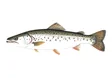
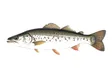
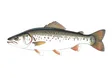
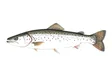
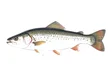
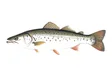
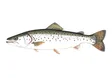
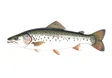
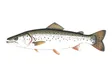
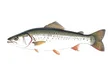
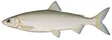
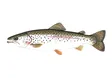
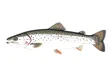
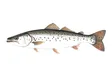
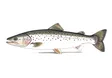
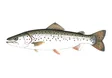
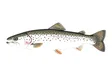
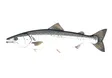
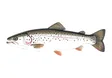
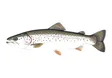
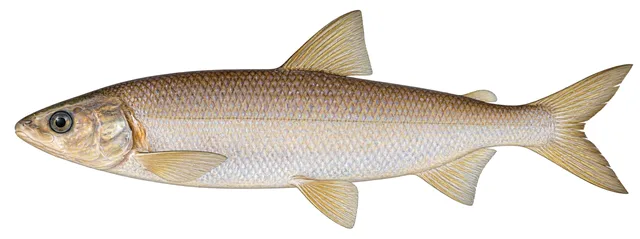
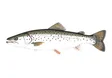
Shortjaw Cisco field guide illustration

About Shortjaw Cisco

The shortjaw cisco (Coregonus zenithicus) is a North-American freshwater whitefish in the salmon family. Adult fish range to about 30 cm (12 in) in length and are silver, tinged with green above and paler below. One of the members of the broader Coregonus artedi complex of ciscoes, it is distributed widely in the deeper lakes of Canada, but populations in the Great Lakes have been declining and it is no longer present in Lakes Michigan, Huron, and Erie. It feeds mainly on crustaceans and insect larvae and spawns in the autumn on the lake bed. It is part of the important cisco (chub) fishery in the Great Lakes. The International Union for Conservation of Nature has rated its conservation status as "vulnerable". Shortjaw cisco have however evolved from the cisco Coregonus artedi independently in different lakes and different parts of the range, and conservation assessments therefore should be made on a lake-wise rather than range-wide basis.

Description

The shortjaw cisco has large, smooth scales and is iridescent silver, with a greenish back and white belly. The mouth is small and toothless, and the lower jaw is shorter than or equal in length to the upper jaw. It typically weighs approximately 300 g (11 oz), and ranges from 150 to greater than 300 mm (6 to 12 inches) standard length. Very difficult to differentiate from other cisco species by superficial appearance, this species typically has fewer gillrakers than other ciscoes.

Distribution

Once common throughout the upper Laurentian Great Lakes Coregonus zenithicus is no longer found in Lake Michigan or Lake Huron, with the last specimens reported in 1975 and in 1982, respectively. It has been absent from Lake Erie since 1957. The population in Lake Superior is known to be lower than historic levels, based on commercial catch statistics. Its status in Lake Nipigon is uncertain. It has been reported in at least 22 other lakes outside of the Great Lakes, from the Canadian provinces of Ontario, Manitoba, Saskatchewan, Alberta, and the Northwest Territories. It is not known whether the remaining Great Lakes populations are increasing, decreasing or stable. Population trends in other lakes are unknown.

Habitat

The shortjaw cisco is most commonly found in the deeper waters of large lakes. It has been found at depths of between 55 and 114 m (180 and 374 ft) in Lakes Superior, Michigan, and Huron, and is known to exhibit seasonal changes in depth distribution in Lake Superior.

Reproduction

Spawning occurs in the autumn. Eggs are deposited over the lake bottom in deep water and develop over three to four months, depending on water temperature. This fish reaches sexual maturity at five years of age.

Ecology

Crustaceans and insect larvae are important food items. Lake trout (Salvelinus namaycush) and burbot (Lota lota) are known to feed on shortjaw cisco. Shortjaw cisco are believed to be vulnerable to the invasive sea lamprey (Petromyzon marinus,) which has presumably played a role in its decline in the Great Lakes, where expansion in the range of sea lamprey has overlapped the decline in shortjaw cisco numbers.

Fisheries

This species was an important component of the cisco (chub) fishery in the Great Lakes. Competition and predation from rainbow smelt (Osmerus mordax) and alewife (Alosa pseudoharengus), two introduced exotic fish species, have had a negative impact on shortjaw cisco populations. The cumulative effect of these factors, sea lamprey predation and habitat changes associated with urban, agricultural, and industrial activities in the Great Lakes Basin undoubtedly combined to make this species vulnerable to over-exploitation, even at exploitation rates that had once been sustainable.

In lake Superior, the shortjaw cisco has been part of deepwater cisco fisheries. The deepwater ciscoes there also comprise Coregonus hoyi and Coregonus kiyi.

Systematics

The systematics of the group of fishes called "ciscoes" is complicated. The shortjaw cisco is part of the Coregonus artedi complex (which also comprises C. hoyi and C. kiyi). Particularly it was thought to be conspecific with the (presumably now extinct) longjaw cisco (Coregonus alpenae). Genetic data show that the shortjaw cisco is not a unique and coherent taxon, but has evolved from the sympatric Coregonus artedi s.str. independently in different lakes. Particularly there is a major distinction between the eastern and western parts of the range, and the differences between sympatric C. artedi and C. zenithicus are smaller than differences among lakes.

Article text: Wikipedia contributors, Shortjaw cisco (source revision). Licensed under CC BY-SA 4.0. Retrieved 2026-10-11.
Diet and feeding

The FishTraits compilation records these diet categories for this species: invertebrates or larval fish; larger animal prey (a source category covering fish, crayfish, crabs, or frogs). These are broad categories, not a claim that every individual consumes every example in a category.

Reported feeding positions include bottom feeding and surface or water-column feeding. The compilation combines published observations; diets can vary with age, locality, and available food.

Habitat preferences

Reported habitat associations include still-water habitats.

The source records associations with open water. An association indicates reported use, rather than an exclusive requirement.

Reproduction and parental care

The compilation reports a representative maturity age of 4 years. Its maturity field summarizes mean, median, or modal estimates, usually for females; male estimates can be used when female data are unavailable. It is not a fixed age at which every fish first breeds.

Recorded spawning months are Nov, Dec for the source’s reporting region (Lake Superior). This is a regional calendar, not a range-wide schedule.

The reproductive-guild classification includes spawning on open substrates without guarding the brood.

Size and recorded longevity

FishTraits reports a maximum total length of 36.8 centimetres. Some entries use an estimated asymptotic length; this value should not be treated as a certified record catch.

Recorded longevity in the compilation is 11 years. Wild observations were preferred, but captive records were accepted where wild records were unavailable, and unspecified records were assumed wild. The value is not a guaranteed wild lifespan or an aquarium life expectancy.

Range

Where it lives

Share of 1,306 GBIF observation records with a state location, across 5 states.
0%
73.5%
Share of 1,306 GBIF observation records with a state location, across 5 states.

Habitat

Water and movement

Water
WoRMS records this species in fresh water.
Migration
Not migratory

Classification

Taxonomy

Kingdom
Animalia
Phylum
Chordata
Superclass
Actinopterygii
Class
Teleostei
Order
Salmoniformes
Genus
Coregonus
Species
Coregonus zenithicus
ITIS TSN
161948
WoRMS AphiaID
567528
GBIF key
2350935
Outside the US
ITIS also files it in Canada.

Common questions about Shortjaw Cisco

What is the scientific name of Shortjaw Cisco?
The scientific name is Coregonus zenithicus, in the family Salmonidae. Classification follows ITIS.
Does Shortjaw Cisco live in fresh water or salt water?
WoRMS records this species in fresh water.
Where has Shortjaw Cisco been recorded in the United States?
GBIF has observations in 5 states, with the most records in Michigan, Wisconsin, Indiana. The map shows observation records, which do not establish the complete natural range.

Closest relatives

Other Coregonus species

Same family

More Salmonidae

Alaska Whitefish1 states
Coregonus nelsoniiSalmonidaeNativeFresh
Apache Trout5 states
Oncorhynchus apacheSalmonidaeNativeFresh
Arctic Char8 states
Salvelinus alpinusSalmonidaeNative and introducedFreshSaltBrackish
Arctic Cisco1 states
Coregonus autumnalisSalmonidaeNativeFreshSaltBrackish
Arctic Grayling16 states
Thymallus arcticusSalmonidaeNative and introducedFresh
Atlantic Salmon26 states
Salmo salarSalmonidaeNative and introducedFreshSaltBrackish
Bear Lake Whitefish2 states
Prosopium abyssicolaSalmonidaeNativeFresh
Bering Cisco1 states
Coregonus laurettaeSalmonidaeNativeFreshSaltBrackish
Blackfin Cisco6 states
Coregonus nigripinnisSalmonidaeNativeFresh
Bloater6 states
Coregonus hoyiSalmonidaeNativeFresh
Bonneville Cisco2 states
Prosopium gemmiferSalmonidaeNativeFresh
Bonneville Whitefish2 states
Prosopium spilonotusSalmonidaeNativeFresh
Broad Whitefish1 states
Coregonus nasusSalmonidaeNativeFreshBrackish
Brook Trout40 states
Salvelinus fontinalisSalmonidaeNative and introducedFreshSaltBrackish
Brown Trout41 states
Salmo truttaSalmonidaeIntroducedFreshSaltBrackish
Bull Trout8 states
Salvelinus confluentusSalmonidaeNativeFreshBrackish
Chinook Salmon18 states
Oncorhynchus tshawytschaSalmonidaeNative and introducedFreshSaltBrackish
Chum Salmon5 states
Oncorhynchus ketaSalmonidaeNativeFreshSaltBrackish
Cisco11 states
Coregonus artediSalmonidaeNative and introducedFreshSaltBrackish
Coho Salmon22 states
Oncorhynchus kisutchSalmonidaeNative and introducedFreshSaltBrackish
Cutthroat Trout18 states
Oncorhynchus clarkiiSalmonidaeNative and introducedFreshSaltBrackish
Deepwater Cisco3 states
Coregonus johannaeSalmonidaeNativeFresh
Dolly Varden9 states
Salvelinus malmaSalmonidaeNativeFreshSaltBrackish
Gila Trout2 states
Oncorhynchus gilaeSalmonidaeNative and introducedFresh

All 44 species in Salmonidae