Blackfin Cisco

Coregonus nigripinnis

Salmonidae · freshwater water fish

4 minute read · Species guide

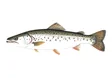
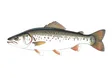
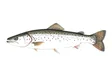
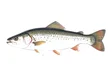
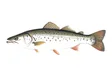
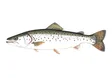
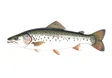
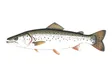
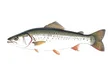
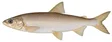
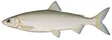
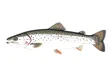
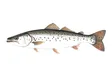
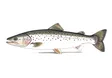
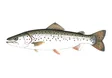
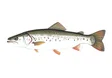
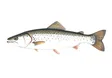
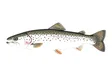
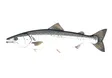
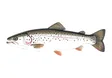
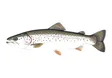
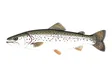
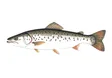
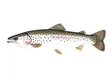
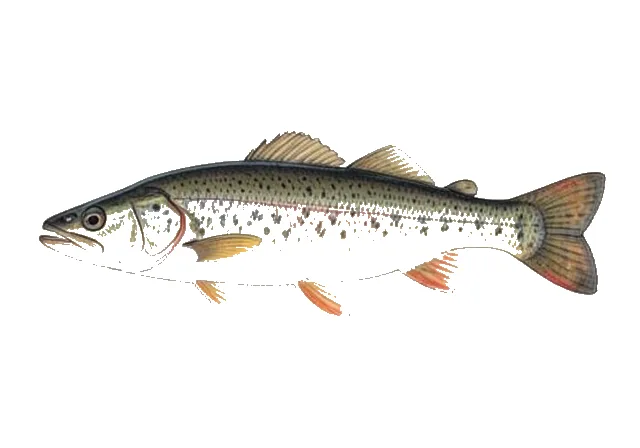
Blackfin Cisco field guide illustration

About Blackfin Cisco

The blackfin cisco (Coregonus nigripinnis) was a North American salmonid fish in the freshwater whitefish sub-family Coregoninae. This silvery, deep-bodied fish with black fins, large eyes, a blunt snout and a terminal mouth, was one of the largest forms of ciscoes. The blackfin cisco used to inhabit the Great Lakes of North America until recently, but has been reported to have gone extinct. The blackfin cisco is a member of the C. artedi complex, whose taxonomy has not yet been resolved, and it may not represent a valid species.

Taxonomy

The species was first mentioned by P.R. Hoy 1872, attributing Gill as the species authority, but Gill's manuscript was never published. The first valid description of this species is attributed to James Wood Milner in 1874.

The taxonomy of C. nigripinnis, along with other ciscoes in the C. artedi complex, is unresolved. C. nigripinnis was recognized by W.N. Koelz in 1929 to consist of four subspecies, but he had difficulty distinguishing some specimens from C. kiyi. The subspecies he named were C. n. nigripinnis in Lake Huron and Lake Michigan, C. n. cyanopterus in Lake Superior, C. n. prognathus in Lake Ontario and C. n. regalis in Lake Nipigon. C. n. cyanopterus was later synonymized with C. zenithicus, and C. n. prognathus was declared a nomen dubium. Specimens from inland lakes in central Canada are generally regarded to be C. artedi.

Turgeon and Bernatchez proposed in 2003 to merge several cisco species, including the blackfin cisco, into the taxon C. artedi sensu lato.

Description

It was a dark silvery color, with a dark green to black back, and pink or purple on the sides; the outer half of the fins was black. Blackfin ciscoes measured up to 510 mm (21 inches in length). Its preferred habitat was cold lakes at depths of up to 180 metres (590 ft).

Decline

The decline of the species was largely caused by overfishing, which occurred during the 1950s as the result of mismanagement in an unregulated fishery, and predation from the invading sea lamprey. The introduced alewife (Alosa pseudoharengus) and rainbow smelt (Osmerus mordax) were also aggressive predators of juveniles. Blackfin ciscoes were commercially fished until the early 1960s when declining stocks made the fishery uneconomic. Current threats to any remaining populations include commercial fishing, predation by rainbow smelt and interbreeding with lake herring (Coregonus artedi).

The blackfin cisco was last seen in Lake Huron in 1960 and in Lake Michigan in 1969. The last sighting of the previously-linked "cyanopterus" population was in 2006 in Long Lake near Thunder Bay on Lake Superior. This species may still be extant in Lake Nipigon. The IUCN Red List lists it as extinct in 1996. The Committee on the Status of Endangered Wildlife in Canada listed it as threatened in 1988 and as data deficient in 2007, due to the uncertainty of its taxonomic status. Efforts are being made to consider reintroducing populations of cisco into the Great lakes, specifically Lake Michigan.

Article text: Wikipedia contributors, Blackfin cisco (source revision). Licensed under CC BY-SA 4.0. Retrieved 2026-10-11.
Diet and feeding

The FishTraits compilation records these diet categories for this species: aquatic or other vascular plants; invertebrates or larval fish. These are broad categories, not a claim that every individual consumes every example in a category.

Habitat preferences

Reported habitat associations include still-water habitats.

The source records associations with open water. An association indicates reported use, rather than an exclusive requirement.

Reproduction and parental care

The compilation reports a representative maturity age of 4.5 years. Its maturity field summarizes mean, median, or modal estimates, usually for females; male estimates can be used when female data are unavailable. It is not a fixed age at which every fish first breeds.

Recorded spawning months are Jan, Dec for the source’s reporting region (WI). This is a regional calendar, not a range-wide schedule.

Size and recorded longevity

FishTraits reports a maximum total length of 39 centimetres. Some entries use an estimated asymptotic length; this value should not be treated as a certified record catch.

Recorded longevity in the compilation is 11 years. Wild observations were preferred, but captive records were accepted where wild records were unavailable, and unspecified records were assumed wild. The value is not a guaranteed wild lifespan or an aquarium life expectancy.

Range

Where it lives

Share of 177 GBIF observation records with a state location, across 6 states.
0%
84.2%
Share of 177 GBIF observation records with a state location, across 6 states.

Habitat

Water and movement

Water
WoRMS records this species in fresh water.
Migration
Not migratory

Classification

Taxonomy

Kingdom
Animalia
Phylum
Chordata
Superclass
Actinopterygii
Class
Teleostei
Order
Salmoniformes
Genus
Coregonus
Species
Coregonus nigripinnis
ITIS TSN
623395
WoRMS AphiaID
1307269
GBIF key
9783661
Outside the US
ITIS also files it in Canada.

Common questions about Blackfin Cisco

What is the scientific name of Blackfin Cisco?
The scientific name is Coregonus nigripinnis, in the family Salmonidae. Classification follows ITIS.
Does Blackfin Cisco live in fresh water or salt water?
WoRMS records this species in fresh water.
Where has Blackfin Cisco been recorded in the United States?
GBIF has observations in 6 states, with the most records in Michigan, Wisconsin, Illinois. The map shows observation records, which do not establish the complete natural range.

Closest relatives

Other Coregonus species

Same family

More Salmonidae

Alaska Whitefish1 states
Coregonus nelsoniiSalmonidaeNativeFresh
Apache Trout5 states
Oncorhynchus apacheSalmonidaeNativeFresh
Arctic Char8 states
Salvelinus alpinusSalmonidaeNative and introducedFreshSaltBrackish
Arctic Cisco1 states
Coregonus autumnalisSalmonidaeNativeFreshSaltBrackish
Arctic Grayling16 states
Thymallus arcticusSalmonidaeNative and introducedFresh
Atlantic Salmon26 states
Salmo salarSalmonidaeNative and introducedFreshSaltBrackish
Bear Lake Whitefish2 states
Prosopium abyssicolaSalmonidaeNativeFresh
Bering Cisco1 states
Coregonus laurettaeSalmonidaeNativeFreshSaltBrackish
Bloater6 states
Coregonus hoyiSalmonidaeNativeFresh
Bonneville Cisco2 states
Prosopium gemmiferSalmonidaeNativeFresh
Bonneville Whitefish2 states
Prosopium spilonotusSalmonidaeNativeFresh
Broad Whitefish1 states
Coregonus nasusSalmonidaeNativeFreshBrackish
Brook Trout40 states
Salvelinus fontinalisSalmonidaeNative and introducedFreshSaltBrackish
Brown Trout41 states
Salmo truttaSalmonidaeIntroducedFreshSaltBrackish
Bull Trout8 states
Salvelinus confluentusSalmonidaeNativeFreshBrackish
Chinook Salmon18 states
Oncorhynchus tshawytschaSalmonidaeNative and introducedFreshSaltBrackish
Chum Salmon5 states
Oncorhynchus ketaSalmonidaeNativeFreshSaltBrackish
Cisco11 states
Coregonus artediSalmonidaeNative and introducedFreshSaltBrackish
Coho Salmon22 states
Oncorhynchus kisutchSalmonidaeNative and introducedFreshSaltBrackish
Cutthroat Trout18 states
Oncorhynchus clarkiiSalmonidaeNative and introducedFreshSaltBrackish
Deepwater Cisco3 states
Coregonus johannaeSalmonidaeNativeFresh
Dolly Varden9 states
Salvelinus malmaSalmonidaeNativeFreshSaltBrackish
Gila Trout2 states
Oncorhynchus gilaeSalmonidaeNative and introducedFresh
Golden Trout8 states
Oncorhynchus aguabonitaSalmonidaeNativeFresh

All 44 species in Salmonidae