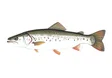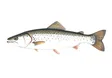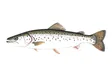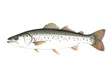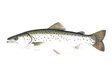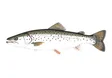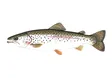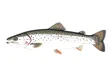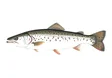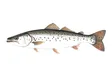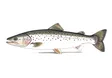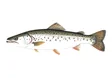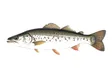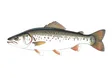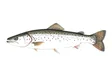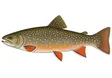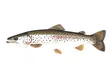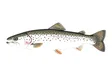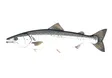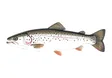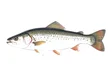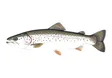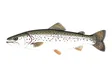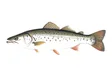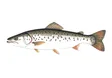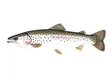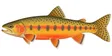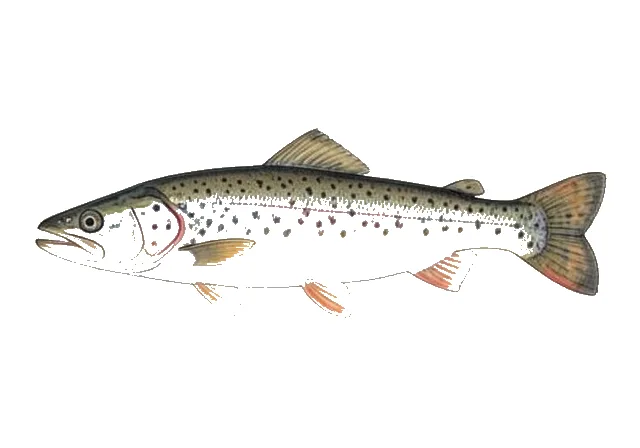
In appearance it is very similar to the closely related Bonneville whitefish P. spilonotus. Generally whitish in color, it has more of a "Roman nose" than the Bonneville whitefish, and larger scales. It never has spots, while young Bonneville whitefish (up to 10 inches) have a pattern of spots. The Bear Lake whitefish tends to be smaller as well, rarely longer than 9 inches, and with a maximum known length of 11 inches.
It is primarily an inhabitant of the deeper parts of the lake bottom, where it feeds on a variety of small invertebrates such as ostracods, copepods, and insects. It spawns from late December to early February, at depths of 50 to 100 feet.
Rarely seen near the shore, it is not often caught by hook and line.
Additional field notes
Bear Lake whitefish are closely associated with the lake bottom.
Sources: Prosopium abyssicola species summary
Where to look within the lake
FishBase describes the species as usually occurring near the bottom and only rarely near shore. A shoreline observation therefore gives a limited view of a fish whose normal habitat lies elsewhere in the lake. The summary classifies it as demersal and non-migratory.
Sources: Prosopium abyssicola species summary
Article text: Wikipedia contributors, Bear Lake whitefish (source revision). Licensed under CC BY-SA 4.0. Retrieved 2026-10-11.