Cisco

Coregonus artedi

Salmonidae · freshwater and saltwater and brackish water fish

6 minute read · Species guide

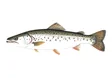
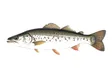
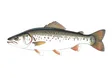
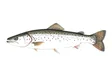
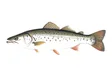
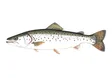
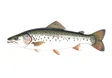
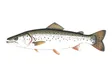
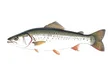
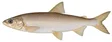
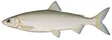
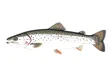
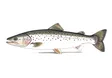
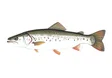
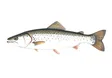
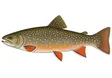
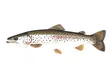
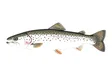
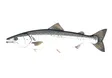
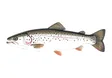
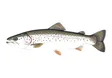
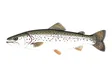
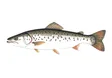
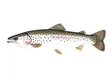
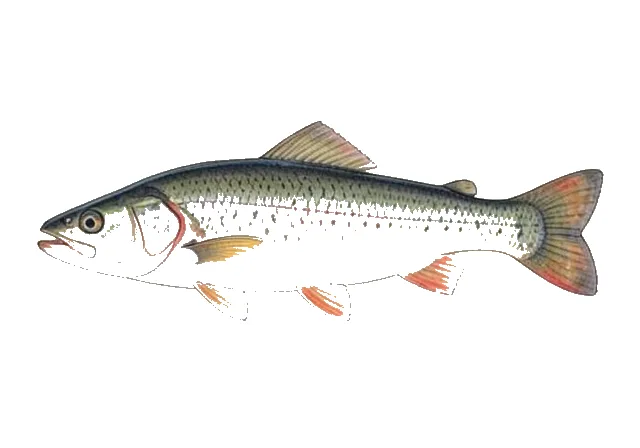
Cisco field guide illustration

About Cisco

Coregonus artedi, commonly known as the cisco, is a North American species of freshwater whitefish in the family Salmonidae. The number of species and definition of species limits in North American ciscoes is a matter of debate. Accordingly, Coregonus artedi may refer either narrowly (sensu stricto) to one of the several types of cisco found e.g. in the Great Lakes, or broadly (sensu lato) to the complex of all ciscoes in continental North American lakes, Coregonus artedi sensu lato.

Coregonus artedi, narrow sense

Narrowly defined, Coregonus artedi is known variously with the common names cisco, northern cisco, lake herring, chub or tullibee and its Anishinaabe name Odoonibiins. It is a pelagic fish occurring in the midwater zone of cold water lakes in North America. In the northern and western parts of its range it is also found in large rivers.

This species occasionally grows as large as 40 cm and 2.3 kg (five pounds), but is more commonly 28 to 38 cm long and 170 to 907 grams (six ounces to two pounds) in weight. It is slender-bodied and silvery with pinkish iridescence on its sides.

Diet is predominantly zooplankton and insect larvae, although fish eggs and larvae, including those of their own species are also documented. Small fish, including some minnow species, are also known to be consumed at times.

Northern cisco are preyed upon by a wide variety of predatory species, and have a particularly important place in the diet of lake trout (Salvelinus namaycush). It is also a common food of rainbow trout (Oncorhynchus mykiss), northern pike (Esox lucius), burbot (Lota lota), yellow perch, (Perca flavescens) and walleye (Sander vitreum) where the species overlap ranges.

The abundance of northern cisco in the North American Great Lakes is much reduced from the levels of the 19th Century. Once abundant in all five lakes, it is now common only in Lake Superior. The Lake Huron population has been increasing recently, perhaps as a consequence of low alewife (Alosa pseudoharengus) abundance. Limited numbers have also reappeared in Lake Michigan's lower Green Bay. Numbers in Lakes Erie and Ontario remain far below historical levels. The reduced abundance is believed to result from the cumulative effects of several factors, including the expansion of non-native species such as alewife, rainbow smelt (Osmerus mordax) and sea lamprey (Petromyzon marinus). These species prey on and compete with various life stages of northern cisco. It is unclear what effect the annual stocking of several million non-native Pacific salmon in the Great Lakes has had on northern cisco.

Additionally, substantial environmental degradation in some parts of the range has undoubtedly contributed to the stresses on northern cisco populations. The populations are therefore believed to be more vulnerable to the effects of exploitation than previously, even at levels of harvest lower than what was once sustainable. The cisco is also very sensitive to changes in temperature and levels of dissolved oxygen.

Northern cisco are fished commercially and for sport. In the early years of the fishery, herring provided some of the largest catches from the Great Lakes and, when salted down or smoked for preservation, provisioned much of the surrounding territory. Northern cisco roe is also valued on the international market.

The Coregonus artedi species complex

The northern cisco or lake herring discussed above is one of several closely related North American species or forms of cisco. The group is the subject of considerable debate about the taxonomic independence and relationships of the different forms, and it has been credibly argued that they all comprise merely one highly variable larger species that also includes the ecologically and morphologically separable fishes, including the following at least (some of which may be extinct):

Collectively, these fishes are often referred to as a species complex, the Coregonus artedi complex, or as Coregonus artedi sensu lato (broad sense).

Commercial fishing

Commercial fishing for northern cisco in Lake Superior and the Northern Channel of Lake Huron is a very important economical source for communities in the Great Lakes region. Commercial fishing for northern cisco began in the 1800s. Initially, in Lake Ontario, northern cisco were destroyed because they were thought of as a nuisance. However, there is evidence of a turnaround in the perception of northern cisco by 1833, where northern cisco were targeted and thought of as better eating than the related lake whitefish. In Ontario, the yield of northern cisco was 328 tonnes in 2018. This number is substantially lower than previous years dating back to 2012, all of which numbered over 350 tonnes. This decline was due to a reduction of quotas for commercial fisheries in hopes to combat a possible population decline.

While northern cisco does play an important role in the diet of many people still, its primary utility from commercial sources is for its roe. Caviar of northern cisco has become popular in Scandinavian culture, and is the leading cause of demand for northern cisco in recent decades. Smaller northern cisco can also be gill-netted and sold as bait for use in recreational fishing.

Recreational fishing

Northern cisco are fished recreationally in many parts of the United States and Canada. They are popular to catch, especially while ice fishing when they are more likely to be found in the shallower parts of the Great Lakes. Recreational fishing is not restricted to the Great Lakes. There is unique popularity for ice fishing in Lake Simcoe, where the fishery reopened in 2015 after a successful population rehabilitation.

Article text: Wikipedia contributors, Coregonus artedi (source revision). Licensed under CC BY-SA 4.0. Retrieved 2026-10-11.
Diet and feeding

The FishTraits compilation records these diet categories for this species: algae or phytoplankton; invertebrates or larval fish; larger animal prey (a source category covering fish, crayfish, crabs, or frogs); fish or frog eggs. These are broad categories, not a claim that every individual consumes every example in a category.

Reported feeding positions include bottom feeding and surface or water-column feeding. The compilation combines published observations; diets can vary with age, locality, and available food.

Habitat preferences

Reported habitat associations include medium to large rivers, still-water habitats.

The source records associations with open water. An association indicates reported use, rather than an exclusive requirement.

Reproduction and parental care

The compilation reports a representative maturity age of 6 years. Its maturity field summarizes mean, median, or modal estimates, usually for females; male estimates can be used when female data are unavailable. It is not a fixed age at which every fish first breeds.

Recorded spawning months are Nov, Dec for the source’s reporting region (WI). This is a regional calendar, not a range-wide schedule.

The reproductive-guild classification includes spawning on open substrates without guarding the brood.

Size and recorded longevity

FishTraits reports a maximum total length of 57.2 centimetres. Some entries use an estimated asymptotic length; this value should not be treated as a certified record catch.

Recorded longevity in the compilation is 31 years. Wild observations were preferred, but captive records were accepted where wild records were unavailable, and unspecified records were assumed wild. The value is not a guaranteed wild lifespan or an aquarium life expectancy.

Spawning movements

The compilation records significant spawning-related movement. Its combined migration flag covers movements within fresh water as well as between rivers and the sea; this flag alone does not establish which migration pattern applies.

Identification and appearance

Scott and Crossman (1973); Trautman (1981); Becker (1983); Page and Burr (1991). Commonly used spelling is C. artedii.

Native range

Widespread through much of Canada and northern United States in St. Lawrence-Great Lakes, Arctic, and upper Mississippi River basins from Quebec to Northwest Territories and Alberta, and south to northern Ohio, Illinois, and Minnesota (Page and Burr 1991).

Introduction history

This species was intentionally stocked either as a food fish or as forage for larger predatory sport fish. Power and Ryckman (1998) noted that the species migrated downstream into the Missouri River drainage of North Dakota from Fort Peck Reservoir, Montana. It was stocked in Tennessee in 1960 (Etnier and Starnes 1993); in Harvey's Lake, Pennsylvania from 1969 to 1972 (Denoncourt et al. 1975); and in Nebraska in 1888 (Morris et al. 1974).

Record fish

State records in 3 states

  • Minnesota5 lb 13 oz

    Sybil Lake · Otter Tail · 3/9/2015

  • Wisconsin4 lbs. 12.8 oz.

    Chain O' Lakes · Waupaca · 03/28/2023

  • Montana2.08 lbs.

    Missouri River · 6/2/14 · Troy Holstein

Each figure is the state agency’s own certified record. The site holds record tables for 11 states so far, so a state missing here has not been read yet. It is not a state where this fish holds no record.

Range

Where it lives

Share of 3,087 GBIF observation records with a state location, across 11 states.
0%
60.4%
Share of 3,087 GBIF observation records with a state location, across 11 states.

Habitat

Water and movement

Water
WoRMS records this species in fresh water, brackish water and the sea.
USGS NAS habitat
Freshwater
US status
Native transplant — native to part of the United States, moved to other waters inside it.
Migration
Undetermined
Pattern
Disagreement
11 published references do not agree on the pattern: Amphidromous, Anadromous, Non-migratory, Potamodromous. The site shows every assignment rather than picking one.

Classification

Taxonomy

Kingdom
Animalia
Phylum
Chordata
Superclass
Actinopterygii
Class
Teleostei
Order
Salmoniformes
Genus
Coregonus
Species
Coregonus artedi
ITIS TSN
623384
WoRMS AphiaID
158725
GBIF key
2351092
Outside the US
ITIS also files it in Canada.

Common questions about Cisco

What is the scientific name of Cisco?
The scientific name is Coregonus artedi, in the family Salmonidae. Classification follows ITIS.
Does Cisco live in fresh water or salt water?
WoRMS records this species in fresh water, brackish water and the sea.
Where has Cisco been recorded in the United States?
GBIF has observations in 11 states, with the most records in Minnesota, Michigan, New York. The map shows observation records, which do not establish the complete natural range.

Closest relatives

Other Coregonus species

Same family

More Salmonidae

Alaska Whitefish1 states
Coregonus nelsoniiSalmonidaeNativeFresh
Apache Trout5 states
Oncorhynchus apacheSalmonidaeNativeFresh
Arctic Char8 states
Salvelinus alpinusSalmonidaeNative and introducedFreshSaltBrackish
Arctic Cisco1 states
Coregonus autumnalisSalmonidaeNativeFreshSaltBrackish
Arctic Grayling16 states
Thymallus arcticusSalmonidaeNative and introducedFresh
Atlantic Salmon26 states
Salmo salarSalmonidaeNative and introducedFreshSaltBrackish
Bear Lake Whitefish2 states
Prosopium abyssicolaSalmonidaeNativeFresh
Bering Cisco1 states
Coregonus laurettaeSalmonidaeNativeFreshSaltBrackish
Blackfin Cisco6 states
Coregonus nigripinnisSalmonidaeNativeFresh
Bloater6 states
Coregonus hoyiSalmonidaeNativeFresh
Bonneville Cisco2 states
Prosopium gemmiferSalmonidaeNativeFresh
Bonneville Whitefish2 states
Prosopium spilonotusSalmonidaeNativeFresh
Broad Whitefish1 states
Coregonus nasusSalmonidaeNativeFreshBrackish
Brook Trout40 states
Salvelinus fontinalisSalmonidaeNative and introducedFreshSaltBrackish
Brown Trout41 states
Salmo truttaSalmonidaeIntroducedFreshSaltBrackish
Bull Trout8 states
Salvelinus confluentusSalmonidaeNativeFreshBrackish
Chinook Salmon18 states
Oncorhynchus tshawytschaSalmonidaeNative and introducedFreshSaltBrackish
Chum Salmon5 states
Oncorhynchus ketaSalmonidaeNativeFreshSaltBrackish
Coho Salmon22 states
Oncorhynchus kisutchSalmonidaeNative and introducedFreshSaltBrackish
Cutthroat Trout18 states
Oncorhynchus clarkiiSalmonidaeNative and introducedFreshSaltBrackish
Deepwater Cisco3 states
Coregonus johannaeSalmonidaeNativeFresh
Dolly Varden9 states
Salvelinus malmaSalmonidaeNativeFreshSaltBrackish
Gila Trout2 states
Oncorhynchus gilaeSalmonidaeNative and introducedFresh
Golden Trout8 states
Oncorhynchus aguabonitaSalmonidaeNativeFresh

All 44 species in Salmonidae