Apache Trout

Oncorhynchus apache

Salmonidae · freshwater water fish

6 minute read · Species guide

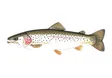
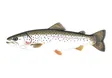
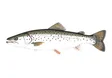
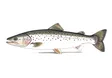
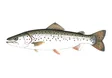
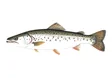
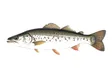
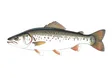
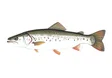
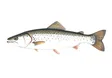
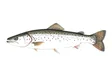
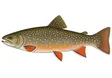
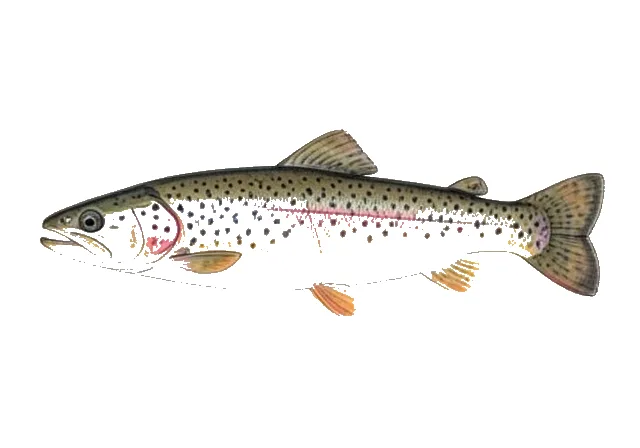
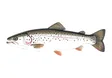
Apache Trout field guide illustration

About Apache Trout

The Apache trout or Arizona trout (Oncorhynchus apache), is a species of freshwater fish in the salmon family (family Salmonidae) of order Salmoniformes. It is closely related to Gila trout and is one of the critically endangered Pacific trouts.

Description

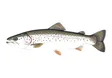
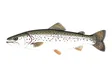
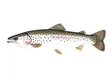
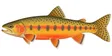
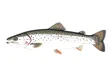
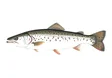
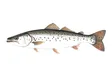
The Apache trout measures in length from 6 to 24 in (15–61 cm), and weighs between 0.4 to 6 lb (0.2–2.7 kg). It rarely exceeds 10 in (25 cm), but can reach up to 16 in (40 cm) in its native, headwater streams. Apache trout are a yellowish-gold color with a golden belly and have medium-sized dark spots that are evenly spaced and that may extend below the lateral line and onto the dorsal and tail fins. The top of its head and back are dark olive in color, and it has the appearance of having a black stripe/mask through each of its eyes, due to two small black dots on either side of the pupil. There can be a throat mark below the lower jaw, ranging in color from yellow to gold.

Distribution

The Apache trout is the state fish of Arizona, and is one of only two species of trout native to that state, with the other being closely related the gila trout (O. g. gilae). It natively lives in clear, cool streams in the White Mountains that flow through coniferous forests and marshes, but has been introduced into several lakes in the area. The Apache trout is native to the upper Salt River watershed (Black and White rivers) and the upper Little Colorado River watershed. Apache trout have been introduced into isolated streams outside of their historic range in the Pinaleño Mountains and the North Rim of the Grand Canyon. Apache trout exist in their most pure form within headwater streams at an elevation of 2,100 meters (6,900 feet) or higher in the White Mountain Apache Reservation.

Life history

The Apache trout spawns from March to the middle of June, and varies with elevations. Maturity was found to occur in three years, and fecundity is based on the size of trout. One female typically produces from 72 to 240 eggs in 13.1 to 19.1 cm (5.2 to 7.5 in) fish and from 646 to 1,083 eggs in 29.8 to 34.9 cm (11.7 to 13.7 in) fish. The eggs hatch after 30 days. The Apache trout eats both terrestrial and aquatic insects, such as Trichoptera and Diptera. In lakes, they also eat small fishes and zooplankton.

Conservation

Recovery and management efforts for Apache trout have been ongoing since the 1940s. Apache trout are raised in federal and state hatcheries, and reared fish have been used to assist with recovery and to maintain populations for sport fishing in certain streams and reservoirs.

While the IUCN considers the Apache trout to be critically endangered, it has been delisted under the Endangered Species Act. Around 100 years ago, they could be found in 600 miles (970 km) of streams in the White Mountains. By the late 1960s, their range had been reduced to around 30 miles (48 km) of these streams. Once the Endangered Species Act of 1969 was passed, they became one of the first species listed under it. When this act was replaced by the Endangered Species Act of 1973, they became one of the first fish species protected under the newer Act. Population numbers for this species are still rising.

Today, major risks to the Apache trout are its easy hybridization with the rainbow trout and major forest fires. Cutthroat trout are also genetically similar and cross-breed with Apache trout, compromising the genetic purity of each species. The range of the Apache trout remains limited, which puts it at risk, but it is now common enough that limited fishing is permitted.

Ongoing conservation efforts by the White Mountain Apache Tribe have helped to preserve the subspecies.

Many of the Mount Baldy headwater streams that are the stronghold of Apache trout are entirely closed to fishing. Catch and release fishing opportunities for wild (stream born), pure-strain Apache trout exist in a limited number of areas. Additionally, there are numerous consumptive fishing opportunities for Apache trout in waters where natural reproduction is not occurring and the Apache trout population is the result of stocking efforts.

The 2011 Wallow Fire resulted in the loss of stream barriers erected to prevent hybridization and the extirpation of Apache trout from Coleman Creek and likely of hybridized populations elsewhere, while the 2017 Frye Fire destroyed a stocked population in Ash Creek in the Pinaleño Mountains. Climate change causing rising temperatures and increasing frequency and intensity of wildfires threatens the existence of Apache trout.

Article text: Wikipedia contributors, Apache trout (source revision). Licensed under CC BY-SA 4.0. Retrieved 2026-10-11.
Identification and appearance

Apache Trout have a short, stocky body that is moderately compressed and a yellowish golden coloration with dark olive on the head and dorsal (back) (Behnke 2002; Minckley and Marsh 2009). The dorsal, pelvic, and anal fins have white tips, along with a yellow, orange, or watery orange cut-throat mark (Minckley and Marsh 2009). Parr marks along the side are absent or reduced in all life stages (Behnke 2002). Apache trout are similar in coloration to the Gila trout (Oncorhynchus gilae), however, the yellowish coloration is restricted to the ventral region of the Apache trout (Behnke 2002). Additionally, the Apache Trout have larger and fewer spots compared to the Gila Trout. Pure strain Apache Trout have black pigment spots in front of and just behind the pupil, like a mask, but this trait is absent from many hatchery-raised fishes (Behnke 2002). In comparison to other western trout, the Apache trout has a larger dorsal fin.

Native range

Apache Trout historically occupied streams and rivers in the upper White, Black, and Little Colorado River drainages in the White Mountains of east-central Arizona (Arizona Game and Fish Department 2009).

Habitat and ecology

Apache Trout require clean coarse gravel substrates for spawning and prefer cover in the form of woody debris, pools, coarse substrate such as gravel, cobble, and boulders, undercut stream-banks or overhanging vegetation at stream edges (Arizona Game and Fish Department 2009). Spawning occurs in the spring (May) when water temperatures are rising and snow runoff into streams is lower. Temperature seems to be the critical factor to the initiation of spawning. Females lay between 70 -300 eggs based on body size (Behnke 2002).

Widely stocked non-native trout species have impacted the Apache Trout. Brown Trout (Salmo trutta) and Brook Trout (Salvelinus fontinalis) devour eggs, fingerling, and parr and out-compete Apache Trout for food and space. Rainbow Trout (Oncorhynchus mykiss) and Cutthroat Trout (Oncorhynchus clarkii) will also predate on Apache Trout and hybridize with them (Arizona Game and Fish Department 2009; Minckley and Marsh 2009).

Introduction history

Stocked outside the native range for conservation efforts (Minckley and Marsh 2009).

Ecological impacts

As of yet, this species has not been adequately studied or evaluated to determine what ecological consequences, if any, have resulted from its introduction into the U.S. or elsewhere. To better understand and adequately assess the possible types and magnitude of any suspected ecological and economic impacts would most likely require further field and laboratory research, along with a review of any possible new literature on the subject.

Statute

The official state fish of Arizona

A state fish is chosen by statute. It says nothing about how common the fish is in the state. See every official state fish.

Range

Where it lives

Share of 307 GBIF observation records with a state location, across 5 states.
0%
82.7%
Share of 307 GBIF observation records with a state location, across 5 states.

Habitat

Water and movement

Water
WoRMS records this species in fresh water.
USGS NAS habitat
Freshwater
US status
Native transplant — native to part of the United States, moved to other waters inside it.

Classification

Taxonomy

Kingdom
Animalia
Phylum
Chordata
Superclass
Actinopterygii
Class
Teleostei
Order
Salmoniformes
Genus
Oncorhynchus
Species
Oncorhynchus apache
ITIS TSN
161981
WoRMS AphiaID
1013114
GBIF key
5204012

Common questions about Apache Trout

What is the scientific name of Apache Trout?
The scientific name is Oncorhynchus apache, in the family Salmonidae. Classification follows ITIS.
Does Apache Trout live in fresh water or salt water?
WoRMS records this species in fresh water.
Where has Apache Trout been recorded in the United States?
GBIF has observations in 5 states, with the most records in Arizona, Tennessee, California. The map shows observation records, which do not establish the complete natural range.

Closest relatives

Other Oncorhynchus species

Same family

More Salmonidae

Alaska Whitefish1 states
Coregonus nelsoniiSalmonidaeNativeFresh
Arctic Char8 states
Salvelinus alpinusSalmonidaeNative and introducedFreshSaltBrackish
Arctic Cisco1 states
Coregonus autumnalisSalmonidaeNativeFreshSaltBrackish
Arctic Grayling16 states
Thymallus arcticusSalmonidaeNative and introducedFresh
Atlantic Salmon26 states
Salmo salarSalmonidaeNative and introducedFreshSaltBrackish
Bear Lake Whitefish2 states
Prosopium abyssicolaSalmonidaeNativeFresh
Bering Cisco1 states
Coregonus laurettaeSalmonidaeNativeFreshSaltBrackish
Blackfin Cisco6 states
Coregonus nigripinnisSalmonidaeNativeFresh
Bloater6 states
Coregonus hoyiSalmonidaeNativeFresh
Bonneville Cisco2 states
Prosopium gemmiferSalmonidaeNativeFresh
Bonneville Whitefish2 states
Prosopium spilonotusSalmonidaeNativeFresh
Broad Whitefish1 states
Coregonus nasusSalmonidaeNativeFreshBrackish
Brook Trout40 states
Salvelinus fontinalisSalmonidaeNative and introducedFreshSaltBrackish
Brown Trout41 states
Salmo truttaSalmonidaeIntroducedFreshSaltBrackish
Bull Trout8 states
Salvelinus confluentusSalmonidaeNativeFreshBrackish
Chinook Salmon18 states
Oncorhynchus tshawytschaSalmonidaeNative and introducedFreshSaltBrackish
Chum Salmon5 states
Oncorhynchus ketaSalmonidaeNativeFreshSaltBrackish
Cisco11 states
Coregonus artediSalmonidaeNative and introducedFreshSaltBrackish
Coho Salmon22 states
Oncorhynchus kisutchSalmonidaeNative and introducedFreshSaltBrackish
Cutthroat Trout18 states
Oncorhynchus clarkiiSalmonidaeNative and introducedFreshSaltBrackish
Deepwater Cisco3 states
Coregonus johannaeSalmonidaeNativeFresh
Dolly Varden9 states
Salvelinus malmaSalmonidaeNativeFreshSaltBrackish
Gila Trout2 states
Oncorhynchus gilaeSalmonidaeNative and introducedFresh
Golden Trout8 states
Oncorhynchus aguabonitaSalmonidaeNativeFresh

All 44 species in Salmonidae