Bloater

Coregonus hoyi

Salmonidae · freshwater water fish

6 minute read · Species guide

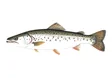
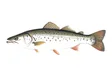
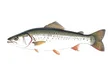
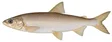
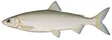
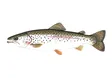
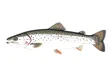
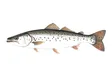
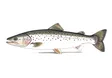
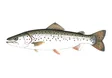
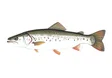
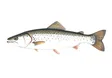
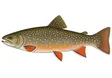
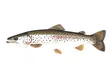
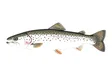
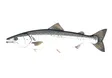
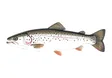
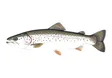
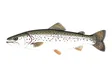
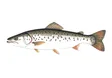
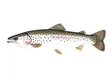
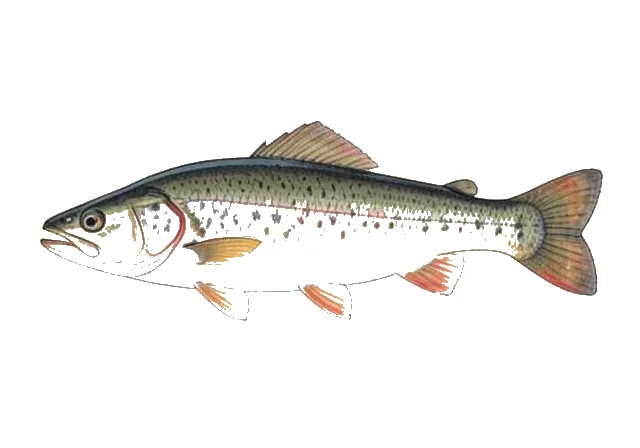
Bloater field guide illustration

About Bloater

Coregonus hoyi, also known as the bloater, is a species or form of freshwater whitefish in the family Salmonidae. It is a silvery-coloured herring -like fish, 25.5 centimetres (10.0 in) long. It is found in most of the Great Lakes and in Lake Nipigon, and inhabits underwater slopes. This fish is not to be confused with the extinct deepwater cisco (Coregonus johannae), a large fish that shared a common name with the bloater.

Description

The bloater is a small, silvery-coloured whitefish with a pink and purple iridescence. It has a greenish tinge above, and a whitish belly. It is very similar to the kiyi, from which it may be distinguished by its lighter upper lip and smaller eye. Its body is deepest at its middle, it has small and pale fins, and it has 40–47 long gill rakers. The discoverer of the bloater, P. R. Hoy, thought it to be "the most beautiful of the white fish". It reaches a maximum total length of 37.0 centimetres (14.6 in) and commonly is 25.5 centimetres (10.0 in).

Distribution

The bloater is native to all of the Great Lakes (except Lake Erie) and in Lake Nipigon. Across its range it is in decline, and it is listed as Vulnerable to global extinction by the IUCN Red List. It was extirpated in Lake Ontario and is extirpated in Lake Nipigon, is uncommon in Lake Michigan and is in decline Lakes Superior and Huron. This decline is caused mostly by predation by the alewife, and also by sea lamprey predation and pollution.

However, efforts to re-introduce the species in to Lake Ontario have been met with great success. Multiple North American fishery agencies have aided in the bloater's return to the lake, due to the positive impact it could have on its food web. Recent studies have shown that this fish has made a surprising comeback, and it is now re-established in Lake Ontario. State, provincial and federal agencies aim to stock 500,000 Coregonus hoyi into Lake Ontario by the year 2015.

Taxonomy and etymology

The specific epithet of the bloater is given after Dr. P. R. Hoy of Racine, Wisconsin. Dr. Hoy collected the first specimens of this species in 1870 while dredging in Lake Michigan at least 16 miles (14 nmi; 26 km) off Racine, at depths of 50 to 70 fathoms (300 to 420 ft; 91 to 128 m). Hoy did not describe the fish himself, but had ichthyologist James W. Milner name the species. Milner placed it in the genus Argyrosomus, now considered a junior synonym of Coregonus, the genus in which the bloater is now placed. The generic name Coregonus, given by Carl Linnaeus in his 1758 tenth edition of Systema Naturæ, is derived from Greek and means "angled eye", referring to the tilted pupil of whitefishes. It is closely related to the cisco or lake herring, Coregonus artedi, and the shortjaw cisco, both of which it is known to hybridise with. The common name of the bloater comes from the swollen appearance it has after being brought up from the deep waters it inhabits. The same name is given to certain type of smoked herring in Britain, which is swelled in its preparation. The bloater is one of the several taxa in the Coregonus artedi complex of freshwater whitefishes, which sometimes all are considered to belong to a single species.

Ecology and behaviour

The bloater is found at depths of 30 to 198 metres (98 to 650 ft). There it inhabits underwater slopes, and is tolerant of temperatures between 34.7 and 52.4 degrees Fahrenheit (1.5 to 11.4 Celsius). When it is brought to the surface its gas bladder expands, giving it a swollen appearance.

The bloater feeds mostly on animals living at the lake bottom (zoobenthos), but will sometimes eat small drifting animals, or zooplankton. The shrimp Mysis diluviana, and the amphipod Diporeia hoyi, also named after P. R. Hoy, are recorded as food items. The lake trout, various species of introduced salmon, and the burbot all are known to prey on the bloater. In the nineteenth century it was abundant, and was often caught by fishermen, among whom it was known as the "moon-eye". It was considered a good panfish, but too small to be marketable. Since most of the other "chubs" of the Great Lakes have become extinct, the average size of the bloater has increased, and it is caught and smoked in the United States. The bloater is ignored by sport fishermen, since it is small and found at great depths, and it has too small of a mouth to be used as bait.

Spawning occurs all year round, but is usually in the winter or autumn. Spawning occurs at depths of 37 to 92 metres (121 to 302 ft). The amount of eggs produced by the female varies depending upon her size, and ranges between 3,230 and 18,768. Eggs incubate for 4 months, and bloaters are 1.01 centimetres (0.40 in) in length at hatching. Larval bloaters head to the cool bottom of lakes before becoming pelagic, and by their first summers they become bottom-dwellers. Larval bloaters have a high mortality until they become large enough to avoid predation by other bloaters and alewives. It is slow-growing, because of the scarcity of food in its habitat. The bloater's average length at maturity is 18.3 centimetres (7.2 in), and maximum age reported from otoliths is 10 years.

Article text: Wikipedia contributors, Coregonus hoyi (source revision). Licensed under CC BY-SA 4.0. Retrieved 2026-10-11.
Diet and feeding

The FishTraits compilation records these diet categories for this species: invertebrates or larval fish; larger animal prey (a source category covering fish, crayfish, crabs, or frogs); fish or frog eggs. These are broad categories, not a claim that every individual consumes every example in a category.

Reported feeding positions include bottom feeding and surface or water-column feeding. The compilation combines published observations; diets can vary with age, locality, and available food.

Habitat preferences

Reported habitat associations include still-water habitats.

The source records associations with open water. An association indicates reported use, rather than an exclusive requirement.

Reproduction and parental care

The compilation reports a representative maturity age of 2 years. Its maturity field summarizes mean, median, or modal estimates, usually for females; male estimates can be used when female data are unavailable. It is not a fixed age at which every fish first breeds.

Recorded spawning months are Feb, Mar for the source’s reporting region (Lake Huron). This is a regional calendar, not a range-wide schedule.

The reproductive-guild classification includes spawning on open substrates without guarding the brood.

Size and recorded longevity

FishTraits reports a maximum total length of 36.6 centimetres. Some entries use an estimated asymptotic length; this value should not be treated as a certified record catch.

Recorded longevity in the compilation is 11 years. Wild observations were preferred, but captive records were accepted where wild records were unavailable, and unspecified records were assumed wild. The value is not a guaranteed wild lifespan or an aquarium life expectancy.

Range

Where it lives

Share of 692 GBIF observation records with a state location, across 6 states.
0%
35.1%
Share of 692 GBIF observation records with a state location, across 6 states.

Habitat

Water and movement

Water
WoRMS records this species in fresh water.
Migration
Undetermined
Pattern
Disagreement
2 published references do not agree on the pattern: Non-migratory, Potamodromous. The site shows every assignment rather than picking one.

Classification

Taxonomy

Kingdom
Animalia
Phylum
Chordata
Superclass
Actinopterygii
Class
Teleostei
Order
Salmoniformes
Genus
Coregonus
Species
Coregonus hoyi
ITIS TSN
623394
WoRMS AphiaID
1049459
GBIF key
2351195
Outside the US
ITIS also files it in Canada.

Common questions about Bloater

What is the scientific name of Bloater?
The scientific name is Coregonus hoyi, in the family Salmonidae. Classification follows ITIS.
Does Bloater live in fresh water or salt water?
WoRMS records this species in fresh water.
Where has Bloater been recorded in the United States?
GBIF has observations in 6 states, with the most records in Michigan, Wisconsin, New York. The map shows observation records, which do not establish the complete natural range.

Closest relatives

Other Coregonus species

Same family

More Salmonidae

Alaska Whitefish1 states
Coregonus nelsoniiSalmonidaeNativeFresh
Apache Trout5 states
Oncorhynchus apacheSalmonidaeNativeFresh
Arctic Char8 states
Salvelinus alpinusSalmonidaeNative and introducedFreshSaltBrackish
Arctic Cisco1 states
Coregonus autumnalisSalmonidaeNativeFreshSaltBrackish
Arctic Grayling16 states
Thymallus arcticusSalmonidaeNative and introducedFresh
Atlantic Salmon26 states
Salmo salarSalmonidaeNative and introducedFreshSaltBrackish
Bear Lake Whitefish2 states
Prosopium abyssicolaSalmonidaeNativeFresh
Bering Cisco1 states
Coregonus laurettaeSalmonidaeNativeFreshSaltBrackish
Blackfin Cisco6 states
Coregonus nigripinnisSalmonidaeNativeFresh
Bonneville Cisco2 states
Prosopium gemmiferSalmonidaeNativeFresh
Bonneville Whitefish2 states
Prosopium spilonotusSalmonidaeNativeFresh
Broad Whitefish1 states
Coregonus nasusSalmonidaeNativeFreshBrackish
Brook Trout40 states
Salvelinus fontinalisSalmonidaeNative and introducedFreshSaltBrackish
Brown Trout41 states
Salmo truttaSalmonidaeIntroducedFreshSaltBrackish
Bull Trout8 states
Salvelinus confluentusSalmonidaeNativeFreshBrackish
Chinook Salmon18 states
Oncorhynchus tshawytschaSalmonidaeNative and introducedFreshSaltBrackish
Chum Salmon5 states
Oncorhynchus ketaSalmonidaeNativeFreshSaltBrackish
Cisco11 states
Coregonus artediSalmonidaeNative and introducedFreshSaltBrackish
Coho Salmon22 states
Oncorhynchus kisutchSalmonidaeNative and introducedFreshSaltBrackish
Cutthroat Trout18 states
Oncorhynchus clarkiiSalmonidaeNative and introducedFreshSaltBrackish
Deepwater Cisco3 states
Coregonus johannaeSalmonidaeNativeFresh
Dolly Varden9 states
Salvelinus malmaSalmonidaeNativeFreshSaltBrackish
Gila Trout2 states
Oncorhynchus gilaeSalmonidaeNative and introducedFresh
Golden Trout8 states
Oncorhynchus aguabonitaSalmonidaeNativeFresh

All 44 species in Salmonidae