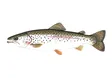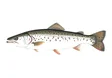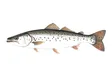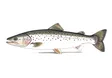
Taxonomy
The scientific name of the Dolly Varden is Salvelinus malma. The species was originally named by German naturalist and taxonomist Johann Julius Walbaum in 1792 based on type specimens from the Kamchatka Peninsula in Siberia. The name malma was based on Russian мальма, the local colloquial name for the fish. The Dolly Varden trout is considered part of the S. alpinus or Arctic char complex.
For most of the 19th and 20th centuries, the Dolly Varden trout (S. malma) and the bull trout (S. confluentus) were considered the same species. Additionally, the Arctic char (S. alpinus) along with the bull trout have ranges that overlap and are remarkably similar in appearance, thus complicating identification. In 1978, inland forms of the Dolly Varden trout were reclassified as Salvelinus confluentus, retaining the common name bull trout. It appears that the first recorded use of the Dolly Varden name for fish referred to S. confluentus, now commonly known as the bull trout. This was likely due to overlapping ranges and similar appearances among members of the two species.
Subspecies
In North America, two subspecies of Dolly Varden are distinguished, the Northern Dolly Varden (S. m. malma) of the Arctic drainages and the Southern Dolly Varden (S. m. lordi) of the Pacific drainages. These can be distinguished as separate mitochondrial lineages also. The status of the Beringian drainage populations remains unclear. Northern populations on the Russian side of the Pacific down to Kamchatka are considered S. m. malma, and the southerly populations make another lineage and subspecies, the Asian Dolly Varden (or southern Dolly Varden) S. m. krascheninnikova (= S. curilus). The landlocked Miyabe Char (S. m. miyabei Oshima, 1938) from Lake Shikaribetsu on Hokkaido in Japan is also included in the Dolly Varden species.
The angayukaksurak char (formerly Salvelinus anaktuvukensis) of northern Alaska was described as a distinct species on morphological grounds by Morrow in 1973, but the concept of a separate species status was soon refuted, even by Morrow himself. Further genetic studies have also failed to distinguish this fish from the more widespread Dolly Varden trout (Salvelinus malma malma), and it is now considered to represent natural variation within that subspecies.
Origin of common name "Dolly Varden"
The first recorded use of the name "Dolly Varden" was applied to members of S. confluentus caught in the McCloud River in northern California in the early 1870s. In his book Inland Fishes of California, Peter B. Moyle recounts a letter sent to him on March 24, 1974, from Valerie Masson Gomez:
In 1874, Livingston Stone, a naturalist working for the U.S. government, wrote of this fish:
Although the name "Dolly Varden"was originally given to the bull trout of the McCloud River, bull trout (S. confluentus) and Dolly Varden trout (S. malma) were considered the same species (S. malma) until 1978. Thus the common name"Dolly Varden" gained acceptance for S. malma for over 100 years. Additionally, the Arctic char (S. alpinus) and Russian subspecies have been referred to as Dolly Varden. It is known as belyi golets in Russian.
Description
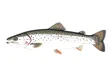
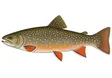
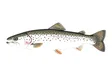
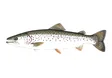
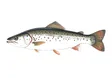
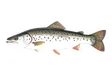
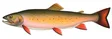
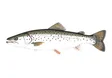
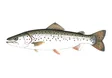
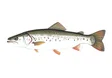
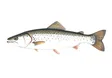
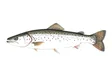
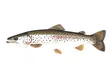
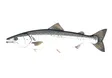
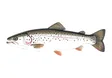
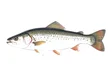
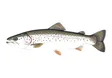
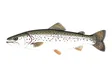
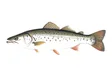
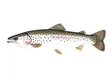
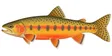
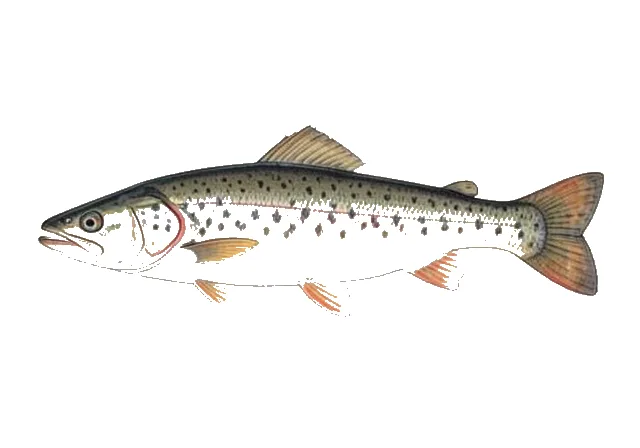
The back and sides are olive green or muddy gray, shading to white on the belly. The body has scattered pale yellow or pinkish-yellow spots. There are no black spots or wavy lines on the body or fins. Small red spots are present on the lower sides. These are frequently indistinct. The fins are plain and unmarked except for a few light spots on the base of the caudal fin rays. S. malma is extremely similar in appearance to the bull trout (S. confluentus) and Arctic char (S. alpinus), so much so that they are sometimes referred to as "native char" without a distinction.
Range
The Dolly Varden trout is found in coastal waters of the North Pacific from Puget Sound north along the British Columbia Coast to the Alaska Peninsula and into the eastern Aleutian Islands, along the Bering Sea and the Arctic Sea to the Mackenzie River. The range in Asia extends south through the Kamchatka Peninsula into northern Japan.
Life cycle
Dolly Varden are found in three distinct forms. A semi-anadromous or sea-run form migrates from fresh water and spends some time in the ocean or saltwater bays and estuaries to feed before returning to fresh water to spawn. Fluvial forms live in moderate to large freshwater riverine environments and migrate into smaller tributaries to spawn. A third form is found in deep, cold lakes, from where they eventually migrate into tributary streams to spawn. Most populations of the northern Dolly Varden (S. m. malma) are semi-anadromous, while more fluvial and lacustrine populations are found among the southern Dolly Varden (S. m. lordi).
Conservation
In the early 20th century, the Dolly Varden (still including bull trout, and often confused with Arctic char) suffered from a reputation as an undesirable predator of fish such as salmon, steelhead and cutthroat trout. Despite co-evolving with these other species for thousands of years, Dolly Varden were accused of indiscriminately feeding on eggs and fry of other species to their detriment. Between 1921 and 1941, the Territory of Alaska, supported by the U.S. Bureau of Fisheries, had an official extermination program that paid bounties on Dolly Varden. In the Iliamna Lake / Kvichak River region in southwest Alaska, the bounty was 2.5 cents per Dolly Varden tail turned into the territorial tax collector. Locals would trap Dolly Varden in nets and weirs, string 40 tails on a hoop of bailing wire and smoke them over a wood fire. One hoop would be worth one dollar. The fish carcasses would be used for dog food. The hoops of fishtails were then used as currency to pay for supplies, or in some reports, airfare with local bush pilots.
The northern Dolly Varden in the Canadian province of British Columbia and in the federal region of the Northwest Territories is listed as a species of special concern.
Fishing
The Dolly Varden is considered and regulated as a game fish in the U.S. and Canada. Dolly Varden make up a sizable percentage of the catch in Alaskan subsistence fisheries where salmon are not abundant. Anglers will use a variety of lures to catch Dolly Varden, but when fishing during salmon spawning season, salmon roe is the bait of choice.
Article text: Wikipedia contributors, Dolly Varden trout (source revision). Licensed under CC BY-SA 4.0. Retrieved 2026-10-11.