Coho Salmon

Oncorhynchus kisutch

Salmonidae · freshwater and saltwater and brackish water fish

15 minute read · Species guide

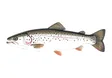
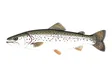
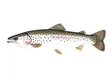
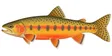
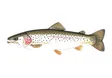
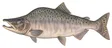
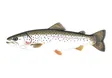
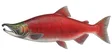
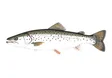
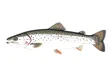
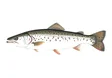
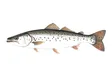
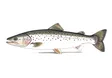
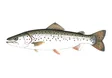
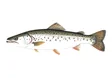
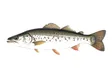
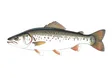
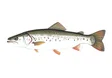
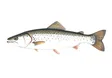
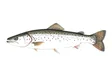
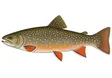
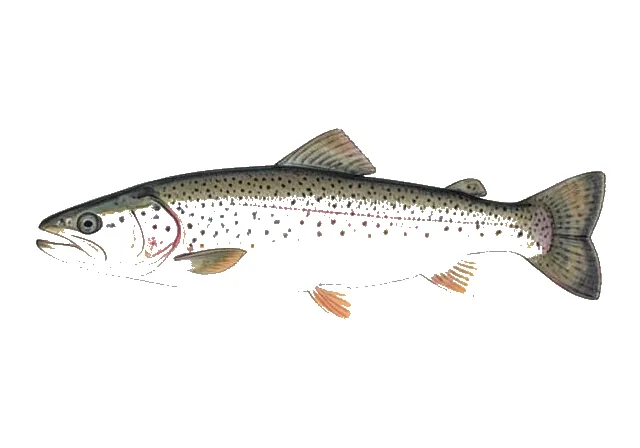
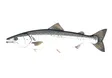
Coho Salmon field guide illustration

About Coho Salmon

The coho salmon (Oncorhynchus kisutch) is a species of anadromous fish in the salmon family and one of the six Pacific salmon species. Coho salmon are also known as silver salmon (or "silvers") and is often sold as medium red salmon. "Coho" was borrowed into English from the word k̓ʷə́xʷəθ, the species' name in the downriver dialect of the Halkomelem language spoken in Vancouver. The scientific species name is based on the Russian common name kizhuch (кижуч).

Description

During their ocean phase, coho salmon have silver sides and dark-blue backs with spots on their back and upper tail lobe. During their spawning phase, their jaws and teeth become hooked. After entering fresh water, they develop bright-red sides, bluish-green heads and backs, dark bellies and dark spots on their backs. Sexually maturing fish develop a light-pink or rose shading along the belly, and the males may show a slight arching of the back. Mature adults have a pronounced red skin color with darker backs and spots, with females having darker shades than males.

Coho salmon average 20 to 28 inches (50.8 to 71 cm) and 7 to 11 pounds (3.2 to 5.0 kg), occasionally reaching up to 36 pounds (16 kg). Size can vary depending on age and geographic location. Males tend to be slightly larger than females. Mature adults also develop a large kype (hooked beak) which is used to attract a mate during spawning, with males having a more pronounced kype than females. The coho salmon's lower jaw can be distinguished by a light shade at its superior edge.

Reproduction

Once the mature coho has reached three or four years old, it swims up freshwater rivers and streams to spawn. Coho will swim up streams as far as they are physically able, usually reaching areas of water as little as 5 centimetres (2.0 in) deep. Females seek out beds of gravel at the head of a riffle, where they turn on their sides to dig a nest with movements of their tail, creating round or oval depressions roughly the same lengths and width as the fish. This process is repeated for up to seven nests, each called a redd. Females become extremely aggressive with each other over nesting sites, and with males until these are dug. Males then fight for the right to mate. Once a female has chosen a mate, usually the largest male, she lays her eggs onto the redd, while he simultaneously releases milt (sperm) onto the eggs. Unchosen males also sneak in to release milt at this time. Once all eggs are laid, she covers them with rocks and pebbles using her tail. The adults then begin semelparity, whereby they stop eating and deteriorate to death.

Life stages

The eggs hatch in the late winter or early spring after six to seven weeks in the redd. Once hatched, they remain mostly immobile in the redd during the alevin life stage, which also lasts for six to seven weeks. Alevin no longer have the protective egg shell, or chorion, and rely on their yolk sacs for nourishment during growth. The alevin life stage is very sensitive to aquatic and sedimental contaminants. When the yolk sac is completely resorbed, the alevin leaves the redd. Young coho spend one to two years in their freshwater natal streams, often spending the first winter in off-channel sloughs, before transforming to the smolt stage. Smolts are generally 100–150 mm (3.9–5.9 in) and as their parr marks fade and the adult's characteristic silver scales start to dominate. Smolts migrate to the ocean from late March through July. Some fish leave fresh water in the spring, spend summer in brackish estuarine ponds, and then return to fresh water in the fall. Coho salmon live in salt water for one to three years before returning to spawn. Some precocious males, known as "jacks", return as two-year-old spawners. Spawning males develop kypes, which are strongly hooked snouts and large teeth.

Range

The traditional range of the coho salmon runs along both sides of the North Pacific Ocean, from Hokkaidō, Japan and eastern Russia, around the Bering Sea to mainland Alaska, and south to Monterey Bay, California. Coho salmon have also been introduced in all the Great Lakes, as well as many landlocked reservoirs throughout the United States. Coho salmon were first introduced in Lake Erie in the 1920s to control the lake's alewife population. Large-scale stocking began in 1966, when 660,000 fingerlings were introduced in Lake Michigan. Wisconsin began a program of introduction of 500,000 fry a year, mainly on the coastline of Lake Michigan. By 1970, the species was present in all of the Great Lakes. Ontario and Minnesota adopted stocking programs in 1969, but later abandoned them. Colorado began stocking coho salmons in the early 1900s, although only limited reproduction is recorded in the Colorado River. Another stocking was done in New Hampshire in the late 1960s, which dispersed to Maine and Massachusetts and were recorded to engage in sporadic reproduction.

Natural reproduction in introduced areas is generally low. Limited self-sustaining populations are recorded in Lake Superior and Michigan, but the salmon does not reproduce naturally in the Wisconsin tributaries of Lake Michigan and relies on stocking to maintain a large population. The species is no longer stocked in Lake Erie, although stray individuals from elsewhere in the Great Lakes are caught on occasion. Efforts to establish the species in Connecticut began in the 1800s, but were discontinued when the species failed to establish a stable population. Introductions in Connecticut and Delaware also failed to found permanent populations.

Over twenty specimens were caught in waters surrounding Denmark and Norway in 2017. Their source is currently unknown, but the salmon species is farmed at several locations in Europe, making it probable that the animal has slipped the net at such a farm.

Ecology

In their freshwater stages, coho feed on plankton and aquatic invertebrates in the benthos and water column, such as Chironomids, midge larvae, and terrestrial insects that fall into the water. Upon entering the marine environment, they switch to a diet of plankton and fish, with fish making up most of their diets after a certain size. Introduced populations in the Great Lakes feed primarily on alewife and smelt. Great Lakes salmon are known to compete with native lake trout, brook trout, and brown trout for food and space when resources are scarce. Due to emerging earlier and having a larger hatching size, coho salmon typically have an advantage in these confrontations.

Salmonid species on the west coast of the United States have experienced dramatic declines in abundance during the past several decades as a result of human-induced and natural factors.

Fisheries

The total North Pacific harvest of coho salmon in 2010 exceeded 6.3 million fish, of which 4.5 million were taken in the United States and 1.7 million in Russia. This corresponds to some 21,000 tonnes in all. Coho salmon are the backbone of the Alaskan troll fishery, though the majority are caught by the net fishery (gillnet and seine fishing). They average 3.5% by fish and 5.9% by weight of the annual Alaska salmon harvest. The North Pacific yields of pink salmon, chum salmon and sockeye salmon are about 15 times larger by weight.

Game fish

In North America, coho salmon is a game fish in fresh and salt water from July to December, especially with light fishing tackle. It is one of the most popular sport fish in the Pacific Northwest of the United States and Canada. Its popularity is due in part to the reckless abandon which it frequently displays chasing bait and lure while in salt water, and the large number of coastal streams it ascends during its spawning runs. Its habit of schooling in relatively shallow water, and often near beaches, makes it accessible to anglers on the banks, as well as in boats.

Nutritional value

Ocean-caught coho is regarded as excellent table fare. It has a moderate to high amount of fat, which is considered to be essential when judging taste. Only spring chinook and sockeye salmon have higher levels of fat in their meat. When smoking coho it is best to use a cold-smoking rather than hot-smoking process, due to their lower fat content compared to sockeye and chinook.

Cultural tradition

Historically coho, along with other species, has been a staple in the diet of several indigenous peoples, who would also use it to trade with other tribes farther inland. The coho salmon is also a symbol of several tribes, representing life and sustenance.

Conservation

The U.S. National Marine Fisheries Service (NMFS) has identified seven populations, called Evolutionary Significant Units (ESUs), of coho salmon in Washington, Oregon and California. Four of these ESUs are listed under the U.S. Endangered Species Act (ESA). These are the Lower Columbia River (threatened), Oregon Coast (threatened), Southern Oregon and Northern California Coasts (threatened), and Central California Coast (endangered). The long-term trend for the listed populations is still downward, though there was one recent good year with an increasing trend in 2001.

The Puget Sound / Strait of Georgia ESU in Washington is an NMFS "Species of Concern". Species of Concern are those species for which insufficient information prevents resolving the U.S. National Oceanic and Atmospheric Administration's concerns regarding status and threats and whether to list the species under the ESA.

On May 6, 1997, NMFS, on behalf of the Secretary of Commerce, listed as threatened the Southern Oregon/Northern California Coast coho salmon ESU. The coho salmon population in the Southern Oregon/Northern California region has declined from an estimated 150,000–400,000 naturally spawning fish in the 1940s to fewer than 10,000 naturally producing adults today. These reductions are due to natural and man-made changes, including short-term atmospheric trends (such as El Niño, which causes extremes in annual rainfall on the northern California coast), predation by the California sea lion and Pacific harbor seal, and commercial timber harvesting.

More than 680,000 coho salmon returned to Oregon in 2009, double that of 2007. The Oregon Department of Fish and Wildlife required volunteers to herd fish into hatchery pens. Some creeks were reported to have so many fish, "you could literally walk across on the backs of coho," claimed a Portland television station. Lower temperatures in 2008 North Pacific waters brought in fatter plankton, which, along with greater outflows of Columbia River water, fed the resurgent populations. The 2009 run was so large, food banks were able to freeze 40 tonnes (39 long tons; 44 short tons) for later use.

Article text: Wikipedia contributors, Coho salmon (source revision). Licensed under CC BY-SA 4.0. Retrieved 2026-10-11.
Diet and feeding

The FishTraits compilation records these diet categories for this species: invertebrates or larval fish; larger animal prey (a source category covering fish, crayfish, crabs, or frogs). These are broad categories, not a claim that every individual consumes every example in a category.

Reported feeding positions include surface or water-column feeding. The compilation combines published observations; diets can vary with age, locality, and available food.

Habitat preferences

Reported habitat associations include medium to large rivers, streams and small rivers, creeks, still-water habitats.

The source records associations with gravel, open water. An association indicates reported use, rather than an exclusive requirement.

The species is classified as tolerant of a broad range of salinities. This flag does not specify a salinity range for aquarium care.

Reproduction and parental care

The compilation reports a representative maturity age of 3 years. Its maturity field summarizes mean, median, or modal estimates, usually for females; male estimates can be used when female data are unavailable. It is not a fixed age at which every fish first breeds.

Recorded spawning months are Oct, Nov, Dec for the source’s reporting region (WI). This is a regional calendar, not a range-wide schedule.

The reproductive-guild classification includes hiding a brood without subsequent guarding.

Size and recorded longevity

FishTraits reports a maximum total length of 108 centimetres. Some entries use an estimated asymptotic length; this value should not be treated as a certified record catch.

Recorded longevity in the compilation is 4 years. Wild observations were preferred, but captive records were accepted where wild records were unavailable, and unspecified records were assumed wild. The value is not a guaranteed wild lifespan or an aquarium life expectancy.

Spawning movements

The compilation records significant spawning-related movement. Its combined migration flag covers movements within fresh water as well as between rivers and the sea; this flag alone does not establish which migration pattern applies.

Native range

Arctic and Pacific drainages from Point Hope, Alaska, to Monterey Bay, California, infrequently as far south as Chamalu Bay, Baja California. Also in northeastern Asia (Page and Burr 1991).

Habitat and ecology

Once stocked in the Great Lakes, coho salmon grow rapidly, feeding mainly on alewife and smelt. After less than two years in the lake they mature and begin their autumn spawning migration to the streams in which they were planted. At this time in their life they become darker colored and the male develops a hooked jaw and a slightly humped back. Eggs for the hatcheries are collected during the upstream migration because there is no natural reproduction of cohos in the Lake Michigan tributaries of Wisconsin. Thus, the stocking program is essential to maintain the salmon fishing in Lake Michigan. Great Lakes coho migrate from their natal river in search of food and due to changes in temperature. Warmer temperatures drive the fish to the deeper cooler areas of lakes, and feeding fish are also located there.

Introduction history

Introductions of coho salmon as sport fish began as early as the 1920s. The coho was introduced into the Great Lakes to control the alewife population (Eddy and Underhill 1974). The first stocking in the Great Lakes was in Lake Erie in 1933 by the Ohio Division of Conservation (Parsons 1973). The first large planting in the Great Lakes occurred in 1966 in Lakes Michigan and Superior. The species had been stocked in all the Great Lakes by 1970 (Parsons 1973). A total of 16 million fish had been stocked in the Great Lakes between 1966 and 1970 (Parsons 1973). Fish intentionally stocked into coastal New Hampshire in the late 1960s dispersed to Maine and Massachusetts (Stolte 1974). It was introduced into the Colorado River in 1967 (Rinne 1995). Colorado first began stocking cohos in the early 1900s (Everhart and Seaman 1971). Originally, the stock used for Colorado came from Oregon; more recently stock from Lake Michigan has been used (Everhart and Seaman 1971). Introduced into Connecticut since the late 1800s (Whitworth 1996). Most attempts to establish populations failed; therefore, stocking was discontinued.

Ecological impacts

Coho salmon compete with native lake trout Salvelinus namaycush (Page and Laird 1993). Fausch and White (1986) found that coho salmon may compete with brook trout S. fontinalis and brown trout Salmo trutta for food and space in the Great Lakes if resources become scarce. Coho have an advantage over brook and brown trout because of an earlier emergence and a larger size at emergence (Fausch and White 1986).

NOAA Fisheries

Life history and status

ESA Endangered
Central California Coast ESU
ESA Threatened
Lower Columbia River ESU; Oregon coast ESU; Southern Oregon & Northern California coasts ESU
Length
2 to 21/2 feet
Weight
Typically 8 to 12 pounds
Lifespan
Typically 2 to 3 years, with most being three years old
NOAA management region
Alaska, West Coast

About the species

U.S. wild-caught coho salmon is a smart seafood choice because it is sustainably managed and responsibly harvested under U.S. regulations.

NOAA Fisheries works in cooperation with federal, state, tribal, and Canadian officials to manage these commercial, recreational, and tribal harvest of salmon and steelhead in ocean and inland waters of the West Coast and Alaska. To learn more about management of these fisheries, visit our West Coast and Alaska fisheries management pages.

Some evolutionarily significant units (ESUs) of coho salmon are listed as endangered or threatened under the Endangered Species Act. Learn more about protected coho salmon .

Appearance

  • Commonly called silver salmon, coho have dark metallic blue or greenish backs with silver sides and a light belly.
  • While they are in the ocean, they have small black spots on their back and on the upper lobe of the tail.
  • The gumline in the lower jaw has lighter pigment than on Chinook salmon.
  • In fresh water, spawning coho are dark with reddish-maroon coloration on the sides.
  • Spawning males develop a strongly hooked snout and large teeth.
  • Before juvenile coho migrate to the sea, they lose their parr marks (a pattern of vertical bars and spots useful for camouflage) and gain the dark back and light belly coloration of coho living in the ocean.

Biology

  • Coho salmon are anadromous—they hatch in freshwater streams and spend a year in streams and rivers then migrate out to the saltwater environment of the ocean to feed and grow.
  • Some stocks of coho salmon migrate more than 1,000 miles in the ocean, while other stocks remain in marine areas close to the streams where they were born.
  • They spend about 1½ years feeding in the ocean, then return to their natal streams or rivers to spawn, generally in fall or early winter.
  • Adult coho salmon usually weigh 8 to 12 pounds and are 24 to 30 inches long.
  • They typically spawn between the ages of 3 and 4.
  • Female coho dig out gravel nests (redds) on stream bottoms where they lay their eggs.
  • The eggs incubate for 6 to 7 weeks until they hatch.
  • All coho salmon die after spawning.
  • The newly hatched larvae remain in the gravel until the yolk sac is absorbed.
  • While in fresh water, young coho salmon feed on plankton and insects.
  • While in the ocean, they switch to a diet of small fishes such as herring, sandlance, anchovies, and sardines.
  • Adults are also known to eat juveniles of other salmon species, especially pink and chum salmon, as well as juvenile sablefish.
  • Otters, seals, and a variety of fish and birds prey on juvenile coho. Sharks, sea lions, seals, and orcas feed on adult coho.
  • After salmon spawn and die, salmon carcasses are a valuable source of energy and nutrients to the river ecosystem. Carcasses have been shown to improve newly hatched salmon growth and survival by contributing nitrogen and phosphorous compounds to streams.

Where they live

  • Coho salmon spend their early life growing and feeding in freshwater streams, estuaries, and associated wetlands.
  • They spend the remainder of their life foraging in the ocean before returning to the streams and tributaries where they were born to spawn.

Management

We listed the Central California coast ESU of coho salmon as endangered and the Lower Columbia River ESU, Oregon coast ESU, Southern Oregon & Northern California coasts ESU as threatened under the Endangered Species Act .

Learn more about the regulatory history of coho salmon

Recovery

Erin Seghesio , Recovery Coordinator

Science

NOAA Fisheries conducts various research activities on the biology, behavior, and ecology of coho salmon. The results of this research are used to inform management decisions for this species.

For detailed information about stock status, management, assessments, and resource trends, you can search for coho salmon, and any other species of interest, using NOAA’s StockSMART web tool .

Coho Salmon Research in Alaska

Our work to forecast salmon harvests, assess the impact of commercial fisheries on salmon, and evaluate how salmon populations respond to environmental changes enable us to estimate abundance and trends for coho salmon in Alaska.

More on salmon research in Alaska

Coho Salmon Research in the Pacific Northwest

Our research on Pacific salmon covers several topics including bycatch, salmon harvest forecasts, ecotoxicology, genetics, marine survival and responses to climate change.

More on coho salmon research in the Pacific Northwest

Salmon Stock Assessments

NOAA Fisheries’ scientific stock assessments are key to fisheries management. They examine the effects of fishing and other factors to describe the past and current status of a fish stock, answer questions about the size of a fish stock, and make predictions about how a fish stock will respond to current and future management measures. Fish stock assessments support sustainable fisheries by providing fisheries managers with the information necessary to make sound decisions.

Record fish

State records in 4 states

  • Wisconsin26 lbs. 1.9 oz.

    Lake Michigan · Milwaukee · 08/21/1999

  • Minnesota12 lb 5 oz

    Lake Superior · St. Louis · 6/1/2024 · Austin Stoltenburg, Iron

  • Idaho11.78 lb

    Clearwater River · 10/13/2023 · Matt Hosking

  • Idaho6 lb

    Cascade Reservoir · 09/19/1992 · Ted Bowers

  • Montana4.88 lbs.

    Fort Peck Reservoir Face of Dam · 5/29/73 · Irven F. Stohl

Each figure is the state agency’s own certified record. The site holds record tables for 11 states so far, so a state missing here has not been read yet. It is not a state where this fish holds no record.

Range

Where it lives

Share of 8,615 GBIF observation records with a state location, across 22 states. The orange dots are USGS stream-survey sites where this species was caught.
0%
63.9%
Share of 8,615 GBIF observation records with a state location, across 22 states. The orange dots are USGS stream-survey sites where this species was caught.

A blank area on the dot layer usually means nobody sampled there, not that the fish is absent. Turn on “every survey site” to see where the survey looked.

The USGS stream survey caught it at 277 of its sites, in 8 states. That survey and the GBIF records are two different counts of two different things, so the site keeps them apart.

Habitat

Water and movement

Water
WoRMS records this species in fresh water, brackish water and the sea.
USGS NAS habitat
Freshwater;Marine
US status
Native transplant — native to part of the United States, moved to other waters inside it.
Migration
Migratory
Pattern
Disagreement
9 published references do not agree on the pattern: Anadromous, Potamodromous. The site shows every assignment rather than picking one.

Classification

Taxonomy

Kingdom
Animalia
Phylum
Chordata
Superclass
Actinopterygii
Class
Teleostei
Order
Salmoniformes
Genus
Oncorhynchus
Species
Oncorhynchus kisutch
ITIS TSN
161977
WoRMS AphiaID
127184
GBIF key
5204034
Outside the US
ITIS also files it in Canada.

Common questions about Coho Salmon

What is the scientific name of Coho Salmon?
The scientific name is Oncorhynchus kisutch, in the family Salmonidae. Classification follows ITIS.
Does Coho Salmon live in fresh water or salt water?
WoRMS records this species in fresh water, brackish water and the sea.
Where has Coho Salmon been recorded in the United States?
GBIF has observations in 22 states, with the most records in California, Oregon, Alaska. The map shows observation records, which do not establish the complete natural range.
How long does Coho Salmon live?
NOAA Fisheries lists its lifespan as Typically 2 to 3 years, with most being three years old.
How big does Coho Salmon get?
NOAA Fisheries lists its length as 2 to 21/2 feet and its weight as Typically 8 to 12 pounds.

Closest relatives

Other Oncorhynchus species

Same family

More Salmonidae

Alaska Whitefish1 states
Coregonus nelsoniiSalmonidaeNativeFresh
Apache Trout5 states
Oncorhynchus apacheSalmonidaeNativeFresh
Arctic Char8 states
Salvelinus alpinusSalmonidaeNative and introducedFreshSaltBrackish
Arctic Cisco1 states
Coregonus autumnalisSalmonidaeNativeFreshSaltBrackish
Arctic Grayling16 states
Thymallus arcticusSalmonidaeNative and introducedFresh
Atlantic Salmon26 states
Salmo salarSalmonidaeNative and introducedFreshSaltBrackish
Bear Lake Whitefish2 states
Prosopium abyssicolaSalmonidaeNativeFresh
Bering Cisco1 states
Coregonus laurettaeSalmonidaeNativeFreshSaltBrackish
Blackfin Cisco6 states
Coregonus nigripinnisSalmonidaeNativeFresh
Bloater6 states
Coregonus hoyiSalmonidaeNativeFresh
Bonneville Cisco2 states
Prosopium gemmiferSalmonidaeNativeFresh
Bonneville Whitefish2 states
Prosopium spilonotusSalmonidaeNativeFresh
Broad Whitefish1 states
Coregonus nasusSalmonidaeNativeFreshBrackish
Brook Trout40 states
Salvelinus fontinalisSalmonidaeNative and introducedFreshSaltBrackish
Brown Trout41 states
Salmo truttaSalmonidaeIntroducedFreshSaltBrackish
Bull Trout8 states
Salvelinus confluentusSalmonidaeNativeFreshBrackish
Chinook Salmon18 states
Oncorhynchus tshawytschaSalmonidaeNative and introducedFreshSaltBrackish
Chum Salmon5 states
Oncorhynchus ketaSalmonidaeNativeFreshSaltBrackish
Cisco11 states
Coregonus artediSalmonidaeNative and introducedFreshSaltBrackish
Cutthroat Trout18 states
Oncorhynchus clarkiiSalmonidaeNative and introducedFreshSaltBrackish
Deepwater Cisco3 states
Coregonus johannaeSalmonidaeNativeFresh
Dolly Varden9 states
Salvelinus malmaSalmonidaeNativeFreshSaltBrackish
Gila Trout2 states
Oncorhynchus gilaeSalmonidaeNative and introducedFresh
Golden Trout8 states
Oncorhynchus aguabonitaSalmonidaeNativeFresh

All 44 species in Salmonidae