Deepwater Cisco

Coregonus johannae

Salmonidae · freshwater water fish

2 minute read · Species guide

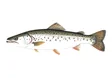
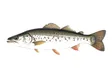
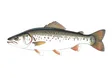
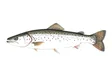
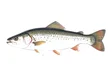
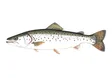
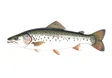
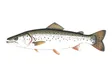
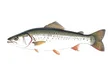
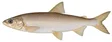
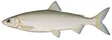
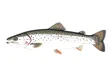
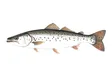
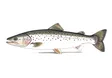
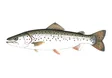
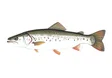
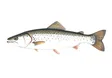
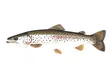
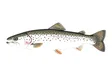
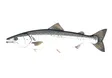
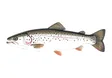
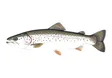
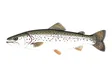
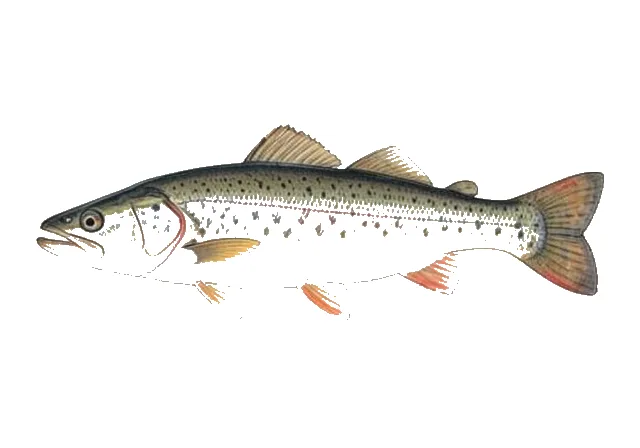
Deepwater Cisco field guide illustration

About Deepwater Cisco

The deepwater cisco (Coregonus johannae) was one of the largest ciscoes in the Great Lakes. Its average length was 30 cm (12 inches) and it was about 1.0 kilogram (2.2 pounds) in weight. Occurring only in Lakes Huron and Michigan, and inhabiting waters between 50 and 150 metres deep, it was difficult to distinguish from other ciscoes and was possibly the same species as the shortjaw cisco (Coregonus zenithicus). The deepwater cisco was distinguished by usually having fewer than 33 gill rakers, relatively long pectoral fins, and unpigmented jaws. It was a silvery colour with a pink or purple lustre and a green or blue back. It spawned in August and September, earlier than most other ciscoes. Not much is known about its specific behaviors. Its diet consisted of Mysis relicta, fingernail clams, and various aquatic insects. Because of its large size, the deepwater cisco was heavily fished commercially.

The main reasons for its extinction was a combination of competition from the invasive alewife, predation by the introduced sea lamprey, and commercial fishing on the Great Lakes.

Commercial fishing in 1930s

Part of the reason for the lack of information on this species could be attributed to the commercial fishing during the early 1930s, before deep water species were properly analysed. The deepwater cisco was abundant before the 1900s as, before large-scale commercial fishing commenced in Lake Michigan, the larger ciscoes had no natural predators.

It was not until the 1930s that the species was subject to commercial fishing exploitation. The deepwater cisco, also known as chubs in fishing terms, was prized for its larger-than-normal size. During this exploitation, the numbers of this species declined dramatically.

The last deepwater cisco specimens were recorded in Lake Michigan in 1951 and Lake Huron in 1952. The species was declared extinct shortly after. When a re-evaluation was conducted in several states bordering Lake Michigan in the 1960s, there were no identifiable specimens of the deepwater cisco in any of the samplings. This served to confirm its extinction, caused by a combination of commercial fishing and invasive predators such as the sea lamprey.

Additional field notes

Deepwater cisco are an extinct Great Lakes fish with a long, narrow snout.

Sources: Coregonus johannae species summary

Appearance of a lost species

FishBase describes a relatively long head on an elongated, moderately compressed body. The mouth is terminal, although the lower jaw can be shorter than, equal to, or longer than the upper one. Silvery coloration can show pink iridescence, with pale blue or green above and mostly translucent fins. These details concern the historical species, rather than a fish that can still be sought in its former lakes.

Sources: Coregonus johannae species summary

Guide sources

Research reviewed 2026-10-19.

Article text: Wikipedia contributors, Deepwater cisco (source revision). Licensed under CC BY-SA 4.0. Retrieved 2026-10-11.
Range

Where it lives

Share of 309 GBIF observation records with a state location, across 3 states.
0%
90.3%
Share of 309 GBIF observation records with a state location, across 3 states.

Share of records by state

Habitat

Water and movement

Water
WoRMS records this species in fresh water.
Migration
Undetermined

Classification

Taxonomy

Kingdom
Animalia
Phylum
Chordata
Superclass
Actinopterygii
Class
Teleostei
Order
Salmoniformes
Genus
Coregonus
Species
Coregonus johannae
ITIS TSN
161944
WoRMS AphiaID
1307267
GBIF key
2350959
Outside the US
ITIS also files it in Canada.

Common questions about Deepwater Cisco

What is the scientific name of Deepwater Cisco?
The scientific name is Coregonus johannae, in the family Salmonidae. Classification follows ITIS.
Does Deepwater Cisco live in fresh water or salt water?
WoRMS records this species in fresh water.
Where has Deepwater Cisco been recorded in the United States?
GBIF has observations in 3 states, with the most records in Michigan, Wisconsin, Indiana. The map shows observation records, which do not establish the complete natural range.

Closest relatives

Other Coregonus species

Same family

More Salmonidae

Alaska Whitefish1 states
Coregonus nelsoniiSalmonidaeNativeFresh
Apache Trout5 states
Oncorhynchus apacheSalmonidaeNativeFresh
Arctic Char8 states
Salvelinus alpinusSalmonidaeNative and introducedFreshSaltBrackish
Arctic Cisco1 states
Coregonus autumnalisSalmonidaeNativeFreshSaltBrackish
Arctic Grayling16 states
Thymallus arcticusSalmonidaeNative and introducedFresh
Atlantic Salmon26 states
Salmo salarSalmonidaeNative and introducedFreshSaltBrackish
Bear Lake Whitefish2 states
Prosopium abyssicolaSalmonidaeNativeFresh
Bering Cisco1 states
Coregonus laurettaeSalmonidaeNativeFreshSaltBrackish
Blackfin Cisco6 states
Coregonus nigripinnisSalmonidaeNativeFresh
Bloater6 states
Coregonus hoyiSalmonidaeNativeFresh
Bonneville Cisco2 states
Prosopium gemmiferSalmonidaeNativeFresh
Bonneville Whitefish2 states
Prosopium spilonotusSalmonidaeNativeFresh
Broad Whitefish1 states
Coregonus nasusSalmonidaeNativeFreshBrackish
Brook Trout40 states
Salvelinus fontinalisSalmonidaeNative and introducedFreshSaltBrackish
Brown Trout41 states
Salmo truttaSalmonidaeIntroducedFreshSaltBrackish
Bull Trout8 states
Salvelinus confluentusSalmonidaeNativeFreshBrackish
Chinook Salmon18 states
Oncorhynchus tshawytschaSalmonidaeNative and introducedFreshSaltBrackish
Chum Salmon5 states
Oncorhynchus ketaSalmonidaeNativeFreshSaltBrackish
Cisco11 states
Coregonus artediSalmonidaeNative and introducedFreshSaltBrackish
Coho Salmon22 states
Oncorhynchus kisutchSalmonidaeNative and introducedFreshSaltBrackish
Cutthroat Trout18 states
Oncorhynchus clarkiiSalmonidaeNative and introducedFreshSaltBrackish
Dolly Varden9 states
Salvelinus malmaSalmonidaeNativeFreshSaltBrackish
Gila Trout2 states
Oncorhynchus gilaeSalmonidaeNative and introducedFresh
Golden Trout8 states
Oncorhynchus aguabonitaSalmonidaeNativeFresh

All 44 species in Salmonidae