Taxonomy
The freshwater omul of the Lake Baikal, formerly considered a subspecies Coregonus autumnalis migratorius of the Arctic cisco, has no close genetic relationship to it and is now classified as a separate species, Coregonus migratorius.
Description
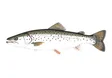
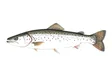
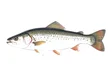
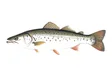
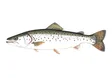
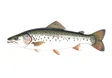
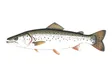
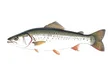
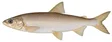
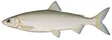
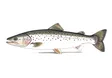
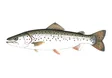
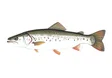
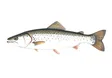
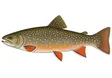
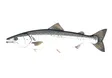
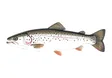
The Arctic cisco has a relatively small head with a non-prominent snout. It has a metallic silver body, a brown or dark green back, and nearly colorless fins. It has neither spots nor teeth on its jaw. It does not have a patch of teeth on its tongue. It can reach 50 cm (20 in) in length and weight up to 2 kg (4.4 lbs) but is usually less than 40 cm (16 in) in length and 1 kg (2.2 lbs) in weight.
Distribution and habitat
The Arctic cisco can be found in the Beaufort Sea, Colville River delta, and freshwater drainages east of the Sagavanirktok River. It can be found in several drainages in the Northwest Territories and Siberia, such as the Chaun River, and is not often found east of Point Barrow.
Diet
The Arctic cisco preys upon plankton, crustaceans and small fishes.
Predators
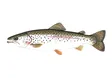
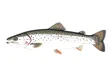
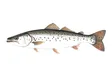
Predators of the Arctic cisco include marine mammals, seabirds and large fishes such as the Dolly Varden trout and burbot.
Reproduction
The Arctic cisco is able to spawn at 8 or 9 years of age. Females may only be able to spawn two or three times in their life, and do not necessarily produce eggs every year.
The Arctic cisco reproduces in September. It does not reproduce in Alaskan waters but does reproduce in the Mackenzie River.
Migration
Young Arctic cisco migrate along the Beaufort Sea coast and are then aided by winds to the Colville River delta, where they are over 160 km (100 mi) from where they spawned. They return to the Mackenzie River to spawn. They do not feed while migrating upwards.
Threats
The largest threats to the Arctic cisco appear to be climate change and oil and gas development.
Additional field notes
Arctic cisco link coastal feeding grounds with freshwater spawning tributaries.
Sources: Coregonus autumnalis species summary
Coastal feeding and river spawning
FishBase describes adults using coastal lagoons, river mouths, and bays, including brackish water with salinity around 20–22 parts per thousand. Their feeding grounds therefore include the transition between fresh river water and the sea. Food extends beyond plankton to insects, worms, clams, and small fish.
Spawning migrations can carry fish far inland. The species account describes shallow tributaries with flowing, well-oxygenated water and gravel beds as spawning habitat. Adults return toward the sea after reproduction, while the developing eggs remain in freshwater through winter. Development can take as long as seven months; newly hatched fish move downstream in May and June. These details describe the broader species account and should not be assumed to give the exact timing of every local population.
Sources: Coregonus autumnalis species summary
Article text: Wikipedia contributors, Arctic cisco (source revision). Licensed under CC BY-SA 4.0. Retrieved 2026-10-11.