Lake Whitefish

Coregonus clupeaformis

Salmonidae · freshwater and brackish water fish

7 minute read · Species guide

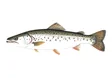
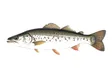
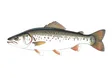
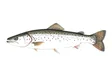
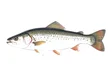
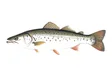
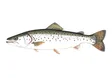
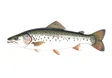
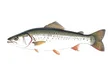
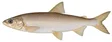
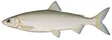
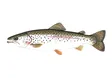
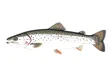
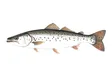
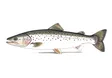
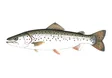
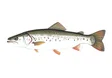
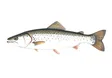
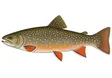
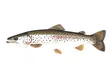
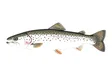
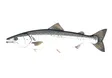
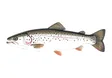
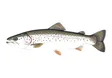
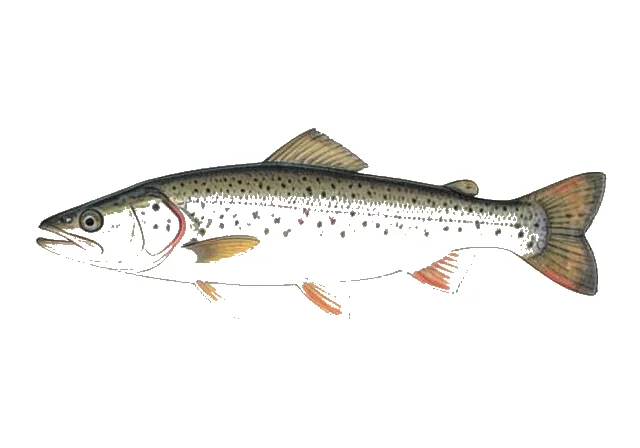
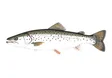
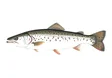
Lake Whitefish field guide illustration

About Lake Whitefish

The lake whitefish (Coregonus clupeaformis) is a species of freshwater whitefish from North America. Lake whitefish are found throughout much of Canada and parts of the northern United States, including all of the Great Lakes. The lake whitefish is sometimes referred to as a "humpback" fish due because of its small head size in relation to the length of the body. It is a valuable commercial fish and also occasionally taken by sport fishermen. Smoked, refrigerated, or vacuum-packed lake whitefish fillets are available in North American grocery stores. Other vernacular names used for this fish include Otsego bass, Sault whitefish, gizzard fish, common whitefish, eastern whitefish, Great Lakes whitefish, humpback whitefish, inland whitefish and whitefish.

Etymology

The scientific genus name Coregonus (co-regg'-on-us) means "angle eye"in Greek, and the species name clupeaformis means" herring -shaped" in Latin.

Description

The lake whitefish is similar in appearance to other whitefishes in the Coregoninae subfamily of the salmon family Salmonidae, such as the northern cisco (Coregonus artedi). As with all salmonids, it has an adipose fin. To the distinction from cisco, the lake whitefish has a snout which overhangs the short lower jaw, so that the mouth opens in a slightly inferior position. Thus the fish can feed on the bottom of lake beds or grab food particulates out of the water or from the surface of a water body. The cisco in turn has a short snout with a lower jaw that extends beyond the snout. Both the cisco and lake whitefish are discernible from the mooneye due to the small posterior dorsal adipose fin. In early life stages the cisco and lake whitefish are indistinguishable based on morphological characters alone, with genetic analyses being necessary to reliably identify species. Another notable feature of the lake whitefish is the presence of two small flaps in each nostril. Its coloration is typically silver to white with an olive to pale-green or brown dorsal hues. The ventral fins are white, and the tail has a dark posterior edge.

Lake whitefish from inland lakes can reach a weight upwards of 5 pounds (2,300 g); the largest caught on rod and reel weighed 14 pounds 6 oz, from Meaford, Ontario, in 1984. On average, the lake whitefish weighs around 4 pounds. They can grow to 31 inches (79 cm) and commonly reach 20 inches (51 cm).

Habitat

Lake whitefish are cool water fish. They are found in a large number of inland lakes, and they have been known to enter brackish water. The lake whitefish is distributed from Alaska and western Canada to the Atlantic coastal drainage of Maine and in New Brunswick north to Labrador.

Reproduction

Lake whitefish spawn from September through January in water two to four metres in depth during the night. In the autumn, mature lake whitefish enter the shallows to lay their eggs on shoals of rubble and gravel. There is no parental care of the young. In the following spring the young will hatch. In northwestern Canada, a large spawning migration enters the Athabasca Delta in late summer, moving upstream in the Athabasca River. The longest single movement of a tagged whitefish was 388 km (241 mi), from Fort McMurray to the north shore of Lake Athabasca in Alberta.

Diet

Fish of larval and postlarval stages feed on plankton. Once the larvae reach 3–4 inches (76–102 mm) they switch to feeding on bottom-dwelling animals (snail, insect larvae, zebra mussels, and fingernail clams) which they will consume for the remainder of their lives. In late June and July, some inland lake populations of ciscoe and lake whitefish leave the deep, cool waters to feast on emerging mayflies and midges. Natural predators include burbot, lake trout, and northern pike.

Commercial fishing

Lake whitefish is one of the most important species for commercial inland fisheries in North America. The total annual catch in 1999 from Canada was 8,328 tons and 5,353 tons in the United States. Lake whitefish is the prime commercial species of the upper Great Lakes fishery, because this delicately flavored fresh fish has high local consumer acceptance. An average of 11 million pounds was harvested from the Great Lakes annually from 1981 to 1999. Although the harvest has declined from 9.5 to 8 million pounds in recent years, prices have not increased. Instead, the price for Great Lakes lake whitefish, which once reached as high as $1.04/lb., currently averages $.75/lb. and has dropped to as low as $.40/lb during periods of high production. Commercial fishing has allowed for the spread of this fish into many different markets, restaurants, and grocery store shelves.

Sport fishing

Many anglers also enjoy hooking this fish in the months of June, July and early August. A simple line and jig system is enough to catch the fish as they feast on mayflies and midges. In winter months, catching ice fishing is popular, particularly in northern Wisconsin, with many fishing guides specializing in this species. Successful ice fishing techniques include using a jigging spoon, with at least one "slider hook" above and separated from the spoon with a barrel swivel, and all hooks tipped with wax worms.

Conservation

A major threat to the lake whitefish is the invasive sea lamprey. In Lake Michigan sea lamprey began to decimate indigenous fish populations in the 1930s and 1940s. It may have entered the Great Lakes region through the Erie Canal which opened in 1825. and spread even further in 1919 with improvements to the Welland Canal. In Lakes Michigan and Huron, the invasive Quagga mussel poses a threat by filtering out the zooplankton that are the main food source for juvenile whitefish.

Evolution

Since the end of the last glaciation (about 12,000 years ago), whitefish have colonized many North American lakes, from different directions, from refugia that represent genetically diverged stocks or races. Whitefish diversified into different populations locally, such that now in many lakes two main ecotypes are recognized within the species: a normal and a dwarf ecotype. These normal and dwarf ecotypes are mainly differentiated by the benthic and pelagic zone they occupy, respectively. Normal whitefish also grow much bigger and live much longer than the dwarf ecotype.

Many of these populations live in sympatry, yet are reproductively isolated. The fact that they are young species makes them prime candidate to study the evolutionary forces driving their ecological divergence and reproductive isolation.

Article text: Wikipedia contributors, Lake whitefish (source revision). Licensed under CC BY-SA 4.0. Retrieved 2026-10-11.
Diet and feeding

The FishTraits compilation records these diet categories for this species: algae or phytoplankton; invertebrates or larval fish; larger animal prey (a source category covering fish, crayfish, crabs, or frogs); fish or frog eggs. These are broad categories, not a claim that every individual consumes every example in a category.

Reported feeding positions include bottom feeding. The compilation combines published observations; diets can vary with age, locality, and available food.

Habitat preferences

Reported habitat associations include medium to large rivers, streams and small rivers, still-water habitats.

The source records associations with open water. An association indicates reported use, rather than an exclusive requirement.

Reproduction and parental care

The compilation reports a representative maturity age of 6 years. Its maturity field summarizes mean, median, or modal estimates, usually for females; male estimates can be used when female data are unavailable. It is not a fixed age at which every fish first breeds.

Recorded spawning months are Jan, Dec for the source’s reporting region (WI). This is a regional calendar, not a range-wide schedule.

The reproductive-guild classification includes spawning on open substrates without guarding the brood.

Size and recorded longevity

FishTraits reports a maximum total length of 50 centimetres. Some entries use an estimated asymptotic length; this value should not be treated as a certified record catch.

Recorded longevity in the compilation is 30 years. Wild observations were preferred, but captive records were accepted where wild records were unavailable, and unspecified records were assumed wild. The value is not a guaranteed wild lifespan or an aquarium life expectancy.

Native range

Throughout Canada south into New England, the Great Lakes basin, and central Minnesota; Copper and Susitna River drainages, Alaska (Page and Burr 2011).

Introduction history

The U.S. Fish Commission was active in stocking Lake Whitefish during the late 1800s and early 1900s (e.g., Smith 1896; Chapman 1942).

Record fish

State records in 3 states

  • Minnesota13 lb 9 oz

    Lake of the Woods · Lake of the Woods · 4/6/2019

  • Wisconsin12 lbs. 6.4 oz.

    Lake Michigan · Sheboygan · 07/09/2013

  • Montana10.46 lbs.

    Flathead Lake · 8/26/06 · Swan T. McDonald V

Each figure is the state agency’s own certified record. The site holds record tables for 11 states so far, so a state missing here has not been read yet. It is not a state where this fish holds no record.

Range

Where it lives

Share of 1,134 GBIF observation records with a state location, across 15 states.
0%
42.7%
Share of 1,134 GBIF observation records with a state location, across 15 states.

Habitat

Water and movement

Water
WoRMS records this species in fresh water and brackish water.
USGS NAS habitat
Freshwater
US status
Native transplant — native to part of the United States, moved to other waters inside it.
Migration
Undetermined
Pattern
Disagreement
10 published references do not agree on the pattern: Anadromous, Non-migratory, Potamodromous. The site shows every assignment rather than picking one.

Classification

Taxonomy

Kingdom
Animalia
Phylum
Chordata
Superclass
Actinopterygii
Class
Teleostei
Order
Salmoniformes
Genus
Coregonus
Species
Coregonus clupeaformis
ITIS TSN
161941
WoRMS AphiaID
158726
GBIF key
2351119
Outside the US
ITIS also files it in Canada.

Common questions about Lake Whitefish

What is the scientific name of Lake Whitefish?
The scientific name is Coregonus clupeaformis, in the family Salmonidae. Classification follows ITIS.
Does Lake Whitefish live in fresh water or salt water?
WoRMS records this species in fresh water and brackish water.
Where has Lake Whitefish been recorded in the United States?
GBIF has observations in 15 states, with the most records in Minnesota, Michigan, New York. The map shows observation records, which do not establish the complete natural range.

Closest relatives

Other Coregonus species

Same family

More Salmonidae

Alaska Whitefish1 states
Coregonus nelsoniiSalmonidaeNativeFresh
Apache Trout5 states
Oncorhynchus apacheSalmonidaeNativeFresh
Arctic Char8 states
Salvelinus alpinusSalmonidaeNative and introducedFreshSaltBrackish
Arctic Cisco1 states
Coregonus autumnalisSalmonidaeNativeFreshSaltBrackish
Arctic Grayling16 states
Thymallus arcticusSalmonidaeNative and introducedFresh
Atlantic Salmon26 states
Salmo salarSalmonidaeNative and introducedFreshSaltBrackish
Bear Lake Whitefish2 states
Prosopium abyssicolaSalmonidaeNativeFresh
Bering Cisco1 states
Coregonus laurettaeSalmonidaeNativeFreshSaltBrackish
Blackfin Cisco6 states
Coregonus nigripinnisSalmonidaeNativeFresh
Bloater6 states
Coregonus hoyiSalmonidaeNativeFresh
Bonneville Cisco2 states
Prosopium gemmiferSalmonidaeNativeFresh
Bonneville Whitefish2 states
Prosopium spilonotusSalmonidaeNativeFresh
Broad Whitefish1 states
Coregonus nasusSalmonidaeNativeFreshBrackish
Brook Trout40 states
Salvelinus fontinalisSalmonidaeNative and introducedFreshSaltBrackish
Brown Trout41 states
Salmo truttaSalmonidaeIntroducedFreshSaltBrackish
Bull Trout8 states
Salvelinus confluentusSalmonidaeNativeFreshBrackish
Chinook Salmon18 states
Oncorhynchus tshawytschaSalmonidaeNative and introducedFreshSaltBrackish
Chum Salmon5 states
Oncorhynchus ketaSalmonidaeNativeFreshSaltBrackish
Cisco11 states
Coregonus artediSalmonidaeNative and introducedFreshSaltBrackish
Coho Salmon22 states
Oncorhynchus kisutchSalmonidaeNative and introducedFreshSaltBrackish
Cutthroat Trout18 states
Oncorhynchus clarkiiSalmonidaeNative and introducedFreshSaltBrackish
Deepwater Cisco3 states
Coregonus johannaeSalmonidaeNativeFresh
Dolly Varden9 states
Salvelinus malmaSalmonidaeNativeFreshSaltBrackish
Gila Trout2 states
Oncorhynchus gilaeSalmonidaeNative and introducedFresh

All 44 species in Salmonidae