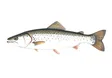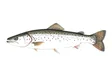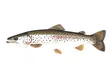
Arctic Grayling

Thymallus arcticus

Salmonidae · freshwater water fish

7 minute read · Species guide

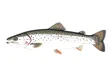
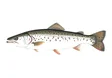
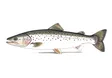
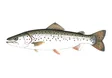
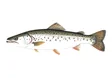
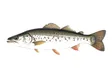
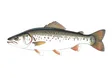
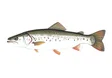
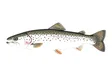
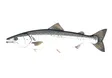
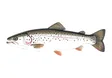
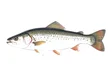
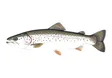
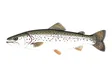
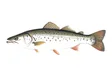
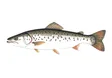
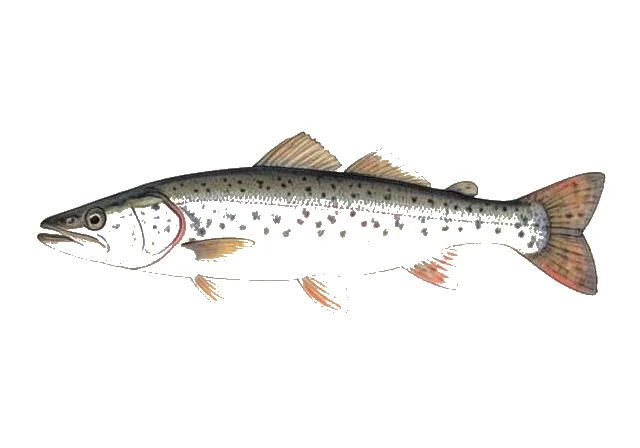
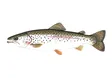
Arctic Grayling field guide illustration

About Arctic Grayling

The Arctic grayling (Thymallus arcticus) is a species of freshwater fish in the salmon family Salmonidae. T. arcticus is widespread throughout the Arctic and Pacific drainages in Canada, Alaska, and Siberia, as well as the upper Missouri River drainage in Montana. In the U.S. state of Arizona, an introduced population is found in the Lee Valley and other lakes in the White Mountains. They were also stocked at Toppings Lake by the Teton Range and in lakes in the high Uinta Mountains in Utah, as well as alpine lakes of the Boulder Mountains (Idaho) in central Idaho.

Taxonomy

The scientific name of the Arctic grayling is Thymallus arcticus. It was named in 1776 by German zoologist Peter Simon Pallas from specimens collected in Russia. The name of the genus Thymallus first given to grayling (T. thymallus) described in the 1758 edition of Systema Naturae by Swedish zoologist Carl Linnaeus originates from the faint smell of the herb thyme, which emanates from the flesh.

Description

Arctic grayling grow to a maximum recorded length of 76 cm (30 in) and a maximum recorded weight of 3.8 kg (8.4 lb). Of typical thymalline appearance, the Arctic grayling is distinguished from the similar European grayling (T. thymallus) by the absence of dorsal and anal spines and by the presence of a larger number of soft rays in these fins,and also having a larger mouth. There is a dark midlateral band between the pectoral and pelvic fins, and the flanks may possess a pink iridescence. T. a. arcticus has been recorded as reaching an age of 18 years.

Range

Arctic grayling are widespread in Arctic Ocean drainages from Hudson Bay, Canada to Alaska and in Arctic and Pacific drainages to central Alberta and British Columbia in Canada. They do not occur naturally in the Fraser and Columbia river basins. There are remnant native populations of fluvial Arctic grayling in the upper Missouri River drainage in the Big Hole River and Red Rock basin ("Montana Arctic grayling"). Fluvial Arctic grayling have been reestablished in the upper Ruby River, a tributary of the Beaverhead River. The native range formerly extended south into the Great Lakes basin in Michigan, where the species was extirpated by 1936 due to habitat destruction, unregulated logging, and competition from non-native fish species.

The arctic grayling occurs naturally in the Arctic Ocean basin in Siberia from the Ob to Yenisei drainages and in European Russia in some tributaries of Pechora river. Lake dwelling forms of Arctic grayling have been introduced in suitable lake habitats throughout the Rocky Mountains including lakes in the Teton Range in Wyoming, central Idaho and the high Uinta Mountains in Utah, Cascade Mountains and Sierra Nevada Mountains as far south as Arizona.

Life cycle

Several life history forms of Arctic grayling occur: fluvial populations that live and spawn in rivers; lacustrine populations that live and spawn in lakes; and potamodromous populations that live in lakes and spawn in tributary streams.

The Arctic grayling occurs primarily in cold waters of mid-sized to large rivers and lakes, returning to rocky streams to breed. The various subspecies are omnivorous. Crustaceans, insects and insect larvae, and fish eggs form the most important food items. Larger specimens of T. arcticus become piscivorous and the immature fish feed on zooplankton and insect larvae.

Spawning takes place in the spring. Adult fish seek shallow areas of rivers with fine, sand substrate and moderate current. Males are territorial and court females by flashing their colourful dorsal fins; the fins are also used to brace receptive females during the vibratory release of milt and roe. The fish are nonguarders: the eggs are left to mix with the substrate. Although the Arctic grayling does not excavate a nest, the highly energetic courtship and mating tends to kick up fine material which covers the zygotes. The zygote is small (approximately 3 mm or 0.1 in in diameter) and the embryo will hatch after two to three weeks. The newly hatched embryo remains in the substrate until all the yolk has been absorbed. They emerge at a length of around 12 to 18 mm (0.5 to 0.7 in), at which time they form shoals at the river margins. The juveniles grow quickly during their first two years of life.

Conservation

Arctic grayling are considered a secure species throughout their range. Although some populations at the southern extent of its native range have been extirpated, it remains widespread elsewhere and is not listed on the IUCN Red List of threatened species.

The fluvial population in the upper Missouri river basin once merited a high priority for listing under the Endangered Species Act (ESA) by the US Fish & Wildlife Service (FWS). This unique southernmost population is now extirpated from all areas of the basin with the exception of the Big Hole River watershed. In preparation for an ESA listing, the US FWS began implementing a "Candidate Conservation Agreement with Assurances"(CCAA). This agreement protects cooperating landowners from being prosecuted under the ESA"takings" clause so long as they fulfill specific obligations, spelled out in a contractual arrangement and intended to restore the dwindling population. Finally, in 2014 the FWS determined not to list the grayling under ESA, due to the effectiveness of the CCAA.

In 2025, efforts to reintroduce Arctic grayling to Michigan streams began, with 400,000 eggs planted in coldwater streams as part of a collaborative restoration initiative.

The Arctic grayling is economically important; it is a "key subsistence species" for the Iñupiat people of the Alaska North Slope, it is raised commercially for food and it is one of the most important species for sport fishing in Alaska.

Article text: Wikipedia contributors, Arctic grayling (source revision). Licensed under CC BY-SA 4.0. Retrieved 2026-10-11.
Diet and feeding

The FishTraits compilation records these diet categories for this species: invertebrates or larval fish; larger animal prey (a source category covering fish, crayfish, crabs, or frogs); fish or frog eggs. These are broad categories, not a claim that every individual consumes every example in a category.

Reported feeding positions include surface or water-column feeding. The compilation combines published observations; diets can vary with age, locality, and available food.

Habitat preferences

Reported habitat associations include medium to large rivers, streams and small rivers, creeks, still-water habitats.

The source records associations with gravel, cobble, open water. An association indicates reported use, rather than an exclusive requirement.

Reproduction and parental care

The compilation reports a representative maturity age of 6 years. Its maturity field summarizes mean, median, or modal estimates, usually for females; male estimates can be used when female data are unavailable. It is not a fixed age at which every fish first breeds.

Recorded spawning months are May, Jun for the source’s reporting region (AK). This is a regional calendar, not a range-wide schedule.

The reproductive-guild classification includes spawning on open substrates without guarding the brood.

Size and recorded longevity

FishTraits reports a maximum total length of 75.7 centimetres. Some entries use an estimated asymptotic length; this value should not be treated as a certified record catch.

Recorded longevity in the compilation is 12 years. Wild observations were preferred, but captive records were accepted where wild records were unavailable, and unspecified records were assumed wild. The value is not a guaranteed wild lifespan or an aquarium life expectancy.

Identification and appearance

Scott and Crossman (1973); Morrow (1980); Page and Burr (1991). Grayling can be distinguished from all other salmonids by the presence of a large, sail-like dorsal fin. At one time T. arcticus was divided into four separate species: T. signifer, T. montanus, T. tricolor, and T. ontariensis. Thymallus signifer is now treated as synonymous with T. arcticus, and the others are considered subspecies of T. arcticus (Lee et al. 1980 et seq.).

Native range

The only remaining natural, native remnant population in the continental United States is in Big Hole River, Montana (Wydoski and Whitney 2003). All other populations are the result of introductions or re-introductions.

Habitat and ecology

Grayling generally inhabit clear, cold, high-altitude lakes and rivers (Behnke 2002; Wydoski and Whitney 2003). Spawning occurs in the spring, when water temperatures reach 45-50° F. Unlike most salmonids, grayling do not construct any sort of nest but spawn directly over gravel or rocky areas of smaller streams and tributaries (Behnke 2002). Diet primarily consists of aquatic and terrestrial invertebrates, zooplankton, small fishes, and occasionally fish eggs (Behnke 2002; Wydoski and Whitney 2003).

Introduction history

Authorized stocking for sportfishing. First stocked in Arizona in 1943 (Rinne 1995). First stocked in Connecticut in the 1870s (Whitworth 1996). Stocked in Nebraska in 1939 (Jones 1963). First stocked in southern Michigan in 1877 (Fukano et al. 1964).

Record fish

State records in 2 states

  • Montana3.63 lbs.

    Washtub Lake · 6/28/03 · Glenn Owens

  • Utah1 lb. 12 oz.

    Big Dog Lake — South Slope Uintas · 1998 · Terry J. Fieldsted

Each figure is the state agency’s own certified record. The site holds record tables for 11 states so far, so a state missing here has not been read yet. It is not a state where this fish holds no record.

Range

Where it lives

Share of 1,089 GBIF observation records with a state location, across 16 states. The orange dots are USGS stream-survey sites where this species was caught.
0%
59.3%
Share of 1,089 GBIF observation records with a state location, across 16 states. The orange dots are USGS stream-survey sites where this species was caught.

A blank area on the dot layer usually means nobody sampled there, not that the fish is absent. Turn on “every survey site” to see where the survey looked.

The USGS stream survey caught it at 31 of its sites, in 2 states. That survey and the GBIF records are two different counts of two different things, so the site keeps them apart.

Habitat

Water and movement

Water
WoRMS records this species in fresh water.
USGS NAS habitat
Freshwater
US status
Native transplant — native to part of the United States, moved to other waters inside it.
Migration
Undetermined
Pattern
Disagreement
3 published references do not agree on the pattern: Non-migratory, Potamodromous. The site shows every assignment rather than picking one.

Classification

Taxonomy

Kingdom
Animalia
Phylum
Chordata
Superclass
Actinopterygii
Class
Teleostei
Order
Salmoniformes
Genus
Thymallus
Species
Thymallus arcticus
ITIS TSN
162016
WoRMS AphiaID
254571
GBIF key
5711974
Outside the US
ITIS also files it in Canada.

Common questions about Arctic Grayling

What is the scientific name of Arctic Grayling?
The scientific name is Thymallus arcticus, in the family Salmonidae. Classification follows ITIS.
Does Arctic Grayling live in fresh water or salt water?
WoRMS records this species in fresh water.
Where has Arctic Grayling been recorded in the United States?
GBIF has observations in 16 states, with the most records in Alaska, Wyoming, Colorado. The map shows observation records, which do not establish the complete natural range.

Same family

More Salmonidae

Alaska Whitefish1 states
Coregonus nelsoniiSalmonidaeNativeFresh
Apache Trout5 states
Oncorhynchus apacheSalmonidaeNativeFresh
Arctic Char8 states
Salvelinus alpinusSalmonidaeNative and introducedFreshSaltBrackish
Arctic Cisco1 states
Coregonus autumnalisSalmonidaeNativeFreshSaltBrackish
Atlantic Salmon26 states
Salmo salarSalmonidaeNative and introducedFreshSaltBrackish
Bear Lake Whitefish2 states
Prosopium abyssicolaSalmonidaeNativeFresh
Bering Cisco1 states
Coregonus laurettaeSalmonidaeNativeFreshSaltBrackish
Blackfin Cisco6 states
Coregonus nigripinnisSalmonidaeNativeFresh
Bloater6 states
Coregonus hoyiSalmonidaeNativeFresh
Bonneville Cisco2 states
Prosopium gemmiferSalmonidaeNativeFresh
Bonneville Whitefish2 states
Prosopium spilonotusSalmonidaeNativeFresh
Broad Whitefish1 states
Coregonus nasusSalmonidaeNativeFreshBrackish
Brook Trout40 states
Salvelinus fontinalisSalmonidaeNative and introducedFreshSaltBrackish
Brown Trout41 states
Salmo truttaSalmonidaeIntroducedFreshSaltBrackish
Bull Trout8 states
Salvelinus confluentusSalmonidaeNativeFreshBrackish
Chinook Salmon18 states
Oncorhynchus tshawytschaSalmonidaeNative and introducedFreshSaltBrackish
Chum Salmon5 states
Oncorhynchus ketaSalmonidaeNativeFreshSaltBrackish
Cisco11 states
Coregonus artediSalmonidaeNative and introducedFreshSaltBrackish
Coho Salmon22 states
Oncorhynchus kisutchSalmonidaeNative and introducedFreshSaltBrackish
Cutthroat Trout18 states
Oncorhynchus clarkiiSalmonidaeNative and introducedFreshSaltBrackish
Deepwater Cisco3 states
Coregonus johannaeSalmonidaeNativeFresh
Dolly Varden9 states
Salvelinus malmaSalmonidaeNativeFreshSaltBrackish
Gila Trout2 states
Oncorhynchus gilaeSalmonidaeNative and introducedFresh
Golden Trout8 states
Oncorhynchus aguabonitaSalmonidaeNativeFresh

All 44 species in Salmonidae