Shorthead Redhorse

Moxostoma macrolepidotum

Catostomidae · freshwater and brackish water fish

7 minute read · Species guide

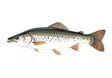
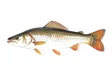
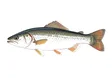
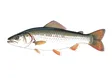
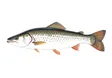
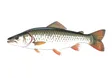
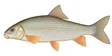
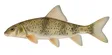
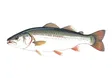
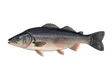
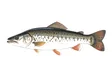
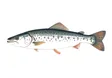
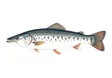
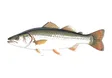
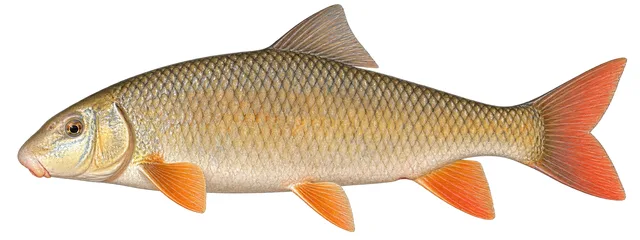
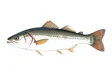
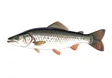
Shorthead Redhorse field guide illustration

About Shorthead Redhorse

The shorthead redhorse (Moxostoma macrolepidotum) is a wide-ranging species in North America. The shorthead redhorse is native to central and eastern North America. However, its range has expanded to include areas like the Hudson estuary and Grayson County, Texas. It inhabits small to large rivers and lakes, and lives in the benthic zone. Shorthead redhorse feed on benthic invertebrates and can consume plant material from the benthic environment that it inhabits. When it spawns, shorthead redhorse move into more shallow streams and spawn over gravel or rocky shoals. They will also spawn in springs with swift moving water. The shorthead redhorse is important to humans because it is a game fish. It is also important to anglers because of its role in the ecosystem; it is prey for larger game fish such as northern pike and muskellunge.

One source gives one of its English names as "common mullet". Others are redfin, redfin sucker, red sucker, redhorse mullet, shorthead mullet, mullet, bigscale sucker, common redhorse, northern redhorse, Des Moines Plunger.

Geographic distribution

Historically, the shorthead redhorse is native to North America. Its native range includes the Great Lakes, Hudson Bay, Mississippi River, and Saint Lawrence River basins. They ranged across from Quebec to Alberta and as far south as northern Alabama and Oklahoma. Shorthead redhorse also originally occupied the Atlantic Slope drainages, ranging from the Hudson River in New York to the Santee River in South Carolina. When the Tennessee Valley Authority started building dams in the 1930s in an attempt to create power, the dams blocked different fish such as striped bass, from moving upstream to their spawning ranges. While some fish ranges have decreased since the construction of the dams, the shorthead redhorse's range has expanded. The shorthead redhorse is a "habitat generalist near the core of its range," so it can tolerate disturbance better than other related redhorse species such as the river redhorse, M. carinatum. Shorthead redhorse can now be found in the tidal zones of the Hudson River. They are believed to have invaded the Hudson by way of the Mohawk River and have established themselves in the Hudson estuary. Other areas they have been found in include the Embarras River system in Illinois and the Red River below Lake Texoma dam in Grayson County, Texas.

Ecology

Shorthead redhorse have a wide habitat range. They live in fresh water and are found in streams, lakes and rivers. Shorthead redhorse can tolerate clear to cloudy water and likes loose substrate like gravel and sand. These fish are benthic feeders that like to feed in riffles and rifle margins. During a study done in Illinois by Sule et al., they found that "shorthead redhorse consumed items from approximately 60 food categories, primarily invertebrate taxa". Twenty-four to sixty-eight percent of their diet was unidentified when stomach contents were analyzed. Also found, 21–50% of the unidentified matter, or 13% of their total diet, was organic matter. Shorthead redhorse eat the most insects out of all the fish in the sucker family. They can also eat microcrustacea and plant matter. Predators of shorthead redhorse vary depending on size. Juveniles can be eaten by northern pike, walleyes, and smallmouth bass. Adult or larger shorthead redhorse are eaten by northern pike and muskellunge. The shorthead redhorse does not actively compete for food. Because of their wide range of prey and eating the most vertebrates of all the suckers, they do not have a competitor. Humans impact shorthead redhorse habitat. The construction of dams blocked free flowing rivers like the Mississippi in which they live, disrupting their spawning migration routes. Shorthead redhorse are killed easily by pollutants in the water. "The upstream migratory range of shorthead redhorse in a Maryland river decreased due to an increase in chlorinated sewage outfalls". Factory pollutants are dumped into streams or rivers and will settle onto the bottom. Because such a large portion of the shorthead redhorse's diet is sediment, it ingests high concentrations of the chemicals and can die.

Life history

The shorthead redhorse spawning season ranges from March to June, depending on location. In order to spawn, the water temperature has to be between 7 and 16 °C (45 and 61 °F). Shorthead redhorse spawn once a year and will travel either upstream or downstream to reach their spawning ground. Spawning areas are usually smaller rivers or steams. They are locally migrant so they do not travel long distances to get their spawning area. Shorthead redhorse spawn in shallows at the edges of sand bars or in riffles over gravel substrate. During spawning, females can produce anywhere from 18,000 to 44,000 eggs. It can take anywhere from 2–5, even 6 years for a shorthead redhorse to become sexually mature. In northern areas of cooler water, growth rates tend to be lower than more southern, warmer areas. The average life span of the shorthead redhorse varies depending on location. More northern locations with cooler water tend to have shorthead redhorse that can live to be approximately 20 years of age. Typical adult size is 12–18 inches (30–46 cm) in length, and 2–3 pounds (0.91–1.36 kg), although some individuals can reach up to 25 inches (64 cm) in length and 6 pounds (2.7 kg) in weight. However, in more southern, warmer water areas, such as the Kankakee River, the average max age is only six to seven. As mentioned previously, the construction of dams has not had a large effect on the population of shorthead redhorse, but it has had some effect. The dams affect the shorthead redhorse just as they do other fish by blocking migration pathways to spawning areas.

Current management and wanton waste

The shorthead redhorse is abundant across its range and has one of the largest ranges of any sucker. This species is not currently endangered or threatened, but has become subject to unregulated bowfishing and wanton waste in the 21st century. In some states like Minnesota, shorthead redhorse disposal from 21st century tournament bowfishing exceeds that of commercial harvest by at least 200 times. As of 2002 there was no management plan for the shorthead redhorse.

Relationship with humans

The shorthead redhorse is becoming a popular game fish for anglers, and a kill-and-dump sportfish via bowfishing. The shorthead redhorse is said to be one of the better tasting fish, however there are many little bones throughout the meat making it superficially unappealing to many American consumers. The meat also spoils rapidly in warm temperatures making it hard to transport. Shorthead redhorse play a key role in their ecosystems as prey for larger game fish. They are often used for bait if caught small enough. Humans impact the population the most through chemical contamination of their habitat. Bioaccumulation of chemicals is common in fish that feed near the benthic zone, like the shorthead redhorse. The current IGFA all tackle world record for the species stands at 5 pounds 6 ounces (2.4 kg), caught from the Prairie River in Minnesota, USA on May 4, 1988 by angler Greg Clusiau.

Article text: Wikipedia contributors, Shorthead redhorse (source revision). Licensed under CC BY-SA 4.0. Retrieved 2026-10-11.
Diet and feeding

The FishTraits compilation records these diet categories for this species: algae or phytoplankton; detritus or unidentified plant material; invertebrates or larval fish. These are broad categories, not a claim that every individual consumes every example in a category.

Reported feeding positions include bottom feeding. The compilation combines published observations; diets can vary with age, locality, and available food.

Habitat preferences

Reported habitat associations include medium to large rivers, streams and small rivers, still-water habitats.

The source records associations with clay or silt, sand, gravel, cobble, bedrock. An association indicates reported use, rather than an exclusive requirement.

Reproduction and parental care

The compilation reports a representative maturity age of 3.5 years. Its maturity field summarizes mean, median, or modal estimates, usually for females; male estimates can be used when female data are unavailable. It is not a fixed age at which every fish first breeds.

Recorded spawning months are Apr, May for the source’s reporting region (NC). This is a regional calendar, not a range-wide schedule.

The reproductive-guild classification includes spawning on open substrates without guarding the brood.

Size and recorded longevity

FishTraits reports a maximum total length of 75 centimetres. Some entries use an estimated asymptotic length; this value should not be treated as a certified record catch.

Recorded longevity in the compilation is 12 years. Wild observations were preferred, but captive records were accepted where wild records were unavailable, and unspecified records were assumed wild. The value is not a guaranteed wild lifespan or an aquarium life expectancy.

Native range

Great Lakes--St. Lawrence River, Hudson Bay, and Mississippi River basins from Quebec to Alberta and south to northern Alabama and Oklahoma; Atlantic Slope drainages from Hudson River, New York to Santee River, South Carolina (Page and Burr 1991).

Record fish

State records in 3 states

  • Minnesota7 lb 15 oz

    Rum River near Ramsey · Anoka · 8/5/1983

  • Montana4.68 lbs.

    Marias River Near Loma · 4/14/85 · Ray Quigley

  • Wisconsin4 lbs. 5.4 oz.

    Wisconsin River · Sauk · 09/17/2025

Each figure is the state agency’s own certified record. The site holds record tables for 11 states so far, so a state missing here has not been read yet. It is not a state where this fish holds no record.

Range

Where it lives

Share of 6,184 GBIF observation records with a state location, across 32 states. The orange dots are USGS stream-survey sites where this species was caught.
0%
31.1%
Share of 6,184 GBIF observation records with a state location, across 32 states. The orange dots are USGS stream-survey sites where this species was caught.

A blank area on the dot layer usually means nobody sampled there, not that the fish is absent. Turn on “every survey site” to see where the survey looked.

The USGS stream survey caught it at 1,750 of its sites, in 27 states. That survey and the GBIF records are two different counts of two different things, so the site keeps them apart.

Habitat

Water and movement

Water
WoRMS records this species in fresh water and brackish water.
USGS NAS habitat
Freshwater
US status
Native transplant — native to part of the United States, moved to other waters inside it.
Migration
Migratory
Pattern

Classification

Taxonomy

Kingdom
Animalia
Phylum
Chordata
Superclass
Actinopterygii
Class
Teleostei
Order
Cypriniformes
Genus
Moxostoma
Species
Moxostoma macrolepidotum
ITIS TSN
163928
WoRMS AphiaID
593217
GBIF key
2359006
Outside the US
ITIS also files it in Canada.

Common questions about Shorthead Redhorse

What is the scientific name of Shorthead Redhorse?
The scientific name is Moxostoma macrolepidotum, in the family Catostomidae. Classification follows ITIS.
Does Shorthead Redhorse live in fresh water or salt water?
WoRMS records this species in fresh water and brackish water.
Where has Shorthead Redhorse been recorded in the United States?
GBIF has observations in 32 states, with the most records in Minnesota, Illinois, Iowa. The map shows observation records, which do not establish the complete natural range.

Closest relatives

Other Moxostoma species

Same family

More Catostomidae

Alabama Hog Sucker6 states
Hypentelium etowanumCatostomidaeNative and introducedFresh
Bigeye Jumprock3 states
Moxostoma ariommumCatostomidaeNativeFresh
Bigmouth Buffalo26 states
Ictiobus cyprinellusCatostomidaeNative and introducedFresh
Black Buffalo26 states
Ictiobus nigerCatostomidaeNative and introducedFresh
Black Redhorse
Moxostoma duquesneiCatostomidaeNativeFresh
Blackfin Sucker2 states
Thoburnia atripinnisCatostomidaeNativeFresh
Blacktail Redhorse9 states
Moxostoma poecilurumCatostomidaeNativeFresh
Blacktip Jumprock7 states
Moxostoma cervinumCatostomidaeNative and introducedFresh
Blue Sucker22 states
Cycleptus elongatusCatostomidaeNativeFresh
Bluehead Sucker7 states
Pantosteus discobolusCatostomidaeNativeFresh
Bridgelip Sucker5 states
Catostomus columbianusCatostomidaeNativeFresh
Creek Chubsucker31 states
Erimyzon oblongusCatostomidaeNativeFresh
Cui-ui2 states
Chasmistes cujusCatostomidaeNativeFresh
Desert Sucker9 states
Pantosteus clarkiiCatostomidaeNativeFresh
Flannelmouth Sucker8 states
Catostomus latipinnisCatostomidaeNativeFresh
Golden Redhorse29 states
Moxostoma erythrurumCatostomidaeNative and introducedFresh
Gray Redhorse2 states
Moxostoma congestumCatostomidaeNative and introducedFresh
Greater Jumprock4 states
Moxostoma lachneriCatostomidaeNative and introducedFresh
Greater Redhorse11 states
Moxostoma valenciennesiCatostomidaeNativeFresh
Green Sucker4 states
Pantosteus virescensCatostomidaeNativeFresh
Highfin Carpsucker23 states
Carpiodes veliferCatostomidaeNative and introducedFresh
June Sucker1 states
Chasmistes liorusCatostomidaeNativeFresh
Klamath Largescale Sucker2 states
Catostomus snyderiCatostomidaeNativeFresh
Klamath Smallscale Sucker2 states
Catostomus rimiculusCatostomidaeNativeFresh

All 67 species in Catostomidae