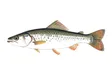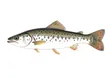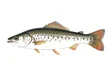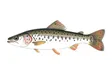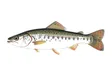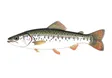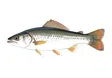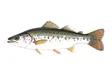
River Darter

Percina shumardi

Percidae · freshwater water fish

8 minute read · Species guide

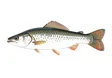
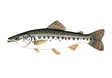
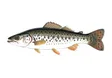
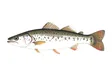
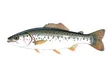
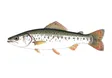
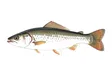
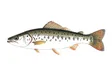
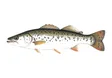
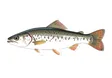
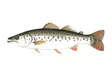
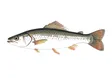
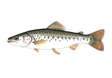
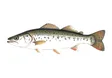
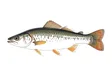
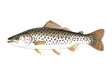
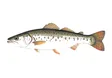
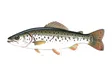
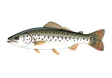
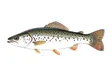
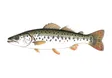
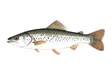
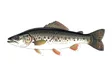
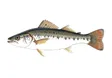
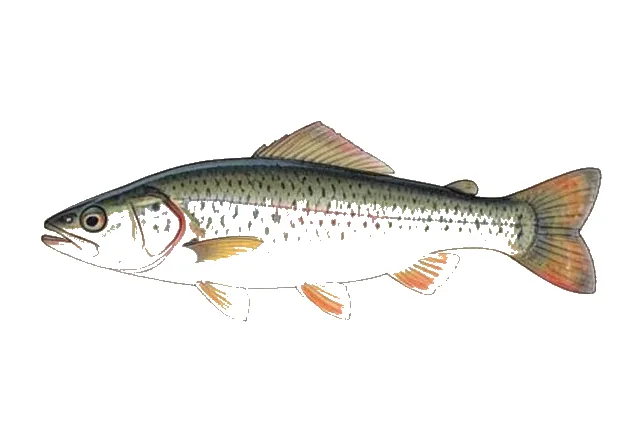
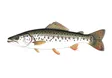
River Darter field guide illustration

About River Darter

Percina shumardi (river darter) is a benthic species of freshwater ray-finned fish, a darter from the subfamily Etheostomatinae, part of the family Percidae, which also contains the perches, ruffes and pikeperches. It is native to North America. It is an inhabitant of small and medium rivers where it occurs in rocky riffles with clear, fast-flowing water. The river darter can reach up to 7.3 cm (2.9 in) in length and has an average lifespan of three years. It can be distinguished from other darters by its unique front and rear spots on the dorsal fin.

Geographic distribution

The river darter is a species native only to the United States and Canada. Within Canada, the river darter is native to southern regions including the Hudson Bay basin, Ontario, and Manitoba. Within the United States, the river darter is native to a band that starts northward in Canada and extends into Minnesota and North Dakota and continues to the Gulf drainages in Alabama and Texas. The river darter is the most common species of darter in the Mississippi River Channel.

Description

Darters are characterized by two dorsal fins and dorsal scutes, a line of modified scales along the midline of the body. They have two anal spins and a complete lateral line. Darters have a moderately pointed snout and a subterminal mouth. River darters are olive brown with distinct dorsal blotching and a mottled back. The dorsal blotches form 8–15 faint bars along the body that become more discernibly ovular towards the tail. A distinctive bar can be seen below the eye. The dorsal fins are clear with light banding. Nuptial males have a bright, golden band in the posterior region of the first, spiny dorsal fin. The second dorsal fin has up to 16 soft rays. The anal fin has 11 rays. Males are darker and more distinctly marked during spawning season, but do not develop bright colors like many other darters. Tubercles develop on the caudal, pelvic and anal fins, and occasionally also occur on the heads of males during the breeding season.

Habitat

As its name implies, the river darter can be found in major rivers and at the mouths of adjoining tributaries. River darters prefer to inhabit regions with moderate to swift currents in regions around 1 metre (3 ft 3 in) deep. They inhabit chutes of oxbow rivers and riffles containing sandy, gravely, and rocky substrates. During the evening river darters migrate inshore and are commonly found along sandbars in shallower depths of around.6–.9 metres (2 ft 0 in – 2 ft 11 in). During the day they move away from the shore and are most abundant in 1.2 metres (3 ft 11 in) or more of water.

Response to turbidity

The river darter relies on frictional contact with the substratum to maintain its position while minimizing its energy usage. The river darter's enlarged pectoral fins help create negative lift and increase the friction between its body and the ground to counteract turbidity. As current speed increases, the river darter, like many lotic fishes, increases its frictional contact with the river bottom by releasing gasses from its swim bladder, which increases its density and keeps it near the river bottom.

Management

The abundance of the River darter in the Mississippi River and tributaries indicates that it is not extremely sensitive to turbidity and water pollution. However, the river darter does require deep swift water habitats, which are quickly disappearing with flood control and river impoundment programs. Darters are at risk to pollution due to their small sizes and benthic breeding and feeding habitats that can be heavily modified by pollution. Somewhere between one half and one third of all darter species are considered to be at risk of extinction. In order to protect the river darter, rivers need to be restored and maintained in their natural state with intact flow patterns. River darter abundance is best surveyed in the summer, when water levels are typically at their lowest.

Diet

The river darter is an invertivore that primarily feeds during the day. Adult individuals feed on a wide variety of all aquatic invertebrates such as midge and caddisfly larvae, which are common in streams and rivers. Snails are another fundamental aspect of the diet of mature river darters. Chironomids, trichopteras, and small crustaceans are other key elements of the adult diet of river darters. Juvenile river darters typically feed on much smaller prey. Primarily food sources for juveniles include small zooplankton floating in their freshwater habitats.

Lifecycle

The river darter attains much of its adult size during the first year of development, and reaches sexual maturity by the age of one. Males tend to develop faster and become larger than females. The average lifespan of a river darter is between 3–4 years.

Reproduction

The river darter spawns from February to May. River darters are brood hiders; they do not guard their eggs. After they have laid their eggs they do not provide parental care. Females bury their fertilized eggs in gravel depressions in areas of slow current. These gravel depressions are called redds. River darter eggs are able to tolerate temperatures between 13–26 °C (55–79 °F). Some reports indicate upstream migration of river darters during the spring. After spawning the fish may move downstream to reach overwintering habitats. The newly hatched larvae may drift downstream as well, and as they grow the darters shift into faster water habitats of mature darters.

Etymology

The river darter's scientific name comes from the Greek root word Percina or 'little perch' and the word shumardi which was given in honor of its discoverer, Dr. George Getz Shumard (1823–1867), a surgeon with the United States Pacific Railroad Survey.

Article text: Wikipedia contributors, Percina shumardi (source revision). Licensed under CC BY-SA 4.0. Retrieved 2026-10-11.
Diet and feeding

The FishTraits compilation records these diet categories for this species: invertebrates or larval fish. These are broad categories, not a claim that every individual consumes every example in a category.
Reported feeding positions include bottom feeding. The compilation combines published observations; diets can vary with age, locality, and available food.

Habitat preferences

Reported habitat associations include medium to large rivers, streams and small rivers.

The source records associations with gravel, cobble. An association indicates reported use, rather than an exclusive requirement.

Reproduction and parental care

The compilation reports a representative maturity age of 1 years. Its maturity field summarizes mean, median, or modal estimates, usually for females; male estimates can be used when female data are unavailable. It is not a fixed age at which every fish first breeds.

Recorded spawning months are Apr, May, Jun for the source’s reporting region (WI). This is a regional calendar, not a range-wide schedule.

The reproductive-guild classification includes hiding a brood without subsequent guarding.

Size and recorded longevity

FishTraits reports a maximum total length of 7.8 centimetres. Some entries use an estimated asymptotic length; this value should not be treated as a certified record catch.

Recorded longevity in the compilation is 2.5 years. Wild observations were preferred, but captive records were accepted where wild records were unavailable, and unspecified records were assumed wild. The value is not a guaranteed wild lifespan or an aquarium life expectancy.

Identification and appearance

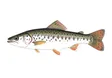
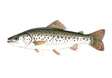
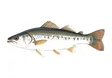
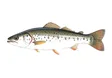
The body of the River Darter Percina shumardi is elongate and slightly compressed laterally. The back is brown to olive brown in color with lighter sides and a white belly. The snout is curved downwards and short. The mouth is slightly slanted and jaw protrudes past the eyes. River Darters are distinguished by 6-7 saddle marks on its back, 8-11 vertical bars along its side, and a black bar below the eyes. The spiny dorsal fin has a large black spot on tissue behind the last 3-4 spines. The caudal fins and second dorsal fins are lightly speckled and barred. Pelvic, pectoral, and anal fins are transparent to lightly pigmented. The species exhibits sexual dimorphism, males will normally have a line of modified scales from the anal fin to pelvic fin. Males will also have a thickened membrane on the edge of pelvic fins, while females lack this feature. Breeding males are typically darker and have more pronounced colors than females (Becker 1983).

Native range

Hudson Bay basin, Ontario, Manitoba, North Dakota, and south in Great Lakes and Mississippi River basins to Louisiana; Gulf drainages from Mobile Bay, Alabama, to Neches River, Texas; isolated population in San Antonio drainage, Texas (Page and Burr 1991). Native to Lake Michigan, Lake Huron, Lake Erie. Absent from Lake Superior and Lake America (Roth et al. 2013; Cudmore-Vokey and Crossman 2000). Although the species has been recorded from the Tennessee drainage in northeastern Tennessee, it has not been reported in Virginia (Jenkins and Burkhead 1994), North Carolina (Menhinick 1991), or Georgia (Dahlberg and Scott 1971a).

Habitat and ecology

Spawning can occurs at 10°C and has been observed in February at the earliest. Larvae take 6-7 days to hatch at temperatures of 22°C and likely take longer to hatch at lower temperatures. Larvae are active during the day can be found drifting downstream near the surface. Once larvae have grown from the initial size of 4mm to 12-15mm they are considered juveniles. Juveniles are found in areas with sand or gravel substrate and moderate current (Etnier and Starnes 1993). Sexual maturity is reached at age 1 and the average lifespan of individuals is three years old (Dalton 1990).

River Darters are benthic invertivores, primarily consuming chironomids, trichopterans, and small crustaceans (Thomas 1970). Small zooplankton are the primary food source for juveniles (Becker 1983). It is also known to exploit pleurocerid snail populations (Haag and Warren 2006).

Introduction history

The River Darter may have found its way to Illinois waters of Lake Michigan through the Chicago Sanitary and Ship Canal. The species likely gained access to the Lake Michigan drainage in Wisconsin via the Wisconsin-Fox Canal at Portage, Wisconsin (Becker 1983). It was first reported from this area in 1963 from the western shore of Lake Winnebago (Becker 1983). This species was not found in this drainage in surveys conducted in the late 1920s (Becker 1983). See Remarks section for a possible alternate scenario.

Range

Where it lives

Share of 1,478 GBIF observation records with a state location, across 21 states. The orange dots are USGS stream-survey sites where this species was caught.
0%
16.4%
Share of 1,478 GBIF observation records with a state location, across 21 states. The orange dots are USGS stream-survey sites where this species was caught.

A blank area on the dot layer usually means nobody sampled there, not that the fish is absent. Turn on “every survey site” to see where the survey looked.

The USGS stream survey caught it at 58 of its sites, in 13 states. That survey and the GBIF records are two different counts of two different things, so the site keeps them apart.

Habitat

Water and movement

Water
WoRMS records this species in fresh water.
USGS NAS habitat
Freshwater
US status
Native transplant — native to part of the United States, moved to other waters inside it.
Migration
Migratory
Pattern

Classification

Taxonomy

Kingdom
Animalia
Phylum
Chordata
Superclass
Actinopterygii
Class
Teleostei
Order
Perciformes
Family
Percidae
Genus
Percina
Species
Percina shumardi
ITIS TSN
168497
WoRMS AphiaID
593220
GBIF key
2382101
Outside the US
ITIS also files it in Canada.

Common questions about River Darter

What is the scientific name of River Darter?
The scientific name is Percina shumardi, in the family Percidae. Classification follows ITIS.
Does River Darter live in fresh water or salt water?
WoRMS records this species in fresh water.
Where has River Darter been recorded in the United States?
GBIF has observations in 21 states, with the most records in Alabama, Texas, Illinois. The map shows observation records, which do not establish the complete natural range.

Closest relatives

Other Percina species

Same family

More Percidae

All 229 species in Percidae