Quillback

Carpiodes cyprinus

Catostomidae · freshwater water fish

6 minute read · Species guide

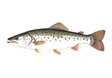
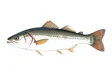
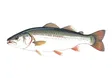
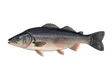
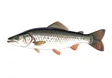
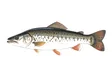
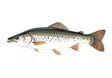
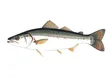
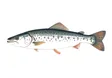
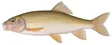
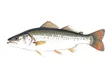
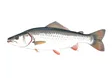
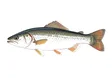
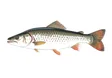
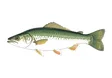
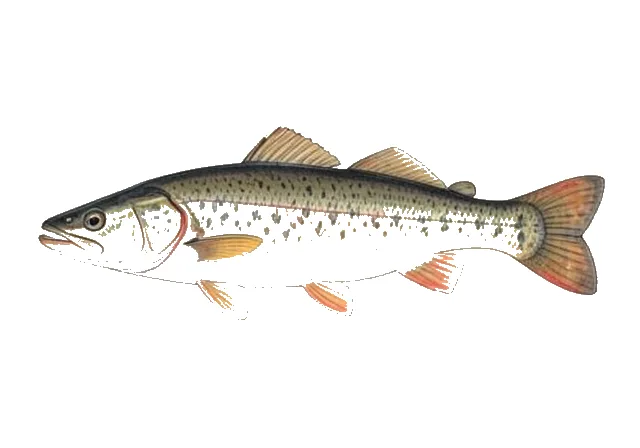
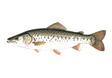
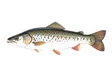
Quillback field guide illustration

About Quillback

The quillback (Carpiodes cyprinus), also known as the quillback sucker or quillback carpsucker, is a type of freshwater fish of the sucker family widely distributed throughout North America. It is deeper-bodied than most suckers, leading to a fuller-bodied appearance. However, the quillback is not a carp. Quillback are catostomids, and like all catostomids, they do not have barbels around the mouth. The quillback is long-lived, with age up to 30 years found in Florida, and lifespans of 44 - 52 years in Canada, Minnesota, Colorado, and Wisconsin.

Physical description

The quillback is a medium-sized, deep-bodied fish found throughout North America. It has a small head, humped back and deeply forked caudal fin. The compressed body of the quillback makes it look flattened when viewed from the side. The quillback has a subterminal mouth with no barbels, and no nipple-like protrusions on the bottom lip. It has large, reflective, silver cycloid scales that are responsible for giving the quillback its characteristic silver color. They have a white belly with yellow or orange lower fins. The tail and dorsal fin are usually gray or silver. The quillback gets its name from the long quill that is formed via the first several fin rays of the dorsal fin. Quillback are typically 15–20 inches on average, weighing between 1 and 4 pounds. However, they can grow up to 26 inches and weigh 10 pounds. The quillback has a nearly straight, hyper-sensitive lateral line, composed of at least 37 lateral line scales. This helps the fish locate predators and prey.

Distribution, habitat and diet

The quillback is found throughout much of North America, from Saskatchewan to Florida, and from South Dakota to Alabama. The quillback occupies temperate, freshwater habitats. This includes many streams, lakes, channels and rivers. They prefer water that is clear, slow moving, highly productive and moderately deep. The quillback can commonly be found in the Hudson Bay, the Mississippi River basin, the Great Lakes, and drainages from the Delaware, Apalachicola, and Pearl rivers. They often comprise a large portion of the biomass of warmwater rivers, but they are very difficult to catch with traditional American angling methods. The quillback is closely related to the highfin carpsucker and the river carpsucker. All three species are rarely caught by anglers due to their feeding habits, but they have been caught occasionally on worms, minnows, and artificial lures.

Quillbacks usually feed in schools. They are omnivores and bottom feeders that prefer lakes, rivers and streams in which the water is clear at the bottom. The school of quillbacks moves slowly over a sand or gravel bottom when they eat. Their typical diet consists of aquatic insect larvae and other small organisms although they have also been known to eat molluscs and aquatic vegetation.

Life history

The quillback is a slow-paced and long-lived freshwater fish species that belongs to a subfamily (Ictiobinae) for which long-lived freshwater fishes are becoming known. In Minnesota they can reach sexual maturity by age 8–9 years, live several decades at adult size, recruit sporadically, and can live more than 40 years. Quillback also may accrue age-spot pigmentation after 30 years, similar to their larger-bodied cousins, the bigmouth buffalo. A study from Colorado revealed sexual maturity by an age of 3 years, highly variable recruitment, population declines, and longevity approaching 50 years. Recruitment is also highly variable in Wisconsin, with asymptotic growth, lifespans more than 50 years, and black spot pigmentation accrual evident.

Reproduction

The quillback reproduces once yearly, typically in late spring or early summer. The timing of reproduction depends on the water temperature. Ideal temperatures for reproduction are between 7–18 degrees Celsius. Spawning occurs upstream of the typical quillback habitat, and they migrate in schools to the spawning site. The female quillback produces between 15,000 and 60,000 eggs, and scatters them in shallow water over a sandy or mud bottom. Fertilization then happens externally, and the eggs are left in quiet water. Since the quillback is oviparous, the eggs are hatched outside of the fish's body. The quillback possesses a polygynandrous mating system, meaning that two or more males have an exclusive sexual relationship with two or more females. Sex ratios may vary significantly by population.

Relationship with humans

The quillback is currently at risk for extinction in various states throughout the continental United States including Vermont, New York and Michigan. A recent threat to the species is modern bowfishing, which is unregulated across the USA and prone to harvest discard. Other places prove vulnerability and population declines to the species including Alberta, Saskatchewan, Quebec, South Dakota, Colorado, Kansas, Oklahoma, Arkansas, Louisiana and North Carolina. Quillbacks benefit the North American ecosystems they reside in because they are vital native members of the community. The quillback has an economic benefit to Mexico. The IGFA world record for the species stands at 8lb 1oz taken from Lake Manitoba in Canada in 2016.

Article text: Wikipedia contributors, Quillback (source revision). Licensed under CC BY-SA 4.0. Retrieved 2026-10-11.
Diet and feeding

The FishTraits compilation records these diet categories for this species: algae or phytoplankton; aquatic or other vascular plants; detritus or unidentified plant material; invertebrates or larval fish. These are broad categories, not a claim that every individual consumes every example in a category.

Reported feeding positions include bottom feeding. The compilation combines published observations; diets can vary with age, locality, and available food.

Habitat preferences

Reported habitat associations include medium to large rivers, streams and small rivers, still-water habitats.

The source records associations with sand, gravel, cobble, boulders, bedrock. An association indicates reported use, rather than an exclusive requirement.

Reproduction and parental care

The compilation reports a representative maturity age of 4 years. Its maturity field summarizes mean, median, or modal estimates, usually for females; male estimates can be used when female data are unavailable. It is not a fixed age at which every fish first breeds.

Recorded spawning months are Apr, May for the source’s reporting region (NC). This is a regional calendar, not a range-wide schedule.

The reproductive-guild classification includes spawning on open substrates without guarding the brood.

Size and recorded longevity

FishTraits reports a maximum total length of 66 centimetres. Some entries use an estimated asymptotic length; this value should not be treated as a certified record catch.

Recorded longevity in the compilation is 10 years. Wild observations were preferred, but captive records were accepted where wild records were unavailable, and unspecified records were assumed wild. The value is not a guaranteed wild lifespan or an aquarium life expectancy.

Identification and appearance

Becker (1983); Page and Burr (1991); Etnier and Starnes (1993); Jenkins and Burkhead (1994). Taxonomy of the genus Carpiodes on the lower Atlantic Slope is uncertain. Some of the forms resembling C. cyprinus and C. velifer may represent undescribed species (Gilbert, personal communication).

Native range

Great Lakes and St. Lawrence River, Hudson Bay, and Mississippi River basins from Quebec to Alberta and south to Louisiana; Atlantic Slope drainages from Delaware River, New York, to Altamaha River, South Carolina (except apparently absent from Rappahannock and York drainages in Virginia, and Tar and Neuse drainages in North Carolina). Gulf Slope drainages from Apalachicola River, Florida and Georgia, to Pearl River, Louisiana (Page and Burr 1991).

Record fish

State records in 3 states

  • Wisconsin13 lbs. 8.8 oz.

    Wolf River · Waupaca · 04/23/2022

  • Arkansas8 lbs., 0 oz.

    Bull Shoals · 03/02/2024 · Chance Williams, Harrison, AR · other legal means

  • Minnesota7 lb 4 oz

    Upper Red Lake · Beltrami · 8/9/2010

Each figure is the state agency’s own certified record. The site holds record tables for 11 states so far, so a state missing here has not been read yet. It is not a state where this fish holds no record.

Range

Where it lives

Share of 4,716 GBIF observation records with a state location, across 35 states. The orange dots are USGS stream-survey sites where this species was caught.
0%
18.1%
Share of 4,716 GBIF observation records with a state location, across 35 states. The orange dots are USGS stream-survey sites where this species was caught.

A blank area on the dot layer usually means nobody sampled there, not that the fish is absent. Turn on “every survey site” to see where the survey looked.

The USGS stream survey caught it at 1,393 of its sites, in 29 states. That survey and the GBIF records are two different counts of two different things, so the site keeps them apart.

Habitat

Water and movement

Water
WoRMS records this species in fresh water.
USGS NAS habitat
Freshwater
US status
Native transplant — native to part of the United States, moved to other waters inside it.
Migration
Migratory
Pattern

Classification

Taxonomy

Kingdom
Animalia
Phylum
Chordata
Superclass
Actinopterygii
Class
Teleostei
Order
Cypriniformes
Genus
Carpiodes
Species
Carpiodes cyprinus
ITIS TSN
163917
WoRMS AphiaID
1022879
GBIF key
2358950
Outside the US
ITIS also files it in Canada.

Common questions about Quillback

What is the scientific name of Quillback?
The scientific name is Carpiodes cyprinus, in the family Catostomidae. Classification follows ITIS.
Does Quillback live in fresh water or salt water?
WoRMS records this species in fresh water.
Where has Quillback been recorded in the United States?
GBIF has observations in 35 states, with the most records in Illinois, Minnesota, Ohio. The map shows observation records, which do not establish the complete natural range.

Closest relatives

Other Carpiodes species

Same family

More Catostomidae

Alabama Hog Sucker6 states
Hypentelium etowanumCatostomidaeNative and introducedFresh
Bigeye Jumprock3 states
Moxostoma ariommumCatostomidaeNativeFresh
Bigmouth Buffalo26 states
Ictiobus cyprinellusCatostomidaeNative and introducedFresh
Black Buffalo26 states
Ictiobus nigerCatostomidaeNative and introducedFresh
Black Redhorse
Moxostoma duquesneiCatostomidaeNativeFresh
Blackfin Sucker2 states
Thoburnia atripinnisCatostomidaeNativeFresh
Blacktail Redhorse9 states
Moxostoma poecilurumCatostomidaeNativeFresh
Blacktip Jumprock7 states
Moxostoma cervinumCatostomidaeNative and introducedFresh
Blue Sucker22 states
Cycleptus elongatusCatostomidaeNativeFresh
Bluehead Sucker7 states
Pantosteus discobolusCatostomidaeNativeFresh
Bridgelip Sucker5 states
Catostomus columbianusCatostomidaeNativeFresh
Creek Chubsucker31 states
Erimyzon oblongusCatostomidaeNativeFresh
Cui-ui2 states
Chasmistes cujusCatostomidaeNativeFresh
Desert Sucker9 states
Pantosteus clarkiiCatostomidaeNativeFresh
Flannelmouth Sucker8 states
Catostomus latipinnisCatostomidaeNativeFresh
Golden Redhorse29 states
Moxostoma erythrurumCatostomidaeNative and introducedFresh
Gray Redhorse2 states
Moxostoma congestumCatostomidaeNative and introducedFresh
Greater Jumprock4 states
Moxostoma lachneriCatostomidaeNative and introducedFresh
Greater Redhorse11 states
Moxostoma valenciennesiCatostomidaeNativeFresh
Green Sucker4 states
Pantosteus virescensCatostomidaeNativeFresh
Highfin Carpsucker23 states
Carpiodes veliferCatostomidaeNative and introducedFresh
June Sucker1 states
Chasmistes liorusCatostomidaeNativeFresh
Klamath Largescale Sucker2 states
Catostomus snyderiCatostomidaeNativeFresh
Klamath Smallscale Sucker2 states
Catostomus rimiculusCatostomidaeNativeFresh

All 67 species in Catostomidae