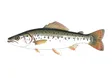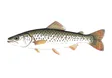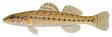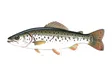
Western Sand Darter

Ammocrypta clara

Percidae · freshwater water fish

3 minute read · Species guide

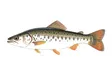
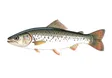
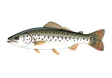
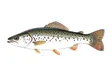
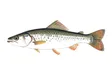
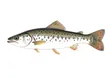
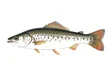
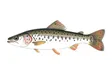
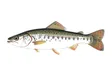
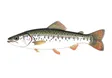
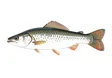
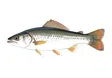
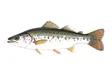
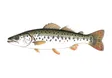
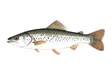
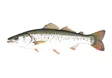
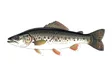
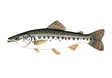
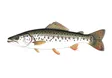
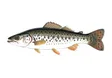
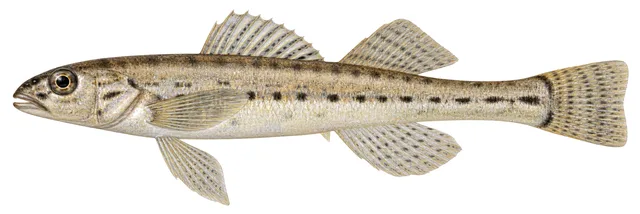
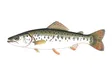
Western Sand Darter field guide illustration

About Western Sand Darter

The western sand darter (Ammocrypta clara) is a species of freshwater ray-finned fish, a darter from the subfamily Etheostomatinae, part of the family Percidae, which also contains the perches, ruffes and pikeperches. It is native to the central United States.

Distribution

The western sand darter occurs in river systems from Lake Michigan to Texas, including several sections of the Mississippi Basin. Its range extends as far east as the Elk River in West Virginia.

Description

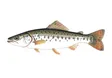
This species is up to 7.1 centimeters in length. It is slender and nearly cylindrical in shape. It is pale, translucent silvery white with yellowish coloration along the back. It is distinguished from other sand darters the lack of dark bands or blotches, and by a spine on its operculum.

Biology

This fish lives in medium and large rivers, over sandy and gravel substrates. It requires loose substrate, because it spends much of its time buried in the sand with just its head protruding. This behavior helps it reach cooler temperatures.

It feeds on invertebrates, especially the larvae of aquatic insects.

It spawns in summer, starting in June in northern regions and May farther south. Females produce an average of 57 eggs at a time, with larger females producing more eggs.

Taxonomy

The Western sand darter was first formally described in 1885 by the American ichthyologists David Starr Jordan (1851–1931) and Seth Eugene Meek (1859–1914) with the type locality given as the Des Moines River at Ottumwa, Iowa. This species forms a clade with the naked sand darter (A. beanii) the Florida sand darter (A. bifascia).

Conservation

This is considered to be a vulnerable species because it has a fragmented distribution and its habitat is degraded in many areas. Increased silt and pollution in river systems reduces the quality of its habitat. The Mississippi River and associated streams and tributaries are heavily channelized and partitioned by locks and dams, eliminating sites where the fish might live.

Article text: Wikipedia contributors, Western sand darter (source revision). Licensed under CC BY-SA 4.0. Retrieved 2026-10-11.
Diet and feeding

The FishTraits compilation records these diet categories for this species: invertebrates or larval fish. These are broad categories, not a claim that every individual consumes every example in a category.

Reported feeding positions include bottom feeding. The compilation combines published observations; diets can vary with age, locality, and available food.

Habitat preferences

Reported habitat associations include medium to large rivers.

The source records associations with sand, gravel, cobble. An association indicates reported use, rather than an exclusive requirement.

Reproduction and parental care

The compilation reports a representative maturity age of 1 years. Its maturity field summarizes mean, median, or modal estimates, usually for females; male estimates can be used when female data are unavailable. It is not a fixed age at which every fish first breeds.

Batch or serial spawning has been reported somewhere in the species’ range. This does not establish the same spawning pattern for every population.

Recorded spawning months are Jun, Jul for the source’s reporting region (WI). This is a regional calendar, not a range-wide schedule.

The reproductive-guild classification includes spawning on open substrates without guarding the brood.

Size and recorded longevity

FishTraits reports a maximum total length of 7.1 centimetres. Some entries use an estimated asymptotic length; this value should not be treated as a certified record catch.

Recorded longevity in the compilation is 2 years. Wild observations were preferred, but captive records were accepted where wild records were unavailable, and unspecified records were assumed wild. The value is not a guaranteed wild lifespan or an aquarium life expectancy.

Native range

Mississippi River basin from Wisconsin and Minnesota south to Mississippi and Sabine and Neches river drainages, Texas; also in the Green, Cumberland, and Tennessee river drainages (presumably extinct in the first two); generally sporadic and rare (Williams 1975; Page and Burr 1991).

Habitat and ecology

Inhabits medium to large streams with moderate current, over sandy areas where it will bury itself leaving only the eyes and mouth visible (Etnier and Starnes 1993).

Introduction history

These fish likely gained access to the Wolf system via the Wisconsin-Fox Canal (Becker 1983). Mechanism of transport to West Virginia is unknown.

Range

Where it lives

Share of 462 GBIF observation records with a state location, across 15 states. The orange dots are USGS stream-survey sites where this species was caught.
0%
16.7%
Share of 462 GBIF observation records with a state location, across 15 states. The orange dots are USGS stream-survey sites where this species was caught.

A blank area on the dot layer usually means nobody sampled there, not that the fish is absent. Turn on “every survey site” to see where the survey looked.

The USGS stream survey caught it at 30 of its sites, in 6 states. That survey and the GBIF records are two different counts of two different things, so the site keeps them apart.

Habitat

Water and movement

Water
WoRMS records this species in fresh water.
USGS NAS habitat
Freshwater
US status
Native transplant — native to part of the United States, moved to other waters inside it.
Migration
Migratory
Pattern

Classification

Taxonomy

Kingdom
Animalia
Phylum
Chordata
Superclass
Actinopterygii
Class
Teleostei
Order
Perciformes
Family
Percidae
Genus
Ammocrypta
Species
Ammocrypta clara
ITIS TSN
168515
WoRMS AphiaID
1019836
GBIF key
2381980

Common questions about Western Sand Darter

What is the scientific name of Western Sand Darter?
The scientific name is Ammocrypta clara, in the family Percidae. Classification follows ITIS.
Does Western Sand Darter live in fresh water or salt water?
WoRMS records this species in fresh water.
Where has Western Sand Darter been recorded in the United States?
GBIF has observations in 15 states, with the most records in Illinois, Texas, Arkansas. The map shows observation records, which do not establish the complete natural range.

Closest relatives

Other Ammocrypta species

Same family

More Percidae

All 229 species in Percidae