Southern Sand Darter

Ammocrypta meridiana

Percidae · freshwater water fish

2 minute read · Species guide

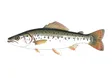
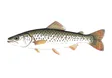
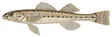
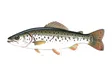
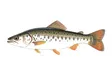
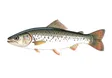
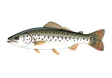
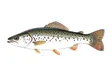
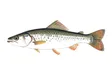
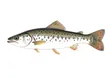
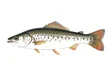
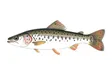
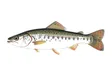
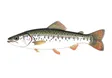
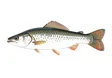
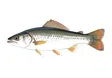
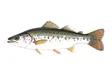
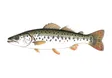
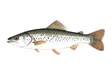
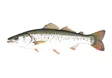
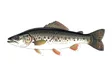
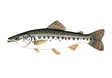
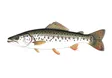
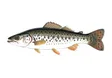
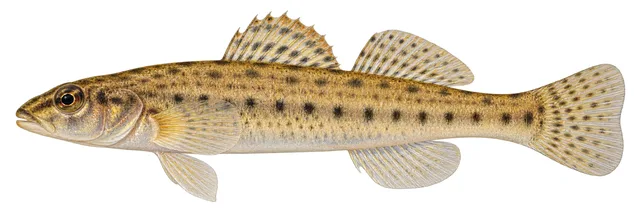
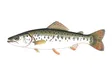
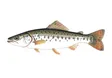
Southern Sand Darter field guide illustration

About Southern Sand Darter

The southern sand darter (Ammocrypta meridiana) is a species of freshwater ray-finned fish, a darter from the subfamily Etheostomatinae, part of the family Percidae, which also contains the perches, ruffes and pikeperches. It is found in the rivers draining into Mobile Bay in the southeastern United States where it inhabits sandy sections of flowing waters from streams to large rivers.

Description

The Southern sand darter is a close relative of the Eastern sand darter (A. pellucida) and of the scaly sand darter (A. vivax). It can be told apart from the scaly sand darter by the lack of any dark bands on the dorsal, anal or caudal fins, that the blotches along the lateral line are lengthened horizontally and that there are no tubercles on the anal fin when breeding. It is more completely covered in scales than the Eastern sand darter, the tip of its snout is usually coloured. This species can reach a length of 7.1 cm (2.8 in), though most are only about 7 cm (2.8 in) in length.

Distribution

The Southern sand darter is found in the rivers draining into Mobile Bay in Alabama and Mississippi. It occurs throughout the Alabama River system, the Tombigbee River, the Black Warrior River, the Cahaba River and the Tallapoosa River.

Habitat and biology

The southern sand darter occur in moderate to large streams and rivers which have clean sandy beds and a moderate current. They are found in water with depths which range from 15 to 150 centimetres (5.9 to 59.1 in). They appear to spawn from early June up to late July. They feed on invertebrates.

Taxonomy

The Southern sand darter was first formally described in 1975 by the American biologist James D. Williams with the type locality given as Cedar Creek on Alabama State Route 41 near Sardis, Alabama. This species forms a clade within the genus Ammocrypta with the scaly sand darter and the eastern sand darter.

Article text: Wikipedia contributors, Southern sand darter (source revision). Licensed under CC BY-SA 4.0. Retrieved 2026-10-11.
Diet and feeding

The FishTraits compilation records these diet categories for this species: invertebrates or larval fish. These are broad categories, not a claim that every individual consumes every example in a category.

Habitat preferences

Reported habitat associations include medium to large rivers, streams and small rivers.

The source records associations with sand. An association indicates reported use, rather than an exclusive requirement.

Reproduction and parental care

Recorded spawning months are May, Jun for the source’s reporting region (AL). This is a regional calendar, not a range-wide schedule.

Size and recorded longevity

FishTraits reports a maximum total length of 5.8 centimetres. Some entries use an estimated asymptotic length; this value should not be treated as a certified record catch.

Range

Where it lives

Share of 594 GBIF observation records with a state location, across 3 states.
0%
52.2%
Share of 594 GBIF observation records with a state location, across 3 states.

Habitat

Water and movement

Water
WoRMS records this species in fresh water.
Migration
Undetermined

Classification

Taxonomy

Kingdom
Animalia
Phylum
Chordata
Superclass
Actinopterygii
Class
Teleostei
Order
Perciformes
Family
Percidae
Genus
Ammocrypta
Species
Ammocrypta meridiana
ITIS TSN
168516
WoRMS AphiaID
1383653
GBIF key
2381975

Common questions about Southern Sand Darter

What is the scientific name of Southern Sand Darter?
The scientific name is Ammocrypta meridiana, in the family Percidae. Classification follows ITIS.
Does Southern Sand Darter live in fresh water or salt water?
WoRMS records this species in fresh water.
Where has Southern Sand Darter been recorded in the United States?
GBIF has observations in 3 states, with the most records in Alabama, Mississippi, Florida. The map shows observation records, which do not establish the complete natural range.

Closest relatives

Other Ammocrypta species

Same family

More Percidae

All 229 species in Percidae