Tangerine Darter

Percina aurantiaca

Percidae · freshwater water fish

5 minute read · Species guide

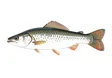
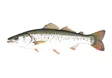
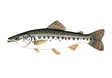
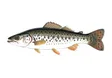
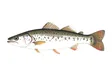
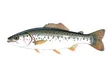
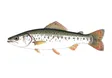
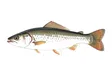
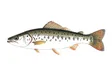
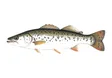
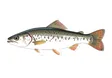
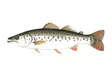
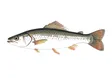
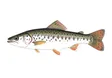
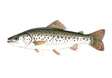
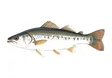
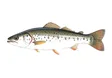
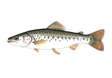
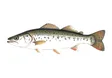
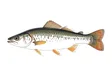
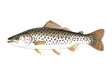
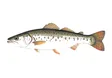
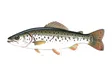
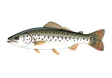
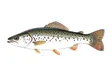
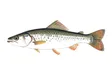
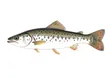
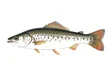
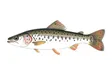
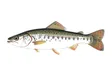
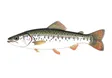
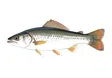
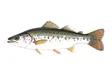
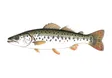
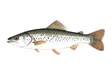
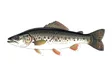
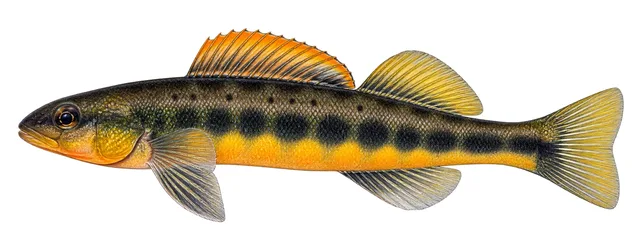
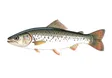
Tangerine Darter field guide illustration

About Tangerine Darter

The tangerine darter or river slick (Percina aurantiaca) is a small species of freshwater ray-finned fish, a darter from the subfamily Etheostomatinae, part of the family Percidae, which also contains the perches, ruffes and pikeperches. It is found in the eastern United States. It grows to a length of 4.3 to 7.1 inches (11 to 18 cm), males being bright orange-red while females are yellow. It is insectivorous, picking insect larvae off aquatic plants and the riverbed, and sometimes rolling small stones over to expose prey. It breeds in late spring and early summer, typically in shallow sandy or gravelly riffles. Pollution and habitat degradation may be a problem in parts of its range; however, it is a fairly common fish with a wide range and the International Union for Conservation of Nature has classified its conservation status as being of "least concern".

Appearance and anatomy

Tangerine darters are typically 4.3 to 7.1 inches (11 to 18 cm) in length, large for a darter species. The males are usually a bright orangish-red color, more elaborately colored than the females, which are yellow.

Distribution

They are a fairly common species; however, their range is limited to clear, cool streams of the southern Appalachian Mountains. The tangerine darter is found throughout mountainous regions of the upper Tennessee River drainage. It resides in smaller rivers and is most common in the Emory, Hiwassee, Little, Little Pigeon, and Tellico rivers. It is found in eastern Tennessee, northern Georgia, and western North Carolina, and Virginia. In Georgia and North Carolina, it is listed as a historic species in need of management.

Habitat and life history

The tangerine darter inhabits clear and cool creeks or small rivers. In these rivers it likes areas that have large boulders, bedrock and a gravel substrate. It also likes to swim in the deeper riffles of these rivers. In winter, the tangerine moves to deeper pools.

The tangerine darter spawns in late spring to summer, in shallow sandy gravel riffles that have consistent flowing water. The breeding season, which is triggered by water temperature, begins in May and runs through July. Spawning occurs at about three to four years of age, although sexual maturity comes much earlier for tangerine darters, with males reaching maturity at one year of age and females two years of age. The species' life span is about four years.

Tangerine darters spawn by first the male mounting the female; the female then scatters her eggs over the gravel, while the male disperses milt and fertilizes the eggs. While doing this both the male and female make a quivering motion. Females choose the most brightly colored males (bright orange black line with some blue where orange meets the black). Males also become territorial during mating season and will defend their spawning riffles. Females lay between 120 and 1,100 eggs. The tangerine darter does not care for its eggs. Juveniles are found in calmer water and grow to between 2 and 3 inches (5.1 and 7.6 cm) in their first year of growth.

Diet

The tangerine darter is an insectivorous fish. Juveniles feed primarily on mayflies and midges, and adults feed on mayflies and caddisflies. Tangerine darters get their food by searching through the aquatic vegetation and eating the aquatic insects off of the plants. Adults are also big enough to roll small gravel in search of prey. Although the tangerine darter is not a game species, it is sometimes caught by fly fishermen using mayfly and caddisfly patterns.

Threats

The biggest threat to the tangerine darter is habitat degradation. This is due to point and nonpoint pollution, erosion and sedimentation.

On the Pigeon River in East Tennessee, tangerine darter populations declined and recovered. In 1908, Champion International built a paper mill on the river and decimated many of the native fish. In the 1980s the mill cleaned up its refuse and the river is steadily getting better. Tangerine darters have been successfully reintroduced back into the Pigeon River downstream of the paper mill.

In general, the tangerine darter has a wide range, has a large number of subpopulations and a large total population size, and no major threats have been identified, so the International Union for Conservation of Nature has classified its conservation status as being of "least concern".

Article text: Wikipedia contributors, Tangerine darter (source revision). Licensed under CC BY-SA 4.0. Retrieved 2026-10-11.
Diet and feeding

The FishTraits compilation records these diet categories for this species: invertebrates or larval fish. These are broad categories, not a claim that every individual consumes every example in a category.
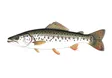
Reported feeding positions include bottom feeding. The compilation combines published observations; diets can vary with age, locality, and available food.

Habitat preferences

Reported habitat associations include medium to large rivers, streams and small rivers.

The source records associations with clay or silt, sand, gravel, cobble, boulders, bedrock. An association indicates reported use, rather than an exclusive requirement.

Reproduction and parental care

The compilation reports a representative maturity age of 3 years. Its maturity field summarizes mean, median, or modal estimates, usually for females; male estimates can be used when female data are unavailable. It is not a fixed age at which every fish first breeds.

Batch or serial spawning has been reported somewhere in the species’ range. This does not establish the same spawning pattern for every population.

Recorded spawning months are May, Jun for the source’s reporting region (NC). This is a regional calendar, not a range-wide schedule.

The reproductive-guild classification includes spawning on open substrates without guarding the brood.

Size and recorded longevity

FishTraits reports a maximum total length of 18 centimetres. Some entries use an estimated asymptotic length; this value should not be treated as a certified record catch.

Recorded longevity in the compilation is 4.5 years. Wild observations were preferred, but captive records were accepted where wild records were unavailable, and unspecified records were assumed wild. The value is not a guaranteed wild lifespan or an aquarium life expectancy.

Range

Where it lives

Share of 477 GBIF observation records with a state location, across 4 states. The orange dots are USGS stream-survey sites where this species was caught.
0%
54.7%
Share of 477 GBIF observation records with a state location, across 4 states. The orange dots are USGS stream-survey sites where this species was caught.

A blank area on the dot layer usually means nobody sampled there, not that the fish is absent. Turn on “every survey site” to see where the survey looked.

The USGS stream survey caught it at 26 of its sites, in 3 states. That survey and the GBIF records are two different counts of two different things, so the site keeps them apart.

Habitat

Water and movement

Water
WoRMS records this species in fresh water.
Migration
Not migratory

Classification

Taxonomy

Kingdom
Animalia
Phylum
Chordata
Superclass
Actinopterygii
Class
Teleostei
Order
Perciformes
Family
Percidae
Genus
Percina
Species
Percina aurantiaca
ITIS TSN
168477
WoRMS AphiaID
1461254
GBIF key
2382052

Common questions about Tangerine Darter

What is the scientific name of Tangerine Darter?
The scientific name is Percina aurantiaca, in the family Percidae. Classification follows ITIS.
Does Tangerine Darter live in fresh water or salt water?
WoRMS records this species in fresh water.
Where has Tangerine Darter been recorded in the United States?
GBIF has observations in 4 states, with the most records in Tennessee, North Carolina, Virginia. The map shows observation records, which do not establish the complete natural range.

Closest relatives

Other Percina species

Same family

More Percidae

All 229 species in Percidae