Smallmouth Buffalo

Ictiobus bubalus

Catostomidae · freshwater water fish

7 minute read · Species guide

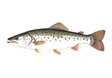
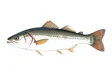
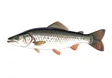
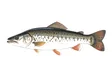
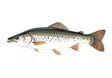
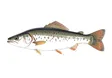
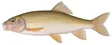
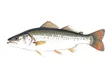
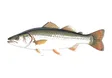
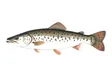
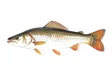
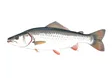
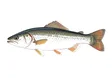
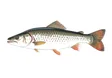
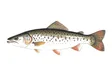
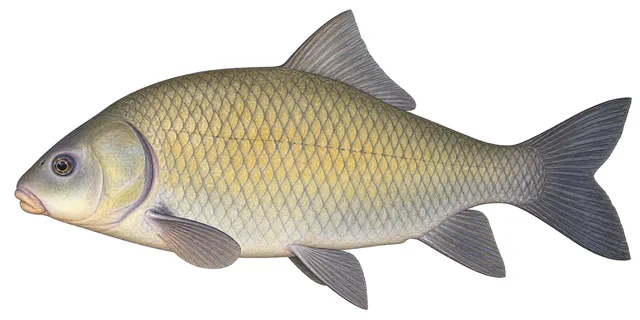
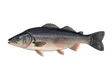
Smallmouth Buffalo field guide illustration

About Smallmouth Buffalo

The smallmouth buffalo (Ictiobus bubalus, from the Greek for "bull-fish"and"buffalo") is a catostomid fish species native to the major tributaries and surrounding waters of the Mississippi River in the United States, as well as some other water systems where it has been introduced. It is a long-lived, stocky fish like its relatives the bigmouth buffalo (I. cyprinellus) and the black buffalo (I. niger). The smallmouth buffalo's mouth is located ventrally like other Catostomidae species, whereas the bigmouth buffalo's mouth is terminal and opens forward. It is thought that smallmouth buffalo eyes are significantly larger than those of the black buffalo. Despite being members of different scientific suborders, these three species are sometimes conflated with common carp (Cyprinus carpio), but an easy and notable difference is that all catostomids lack the characteristic barbels of carp, and carp are not native to North America whereas buffalofish are. The smallmouth buffalo is recently realized as one of the longest-lived fishes, capable of living more than a century. The smallmouth buffalo is in decline across large portions of its range, and is subject to unregulated exploitation. Like the other buffalofish species, the smallmouth buffalo is targeted by modern bowfishing.

Description

The coloration of smallmouth buffalo ranges from shades of gray to brown and coppery green dorsally and pale yellow to white ventrally. Fins color match the portion of the body where they attach and are generally darker towards the tips. They are characteristically stocky, having a hump that rises up from the operculum. Pectoral fins protrude ventrally like the anal fins, the caudal fin has even lobes, and the dorsal fin protrudes from the top of the hump to a blunt point, then shortens and runs the remaining length of the body to the base of the tail. Typical adults reach a length around 40–60 cm (16–24 in), with some specimens reaching as much as 30.1 kg (66.4 pounds) and 101.5 cm (40.0 in).

Habitat

The smallmouth buffalo is a hardy fish that frequents clear, moderate to fast-moving streams, but has been occasionally known in some lakes and ponds. If prefers waters with dense aquatic vegetation and a silty bottom. It has a high tolerance for hard water and can survive in waters with pH ranges of 6.5–8.5.

Diet

The smallmouth buffalo's diet is primarily that of a detritivore, using its ventral sucker mouth to pick up vegetation and other organic matter from the bottom of its habitat, often scraping algae off of rocks. It is also quite the invertivore, consuming zooplankton, insect larvae, mollusk larvae, and small crustaceans.

Life history

Spawning usually takes place in spring and summer, with more specific times depending on the location of the population. Migration is negligible. Spawning often occurs in shallower sections of streams where the egg can adhere to vegetation and gravel to keep from flowing away. Each female can lay tens of thousands to hundreds of thousands of eggs at a time depending on her size, and no parental care is applied and the eggs hatch in one to two weeks. The young hide in aquatic vegetation to avoid predators. The lifespan of a smallmouth buffalo was historically not well known because of limited study on their otoliths and a reliance instead on other structures (e.g. scales, fin rays, gill plates) that are inadequate for age analysis. However, a 2019 study took an initial look at their otoliths (earstones) from a commercially harvested population in the middle Mississippi River drainage and found that even with harvest, about half of the sample was 20 years or older, with the oldest being 39 years of age. A 2020 study on a single female specimen from Oklahoma found it was 62 years old. In 2023, smallmouth buffalo otoliths were age validated, with longevity more than 60 years in Oklahoma. In Arizona, smallmouth buffalo as old as 90–100 years of age were discovered. The onset of sexual maturity for smallmouth buffalo can vary by population but is typically 6–10 years for males and around 8–11 years for females.

Relationship with humans

Although historically and derogatorily considered by many to be a rough fish, smallmouth buffalo are native to North American ecosystems, are the most common commercially sold freshwater fish in the United States, are sought after by traditional anglers on rod-and-line, and they have rapidly become sportfish as modernized night bowfishing has become increasingly popular since 2010 - a sport that targets this species among others. Management of this species is in urgent need of reassessment as essentially no agency is tracking the ecological impact of modernized bowfishing, and there are virtually no limits on harvest. The species is highly valued by some as a human food source and the fish meal is common in animal feed. They are relatively quick and easy to raise in commercial farm ponds. Anglers seeking to hook a smallmouth buffalo have found success with doughballs and corn on hooks.

An 82 lb 3 oz (37.3 kg) fish taken from Athens Lake, Texas on May 6, 1993, by angler Randy Collins stands as the International Game Fish Association (IGFA) all-tackle world record for the species, while a 63 cm (2.07 ft) specimen caught on May 16, 2022, in Livingston Lake, Texas by James Schmid is the current IGFA all-tackle length record. The North Carolina state record for smallmouth buffalo is an 88 lb (40 kg) fish caught in Lake Wylie on November 14, 1993, by Tony Crawford, who had previously set the state record with a 61.02 lb (27.68 kg) fish caught at the same lake on December 1, 1991, both through use of packbait. Smallmouth buffalo are not native to eastern North Carolina, but it is not known when they were introduced there.

Article text: Wikipedia contributors, Smallmouth buffalo (source revision). Licensed under CC BY-SA 4.0. Retrieved 2026-10-11.
Diet and feeding

The FishTraits compilation records these diet categories for this species: algae or phytoplankton; aquatic or other vascular plants; detritus or unidentified plant material; invertebrates or larval fish. These are broad categories, not a claim that every individual consumes every example in a category.

Reported feeding positions include bottom feeding. The compilation combines published observations; diets can vary with age, locality, and available food.

Habitat preferences

Reported habitat associations include medium to large rivers, streams and small rivers, still-water habitats.

The source records associations with vegetation, organic debris, large woody material. An association indicates reported use, rather than an exclusive requirement.

Reproduction and parental care

The compilation reports a representative maturity age of 2 years. Its maturity field summarizes mean, median, or modal estimates, usually for females; male estimates can be used when female data are unavailable. It is not a fixed age at which every fish first breeds.

Recorded spawning months are Mar, Apr, May, Jun for the source’s reporting region (NC). This is a regional calendar, not a range-wide schedule.

The reproductive-guild classification includes spawning on open substrates without guarding the brood.

Size and recorded longevity

FishTraits reports a maximum total length of 112 centimetres. Some entries use an estimated asymptotic length; this value should not be treated as a certified record catch.

Recorded longevity in the compilation is 17.5 years. Wild observations were preferred, but captive records were accepted where wild records were unavailable, and unspecified records were assumed wild. The value is not a guaranteed wild lifespan or an aquarium life expectancy.

Spawning movements

The compilation records significant spawning-related movement. Its combined migration flag covers movements within fresh water as well as between rivers and the sea; this flag alone does not establish which migration pattern applies.

Identification and appearance

The body of Smallmouth Buffalo (Ictiobus bubalus) is deep and highly compressed. Fins are slate brown in color, the back bronze or slate olive, and sides bronze. Colors lighten with age. The snout is blunt with a small, ventral horizontal mouth. Inside the mouth there are 180-190 small fragile teeth per arch. The dorsal fin of Smallmouth Buffalo is sickle shaped with 26-31 rays. Anal fins have approximately 9-10 rays and pelvic fins 9-11 rays. Sexes can be distinguished by the longest dorsal ray which is significantly larger in females (Becker 1983). Common hybridization among buffalo species has caused difficulty in identifying individual species (Dahline 2014).

Native range

Lake Michigan drainage and Mississippi River basin from Pennsylvania and Michigan to Montana and south to Gulf of America; Gulf Slope drainages from Mobile Bay, Alabama, to Rio Grande, Texas and New Mexico. Also in Mexico (Page and Burr 1991).

Habitat and ecology

The Smallmouth Buffalo begins spawning in April to early June at temperatures of 15.6-18.3°C (Becker 1983). 18,000-500,000 adhesive eggs per female are randomly disturbed over any substrate. Smallmouth Buffalo have a possible preference for spawning over submerged vegetation (Etnier and Starnes 1993). Spawning has been observed to be the most successful in years when water levels rise during the spring to flood marshes or low-lying meadows (Becker 1983).

The diet of Ictiobus bubalus under one year old is composed of copepods and cladocerans. Other food sources for young include algae, duckweed, protozoans, rotifers, insect larvae, and insect eggs. When mature, Ictiobus bubalus is an opportunistic feeder, feeding on organisms that are most abundant. The primary source of food depends on where the species is found (Becker 1983).

Introduction history

Accidental introduction in Arizona in 1918 with bigmouth buffalo I. cyprinellus (Minckley 1973; Rinne 1994); unknown means in California, and South Carolina. Likely stocked in North Carolina (Leach 1921, 1923). Stocked in Wisconsin during fish rescue operations from the Mississippi River in the 1930s (Becker 1983).

Record fish

State records in 6 states

  • Arkansas74 lbs., 0 oz.

    Millwood Lake · 04/15/2007 · Zane Barrett, Murfreesboro, AR · other legal means

  • Texas71.63 lb

    Lady Bird Lake · Jun 10, 2024 · Austin Anderson · Tiger Nuts

  • Arkansas68 lbs., 8 oz.

    Lake Hamilton · 05/15/1984 · Jerry Dolezal, Berwyn, IL · rod and reel

  • Oklahoma66 lbs 3.00 ozs

    Broken Bow Lake · 05/03/2019 · Hugh M. Newman · rod and line

  • Montana40 lbs.

    Nelson Reservoir · 5/27/23 · Deborah Henry

  • Texas27.95 lb

    Brazos River · Oct 15, 2024 · Joan Swartz · Fly Rod, Hamon's Buffalo Getter

  • Minnesota20 lb 0 oz

    Big Sandy · Aitkin · 9/20/2003

  • Wisconsin20 lbs

    Milwaukee River · Washington · 12/03/1999

Each figure is the state agency’s own certified record. The site holds record tables for 11 states so far, so a state missing here has not been read yet. It is not a state where this fish holds no record.

Range

Where it lives

Share of 13,922 GBIF observation records with a state location, across 27 states. The orange dots are USGS stream-survey sites where this species was caught.
0%
75.5%
Share of 13,922 GBIF observation records with a state location, across 27 states. The orange dots are USGS stream-survey sites where this species was caught.

A blank area on the dot layer usually means nobody sampled there, not that the fish is absent. Turn on “every survey site” to see where the survey looked.

The USGS stream survey caught it at 1,015 of its sites, in 24 states. That survey and the GBIF records are two different counts of two different things, so the site keeps them apart.

Habitat

Water and movement

Water
WoRMS records this species in fresh water.
USGS NAS habitat
Freshwater
US status
Native transplant — native to part of the United States, moved to other waters inside it.
Migration
Migratory
Pattern

Classification

Taxonomy

Kingdom
Animalia
Phylum
Chordata
Superclass
Actinopterygii
Class
Teleostei
Order
Cypriniformes
Genus
Ictiobus
Species
Ictiobus bubalus
ITIS TSN
163955
WoRMS AphiaID
1022862
GBIF key
2359075
Outside the US
ITIS also files it in Canada, Mexico.

Common questions about Smallmouth Buffalo

What is the scientific name of Smallmouth Buffalo?
The scientific name is Ictiobus bubalus, in the family Catostomidae. Classification follows ITIS.
Does Smallmouth Buffalo live in fresh water or salt water?
WoRMS records this species in fresh water.
Where has Smallmouth Buffalo been recorded in the United States?
GBIF has observations in 27 states, with the most records in Texas, Oklahoma, Illinois. The map shows observation records, which do not establish the complete natural range.

Closest relatives

Other Ictiobus species

Same family

More Catostomidae

Alabama Hog Sucker6 states
Hypentelium etowanumCatostomidaeNative and introducedFresh
Bigeye Jumprock3 states
Moxostoma ariommumCatostomidaeNativeFresh
Bigmouth Buffalo26 states
Ictiobus cyprinellusCatostomidaeNative and introducedFresh
Black Buffalo26 states
Ictiobus nigerCatostomidaeNative and introducedFresh
Black Redhorse
Moxostoma duquesneiCatostomidaeNativeFresh
Blackfin Sucker2 states
Thoburnia atripinnisCatostomidaeNativeFresh
Blacktail Redhorse9 states
Moxostoma poecilurumCatostomidaeNativeFresh
Blacktip Jumprock7 states
Moxostoma cervinumCatostomidaeNative and introducedFresh
Blue Sucker22 states
Cycleptus elongatusCatostomidaeNativeFresh
Bluehead Sucker7 states
Pantosteus discobolusCatostomidaeNativeFresh
Bridgelip Sucker5 states
Catostomus columbianusCatostomidaeNativeFresh
Creek Chubsucker31 states
Erimyzon oblongusCatostomidaeNativeFresh
Cui-ui2 states
Chasmistes cujusCatostomidaeNativeFresh
Desert Sucker9 states
Pantosteus clarkiiCatostomidaeNativeFresh
Flannelmouth Sucker8 states
Catostomus latipinnisCatostomidaeNativeFresh
Golden Redhorse29 states
Moxostoma erythrurumCatostomidaeNative and introducedFresh
Gray Redhorse2 states
Moxostoma congestumCatostomidaeNative and introducedFresh
Greater Jumprock4 states
Moxostoma lachneriCatostomidaeNative and introducedFresh
Greater Redhorse11 states
Moxostoma valenciennesiCatostomidaeNativeFresh
Green Sucker4 states
Pantosteus virescensCatostomidaeNativeFresh
Highfin Carpsucker23 states
Carpiodes veliferCatostomidaeNative and introducedFresh
June Sucker1 states
Chasmistes liorusCatostomidaeNativeFresh
Klamath Largescale Sucker2 states
Catostomus snyderiCatostomidaeNativeFresh
Klamath Smallscale Sucker2 states
Catostomus rimiculusCatostomidaeNativeFresh

All 67 species in Catostomidae