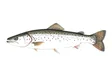
Pygmy Whitefish

Prosopium coulterii

Salmonidae · freshwater water fish

4 minute read · Species guide

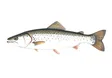
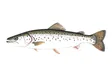
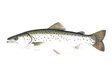
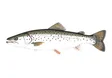
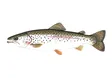
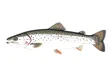
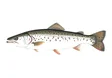
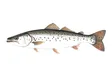
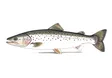
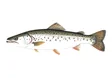
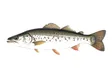
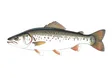
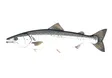
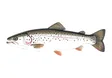
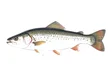
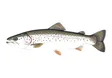
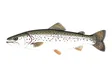
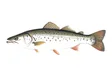
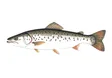
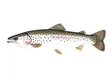
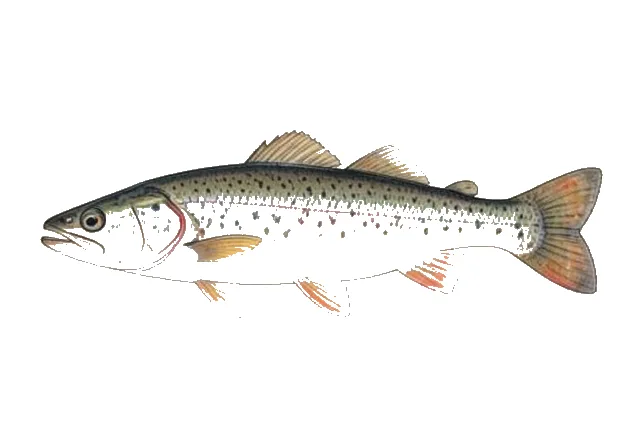
Pygmy Whitefish field guide illustration

About Pygmy Whitefish

The pygmy whitefish (Prosopium coulterii) is a freshwater whitefish of the genus Prosopium in the family Salmonidae. Found in the mountain streams and lakes in western North America, it also has isolated populations in Lake Superior and in Ekityki Lake, Chukchi Peninsula.

Description

The pygmy whitefish is a small herring-like fish with a long and cylindrical body by comparison to other whitefishes. Silvery in colour, it has a brownish back, and a whitish belly. Black spots on the side called "parr marks", which are present on young trout or "parrs", are present on the young of this species, and on adults in some Alaskan populations. Commonly ranging from 3 to 15.3 centimetres (1.2 to 6.0 in) in length, it is typically 12 centimetres (4.7 in) long, and reaches a maximum length of 28 centimetres (11 in). It is identified by its small size, and its large eye, which has a greater length than its blunt snout. Its dorsal fin and pectoral fin are usually clear, and its tail is clear with a faint dark spot. Its anal fin and pelvic fin are plain whitish. It has large scales with only 56–70 on its lateral line, fewer gill rakers, all characteristics that indicate a degree of differentiation from the other Prosopium fishes. Because of this, it is considered sister to many of the other species in its genus, and it is the most trout-like member of a genus considered the most trout-like and primitive whitefish group.

Taxonomy

The pygmy whitefish was first described by Carl H. Eigenmann and Rosa Smith Eigenmann in 1892, as Coregonus coulteri. they named the species after the prominent botanist John Merle Coulter. Since its initial description as a Coregonus, it has been placed in the genus Prosopium of more primitive whitefishes. The members of this genus are distinguished from the other whitefishes by several characteristics, such as a single flap of skin over the nostril, rather than one; "parr marks"as on trout and char; a round body; and a small toothless mouth. The genus name Prosopium, meaning"mask" in Greek, refers to the large bones in front of its eyes.

Distribution

The pygmy whitefish is found mostly in the northern Rocky Mountains, with three other disjunct populations. One is in Lake Superior, another is in southwestern Alaska, and the third is in the Ekityki Lake, Chukchi Peninsula, Russia. The pygmy whitefish's range probably was continuous until the late Pleistocene. In the Rocky Mountains it is found in cold and rapid streams, and in cool lakes at depths of over 6 metres (20 ft). In Lake Superior it is found in cooler water, at depths of 18 to 89 metres (59 to 292 ft).

Ecology

In Lake Superior, the pygmy whitefish spawns during November and December at depths of 31 to 46 metres (102 to 151 ft). Females lay an average of 362 orange eggs, with a diameter of 2.57 millimetres (0.101 in). Elsewhere, the pygmy whitefish migrates upstream to spawn, usually spawning in November or December in gravelly streams. Pygmy whitefish feed primarily on the aquatic larvae of insects, and crustaceans. In Lake Superior, the amphipod Pontoporeia and various other crustaceans, mostly ostracods, form 77 percent of the pygmy whitefish's diet. The burbot, kingfishers, and terns, and pikes have been recorded preying on the pygmy whitefish.

Article text: Wikipedia contributors, Pygmy whitefish (source revision). Licensed under CC BY-SA 4.0. Retrieved 2026-10-11.
Diet and feeding

The FishTraits compilation records these diet categories for this species: invertebrates or larval fish. These are broad categories, not a claim that every individual consumes every example in a category.

Reported feeding positions include bottom feeding and surface or water-column feeding. The compilation combines published observations; diets can vary with age, locality, and available food.

Habitat preferences

Reported habitat associations include streams and small rivers, still-water habitats.

The source records associations with gravel, open water. An association indicates reported use, rather than an exclusive requirement.

Reproduction and parental care

The compilation reports a representative maturity age of 2.5 years. Its maturity field summarizes mean, median, or modal estimates, usually for females; male estimates can be used when female data are unavailable. It is not a fixed age at which every fish first breeds.

Recorded spawning months are Jan, Oct, Nov, Dec for the source’s reporting region (WA). This is a regional calendar, not a range-wide schedule.

The reproductive-guild classification includes spawning on open substrates without guarding the brood.

Size and recorded longevity

FishTraits reports a maximum total length of 28.5 centimetres. Some entries use an estimated asymptotic length; this value should not be treated as a certified record catch.

Recorded longevity in the compilation is 9 years. Wild observations were preferred, but captive records were accepted where wild records were unavailable, and unspecified records were assumed wild. The value is not a guaranteed wild lifespan or an aquarium life expectancy.

Spawning movements

The compilation records significant spawning-related movement. Its combined migration flag covers movements within fresh water as well as between rivers and the sea; this flag alone does not establish which migration pattern applies.

Record fish

The Montana state record

  • Montana0.36 lbs.

    Little Bitterroot Lake · 2/13/10 · Richard Geldrich

Each figure is the state agency’s own certified record. The site holds record tables for 11 states so far, so a state missing here has not been read yet. It is not a state where this fish holds no record.

Range

Where it lives

Share of 132 GBIF observation records with a state location, across 6 states.
0%
58.3%
Share of 132 GBIF observation records with a state location, across 6 states.

Habitat

Water and movement

Water
WoRMS records this species in fresh water.
Migration
Migratory
Pattern

Classification

Taxonomy

Kingdom
Animalia
Phylum
Chordata
Superclass
Actinopterygii
Class
Teleostei
Order
Salmoniformes
Genus
Prosopium
Species
Prosopium coulterii
ITIS TSN
553389
WoRMS AphiaID
567545
GBIF key
2351517

Common questions about Pygmy Whitefish

What is the scientific name of Pygmy Whitefish?
The scientific name is Prosopium coulterii, in the family Salmonidae. Classification follows ITIS.
Does Pygmy Whitefish live in fresh water or salt water?
WoRMS records this species in fresh water.
Where has Pygmy Whitefish been recorded in the United States?
GBIF has observations in 6 states, with the most records in Alaska, Michigan, Wisconsin. The map shows observation records, which do not establish the complete natural range.

Closest relatives

Other Prosopium species

Same family

More Salmonidae

Alaska Whitefish1 states
Coregonus nelsoniiSalmonidaeNativeFresh
Apache Trout5 states
Oncorhynchus apacheSalmonidaeNativeFresh
Arctic Char8 states
Salvelinus alpinusSalmonidaeNative and introducedFreshSaltBrackish
Arctic Cisco1 states
Coregonus autumnalisSalmonidaeNativeFreshSaltBrackish
Arctic Grayling16 states
Thymallus arcticusSalmonidaeNative and introducedFresh
Atlantic Salmon26 states
Salmo salarSalmonidaeNative and introducedFreshSaltBrackish
Bear Lake Whitefish2 states
Prosopium abyssicolaSalmonidaeNativeFresh
Bering Cisco1 states
Coregonus laurettaeSalmonidaeNativeFreshSaltBrackish
Blackfin Cisco6 states
Coregonus nigripinnisSalmonidaeNativeFresh
Bloater6 states
Coregonus hoyiSalmonidaeNativeFresh
Bonneville Cisco2 states
Prosopium gemmiferSalmonidaeNativeFresh
Bonneville Whitefish2 states
Prosopium spilonotusSalmonidaeNativeFresh
Broad Whitefish1 states
Coregonus nasusSalmonidaeNativeFreshBrackish
Brook Trout40 states
Salvelinus fontinalisSalmonidaeNative and introducedFreshSaltBrackish
Brown Trout41 states
Salmo truttaSalmonidaeIntroducedFreshSaltBrackish
Bull Trout8 states
Salvelinus confluentusSalmonidaeNativeFreshBrackish
Chinook Salmon18 states
Oncorhynchus tshawytschaSalmonidaeNative and introducedFreshSaltBrackish
Chum Salmon5 states
Oncorhynchus ketaSalmonidaeNativeFreshSaltBrackish
Cisco11 states
Coregonus artediSalmonidaeNative and introducedFreshSaltBrackish
Coho Salmon22 states
Oncorhynchus kisutchSalmonidaeNative and introducedFreshSaltBrackish
Cutthroat Trout18 states
Oncorhynchus clarkiiSalmonidaeNative and introducedFreshSaltBrackish
Deepwater Cisco3 states
Coregonus johannaeSalmonidaeNativeFresh
Dolly Varden9 states
Salvelinus malmaSalmonidaeNativeFreshSaltBrackish
Gila Trout2 states
Oncorhynchus gilaeSalmonidaeNative and introducedFresh

All 44 species in Salmonidae