Mountain Whitefish

Prosopium williamsoni

Salmonidae · freshwater water fish

6 minute read · Species guide

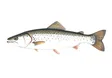
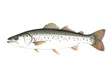
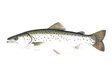
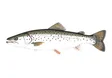
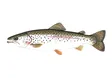
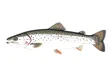
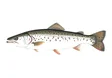
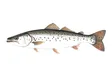
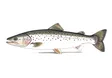
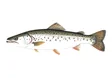
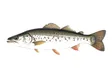
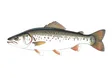
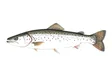
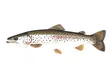
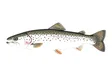
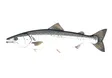
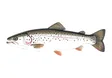
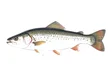
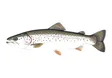
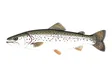
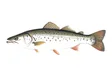
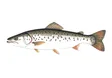
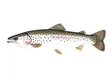
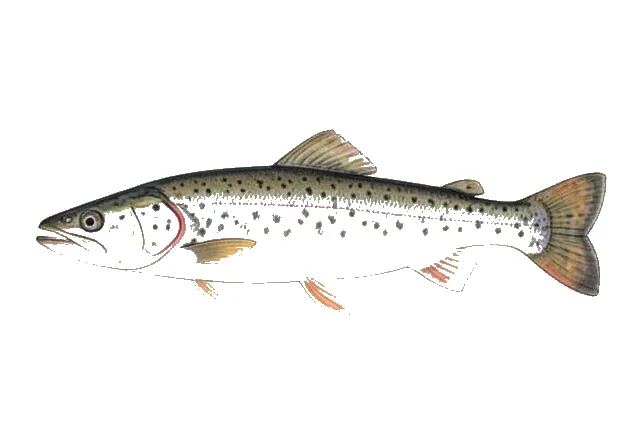
Mountain Whitefish field guide illustration

About Mountain Whitefish

The mountain whitefish (Prosopium williamsoni) is one of the most widely distributed salmonid fish of western North America. It is found from the Mackenzie River drainage in Northwest Territories, Canada through western Canada and the northwestern USA in the Pacific, Hudson Bay and upper Missouri River basins to the Truckee River drainage in Nevada and Sevier River drainage in Utah.

Description

The body shape is superficially similar to the cyprinids, although it is distinguished by having both the adipose fin and axillary process of salmonids. The body is slender and nearly cylindrical in cross section, generally silver with a dusky olive-green shade dorsally. The scales possess pigmented borders, which are especially defined on the posterior end.

Mountain whitefish possess a forked homocercal tail. The short head has a small mouth underneath the snout.

The short dorsal fin has 12–13 rays, with 11–13 for the anal fin, 10–12 for the pelvic fins, and 14–18 for the pectoral fins. Size has been recorded at up to 70 centimeters (28 inches) in length and a weight of 2.9 kilograms (6.4 lb).

Life history

The spawning season is from October to early December, when water temperatures are 2–6 °C. Mountain whitefish congregate in large schools on fall spawning runs and seek out areas of coarse gravels or cobbles at depths of at least 75 cm (30 inches), typically in shallow areas of small tributaries or shorelines of lakes. Their non-adhesive eggs are scattered along the substrate. The eggs then develop slowly through the winter (6–10 weeks), hatching in the early spring, generally in March. Mountain whitefish reach reproductive maturity at approximately three years old, females can produce as many as 4,000 eggs annually. Mountain whitefish typically live between 7–9 years in the wild.

Feeding

Mountain whitefish are demersal feeders, stirring up the substrate with pectoral and tail fins to expose insect larvae and other invertebrates, including snails, crayfish, and amphipods. Their main feeding time is in the evening, but they will also take drifting prey during the day. The mountain whitefish frequently feeds in the lower strata of streams, but populations may rise to the surface to prey on hatching insects, including mayflies. Mountain whitefish fry are a common food source for other trout species.

Habitat

The mountain whitefish are commonly found in mountain streams and lakes, favoring clear cold water and large deep pools of at least a meter's depth; the Lake Tahoe population lives just above the bottom in deeper water.

Range

This species occurs throughout the western half of North America, as far north as the Mackenzie River (Canada) and the drainages of the Hudson Bay, in the Columbia River, upper Missouri River, upper Colorado River, Adirondack Lakes of New York, and Lake Champlain.

Migration

Mountain whitefish are non- anadromous fish and spend the majority of their lives in freshwater ecosystems. Relatively little is known about the migration patterns of whitefish, but it is believed that they do migrate for spawning and because of temperature fluctuations. In the Methow River, a tributary of the Columbia River, mountain whitefish have been found migrating due to increases in shallower tributary water temperatures into the larger Columbia River. Mountain whitefish have also been known to spend the winter in the Columbia River which provides more suitable habitats for these fishes. Evidence shows that mountain whitefish in the Methow River are returning annually to the same headwater tributaries, which indicates migration for the primary purpose of returning to birth streams to spawn – similar to other anadromous salmonid species.

Aging fish

To better understand the conservation and management needs of mountain whitefish biologists seek to understand life history strategies of these fishes. Understanding the growth, age structure, and age at maturity of these fish can better inform limitations on which fish can be harvested and which should be released. If the age at which the fish matures is known, management agencies can estimate sizes of these fishes and inform anglers that no fish under this maturation size may be kept to ensure new generations. The age of these fish can be determined by counting annuli (growth rings) in fish scales, pectoral fin rays, and otoliths (ear bones). Efficacy of these counting strategies can vary, but in combination they could provide vital data to ensure that mountain whitefish populations continue to stay at healthy levels. Some of the most effective ways to age mountain whitefish have been determined to be by examining scales for younger fishes or otoliths for older fishes.

Conservation

Mountain whitefish have a secure conservation status. In many of the larger intermountain Western rivers, mountain whitefish are the only native salmonid. Mountain whitefish typically occur in high abundance, in the Snake River Basin in Idaho, mountain whitefish abundance was found to be 1,257/100 m. Historically, mountain whitefish are not popular game fish and have been thrown onto the banks when caught because they are 'trash fish.' Similar to other native salmonids, mountain whitefish have received backlash because anglers believe that they are competing for food and spawning resources for more popular introduced species, like brook trout (Idaho). Due to common misconceptions, some native mountain whitefish populations have been decimated by both management agencies and anglers alike. The health of mountain whitefish, like other salmonids, can be a predictor of the health of the environment that they live in, so understanding and maintaining their populations can be beneficial for ecosystem prosperity.

Article text: Wikipedia contributors, Mountain whitefish (source revision). Licensed under CC BY-SA 4.0. Retrieved 2026-10-11.
Diet and feeding

The FishTraits compilation records these diet categories for this species: invertebrates or larval fish; larger animal prey (a source category covering fish, crayfish, crabs, or frogs); fish or frog eggs. These are broad categories, not a claim that every individual consumes every example in a category.

Reported feeding positions include bottom feeding and surface or water-column feeding. The compilation combines published observations; diets can vary with age, locality, and available food.

Habitat preferences

Reported habitat associations include medium to large rivers, streams and small rivers, still-water habitats.

The source records associations with clay or silt, sand, gravel, open water. An association indicates reported use, rather than an exclusive requirement.

Reproduction and parental care

The compilation reports a representative maturity age of 4 years. Its maturity field summarizes mean, median, or modal estimates, usually for females; male estimates can be used when female data are unavailable. It is not a fixed age at which every fish first breeds.

Recorded spawning months are Sep, Oct, Nov, Dec for the source’s reporting region (WA). This is a regional calendar, not a range-wide schedule.

The reproductive-guild classification includes hiding a brood without subsequent guarding.

Size and recorded longevity

FishTraits reports a maximum total length of 70 centimetres. Some entries use an estimated asymptotic length; this value should not be treated as a certified record catch.

Recorded longevity in the compilation is 11 years. Wild observations were preferred, but captive records were accepted where wild records were unavailable, and unspecified records were assumed wild. The value is not a guaranteed wild lifespan or an aquarium life expectancy.

Native range

Mackenzie River drainage (Arctic basin), Northern Territories, south through western Canada and northwestern United States in Pacific, Hudson Bay, and upper Missouri River basins, to Truckee River drainage, Nevada, and Sevier River drainage, Utah (Page and Burr 1991).

Habitat and ecology

As with many western North American salmonids, Mountain Whitefish generally inhabit clear, cool waters (< 20° C) of high elevation streams, rivers, and lakes (Moyle 2002). Spawning occurs during late fall to early winter (October - December) in shallow areas of small tributaries or shoreline areas of lakes, primarily over gravel, rubble, or cobble bottoms (McAffee 1966; Moyle 2002). Mountain Whitefish are demersal feeders, consuming a range of benthic invertebrates, including insect larva, gastropods, and small crustaceans(McAffee; Ellison 1980; Moyle 2002).

Introduction history

Stocked for sportfishing in Colorado and as a game and food fish in Michigan.

Record fish

State records in 2 states

  • Montana5.11 lbs.

    Hauser Reservoir · 10/10/07 · Walt Goodman

  • Utah4 lbs. 12 oz.

    Deer Creek Reservoir · 1997 · Roy L. Montoya

Each figure is the state agency’s own certified record. The site holds record tables for 11 states so far, so a state missing here has not been read yet. It is not a state where this fish holds no record.

Range

Where it lives

Share of 2,078 GBIF observation records with a state location, across 10 states. The orange dots are USGS stream-survey sites where this species was caught.
0%
63.7%
Share of 2,078 GBIF observation records with a state location, across 10 states. The orange dots are USGS stream-survey sites where this species was caught.

A blank area on the dot layer usually means nobody sampled there, not that the fish is absent. Turn on “every survey site” to see where the survey looked.

The USGS stream survey caught it at 499 of its sites, in 8 states. That survey and the GBIF records are two different counts of two different things, so the site keeps them apart.

Habitat

Water and movement

Water
WoRMS records this species in fresh water.
USGS NAS habitat
Freshwater
US status
Native transplant — native to part of the United States, moved to other waters inside it.
Migration
Undetermined
Pattern
Disagreement
4 published references do not agree on the pattern: Non-migratory, Potamodromous. The site shows every assignment rather than picking one.

Classification

Taxonomy

Kingdom
Animalia
Phylum
Chordata
Superclass
Actinopterygii
Class
Teleostei
Order
Salmoniformes
Genus
Prosopium
Species
Prosopium williamsoni
ITIS TSN
162009
WoRMS AphiaID
567546
GBIF key
2351530
Outside the US
ITIS also files it in Canada.

Common questions about Mountain Whitefish

What is the scientific name of Mountain Whitefish?
The scientific name is Prosopium williamsoni, in the family Salmonidae. Classification follows ITIS.
Does Mountain Whitefish live in fresh water or salt water?
WoRMS records this species in fresh water.
Where has Mountain Whitefish been recorded in the United States?
GBIF has observations in 10 states, with the most records in Wyoming, Oregon, Idaho. The map shows observation records, which do not establish the complete natural range.

Closest relatives

Other Prosopium species

Same family

More Salmonidae

Alaska Whitefish1 states
Coregonus nelsoniiSalmonidaeNativeFresh
Apache Trout5 states
Oncorhynchus apacheSalmonidaeNativeFresh
Arctic Char8 states
Salvelinus alpinusSalmonidaeNative and introducedFreshSaltBrackish
Arctic Cisco1 states
Coregonus autumnalisSalmonidaeNativeFreshSaltBrackish
Arctic Grayling16 states
Thymallus arcticusSalmonidaeNative and introducedFresh
Atlantic Salmon26 states
Salmo salarSalmonidaeNative and introducedFreshSaltBrackish
Bear Lake Whitefish2 states
Prosopium abyssicolaSalmonidaeNativeFresh
Bering Cisco1 states
Coregonus laurettaeSalmonidaeNativeFreshSaltBrackish
Blackfin Cisco6 states
Coregonus nigripinnisSalmonidaeNativeFresh
Bloater6 states
Coregonus hoyiSalmonidaeNativeFresh
Bonneville Cisco2 states
Prosopium gemmiferSalmonidaeNativeFresh
Bonneville Whitefish2 states
Prosopium spilonotusSalmonidaeNativeFresh
Broad Whitefish1 states
Coregonus nasusSalmonidaeNativeFreshBrackish
Brook Trout40 states
Salvelinus fontinalisSalmonidaeNative and introducedFreshSaltBrackish
Brown Trout41 states
Salmo truttaSalmonidaeIntroducedFreshSaltBrackish
Bull Trout8 states
Salvelinus confluentusSalmonidaeNativeFreshBrackish
Chinook Salmon18 states
Oncorhynchus tshawytschaSalmonidaeNative and introducedFreshSaltBrackish
Chum Salmon5 states
Oncorhynchus ketaSalmonidaeNativeFreshSaltBrackish
Cisco11 states
Coregonus artediSalmonidaeNative and introducedFreshSaltBrackish
Coho Salmon22 states
Oncorhynchus kisutchSalmonidaeNative and introducedFreshSaltBrackish
Cutthroat Trout18 states
Oncorhynchus clarkiiSalmonidaeNative and introducedFreshSaltBrackish
Deepwater Cisco3 states
Coregonus johannaeSalmonidaeNativeFresh
Dolly Varden9 states
Salvelinus malmaSalmonidaeNativeFreshSaltBrackish
Gila Trout2 states
Oncorhynchus gilaeSalmonidaeNative and introducedFresh

All 44 species in Salmonidae