Mobile Logperch

Percina kathae

Percidae · freshwater water fish

4 minute read · Species guide

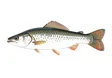
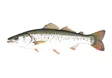
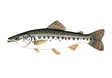
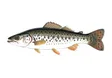
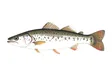
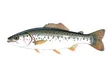
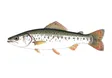
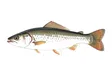
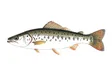
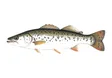
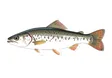
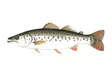
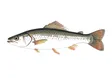
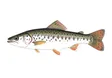
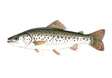
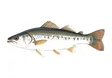
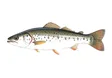
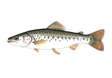
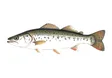
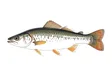
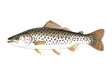
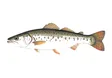
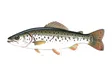
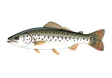
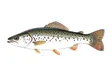
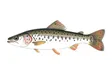
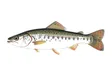
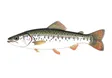
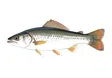
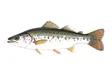
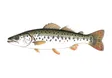
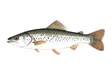
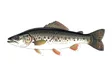
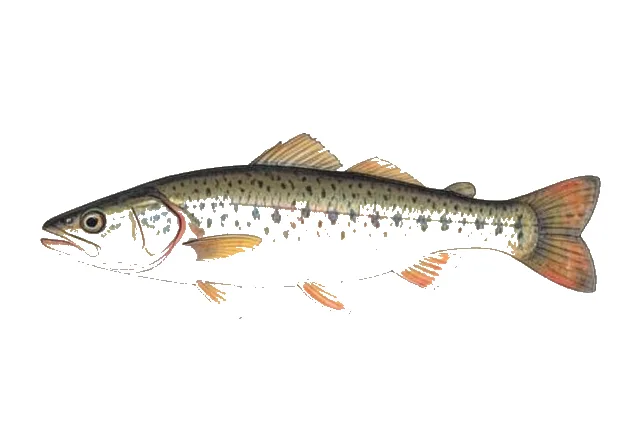
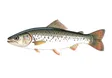
Mobile Logperch field guide illustration

About Mobile Logperch

The Mobile logperch (Percina kathae) is a species of freshwater ray-finned fish, a darter from the subfamily Etheostomatinae, part of the family Percidae, which also contains the perches, ruffes and pikeperches. It is found in the Mobile River basin in Mississippi, Alabama, Tennessee, and Georgia in the southeastern United States. It inhabits clear shallow water and is often associated with Podostemum (riverweed). It grows to about 18 cm (7 in) and is distinguishable from other darters by the distinctive shape of its head and by its pale-yellow base color, with narrow bars on back and sides. It feeds on small invertebrates and breeds between February and May. Lake fish move into small streams to spawn. It is a common fish with a wide range and the International Union for Conservation of Nature has classified its conservation status as being of "least concern".

Anatomy and description

Logperches are easily distinguished from most other darters by their tiger-like coloration. They also have distinctive head and snout shapes. Logperches are a pale-yellow base color, with narrow bars on the side and back. Logperches reach a maximum size of about 18 cm (7 in) and a maximum age of about four years.

Distribution and habitat

Mobile logperches live primarily in the Southeastern U.S. They are endemic to all river systems of the Mobile River basin in Mississippi, Alabama, Tennessee, and Georgia. They are particularly widespread in the upper Cahaba and Coosa River systems. Populations of the Mobile logperch and gulf logperch (Percina suttkusi) occur together at certain locations in the Alabama, Black Warrior, and upper and lower Tombigbee River systems. Studies have been conducted in the Conasauga River (Georgia and Tennessee); Luxapallila Creek, Mississippi; and the Neosho River in Kansas.

The Mobile logperch is found in shallow water in the summer, but uses deeper reaches, or uses depths randomly, in all other seasons. Like other logperches, they inhabit clear, gravelly streams and lakes. Logperches live in mostly shallow, clear water waterways. These habitats are associated with Podostemum (riverweed). Some species (including Percina) indicate that longitudinal position was a strong covariate with little support that Podostemum cover influenced occupancy. The greatest densities of Mobile logperch occur over gravel or sand substrates in moderate current or in lakes over sand and mud substrates.

Life history

Juveniles eat organisms such as rotifers, copepods, and waterfleas. As they grow, they incorporate a greater variety of small aquatic creatures. They eat mostly aquatic insects (especially mayfly and midge larvae), and also may eat young snails, waterfleas, leeches, and fish eggs (including their own) when available. Percina show broad diversity of reproductive behavior and life history traits. Large numbers of reservoir-based individuals frequently migrate upstream into small flowing streams from late February into May to spawn (in Carrolls Creek, a tributary of Lake Tuscaloosa, Alabama). Females are thought to bury eggs in riffles or shoals of sand or gravel. Mobile logperch may live three to four years. They sometimes fall prey to piscivorous fish (more often in lakes than in streams). These fish include lake trout, walleye, rock bass, largemouth bass, burbot, and northern pike. When they spend time in slow and shallow water, they also are eaten by fish-eating birds, such as terns and mergansers.

Etymology

The Mobile logperch was first formally described in 1997 by the American ichthyologist Dr. Bruce A. Thompson (1946–2007) and its specific name honors Thompson's wife, Kathy S. Thompson.

Management

The Mobile logperch is not listed as endangered under Tennessee state law. Not much research on changes in this species' population over time and no management practices have been put in place to protect the Mobile logperch. The International Union for Conservation of Nature has assessed the conservation status of this fish as being of "least concern".

Article text: Wikipedia contributors, Mobile logperch (source revision). Licensed under CC BY-SA 4.0. Retrieved 2026-10-11.
Diet and feeding

The FishTraits compilation records these diet categories for this species: larger animal prey (a source category covering fish, crayfish, crabs, or frogs). These are broad categories, not a claim that every individual consumes every example in a category.
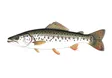
Reported feeding positions include bottom feeding. The compilation combines published observations; diets can vary with age, locality, and available food.

Habitat preferences

Reported habitat associations include streams and small rivers, creeks, still-water habitats.

The source records associations with gravel, cobble, boulders. An association indicates reported use, rather than an exclusive requirement.

Reproduction and parental care

The compilation reports a representative maturity age of 1.5 years. Its maturity field summarizes mean, median, or modal estimates, usually for females; male estimates can be used when female data are unavailable. It is not a fixed age at which every fish first breeds.

Batch or serial spawning has been reported somewhere in the species’ range. This does not establish the same spawning pattern for every population.

Recorded spawning months are Feb, Mar, Apr, May for the source’s reporting region (MS). This is a regional calendar, not a range-wide schedule.

The reproductive-guild classification includes hiding a brood without subsequent guarding.

Size and recorded longevity

FishTraits reports a maximum total length of 12 centimetres. Some entries use an estimated asymptotic length; this value should not be treated as a certified record catch.

Recorded longevity in the compilation is 4 years. Wild observations were preferred, but captive records were accepted where wild records were unavailable, and unspecified records were assumed wild. The value is not a guaranteed wild lifespan or an aquarium life expectancy.

Range

Where it lives

Share of 1,286 GBIF observation records with a state location, across 4 states. The orange dots are USGS stream-survey sites where this species was caught.
0%
74.7%
Share of 1,286 GBIF observation records with a state location, across 4 states. The orange dots are USGS stream-survey sites where this species was caught.

A blank area on the dot layer usually means nobody sampled there, not that the fish is absent. Turn on “every survey site” to see where the survey looked.

The USGS stream survey caught it at 44 of its sites, in 4 states. That survey and the GBIF records are two different counts of two different things, so the site keeps them apart.

Habitat

Water and movement

Water
WoRMS records this species in fresh water.
Migration
Undetermined

Classification

Taxonomy

Kingdom
Animalia
Phylum
Chordata
Superclass
Actinopterygii
Class
Teleostei
Order
Perciformes
Family
Percidae
Genus
Percina
Species
Percina kathae
ITIS TSN
650182
WoRMS AphiaID
1010574
GBIF key
2382047

Common questions about Mobile Logperch

What is the scientific name of Mobile Logperch?
The scientific name is Percina kathae, in the family Percidae. Classification follows ITIS.
Does Mobile Logperch live in fresh water or salt water?
WoRMS records this species in fresh water.
Where has Mobile Logperch been recorded in the United States?
GBIF has observations in 4 states, with the most records in Alabama, Georgia, Mississippi. The map shows observation records, which do not establish the complete natural range.

Closest relatives

Other Percina species

Same family

More Percidae

All 229 species in Percidae