Lake Trout

Salvelinus namaycush

Salmonidae · freshwater water fish

9 minute read · Species guide

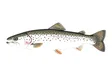
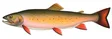
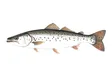
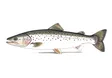
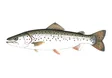
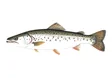
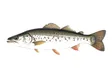
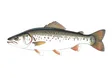
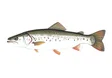
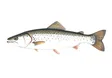
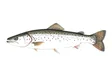
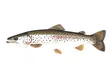
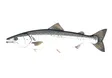
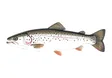
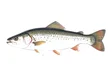
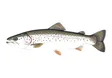
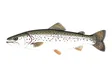
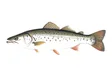
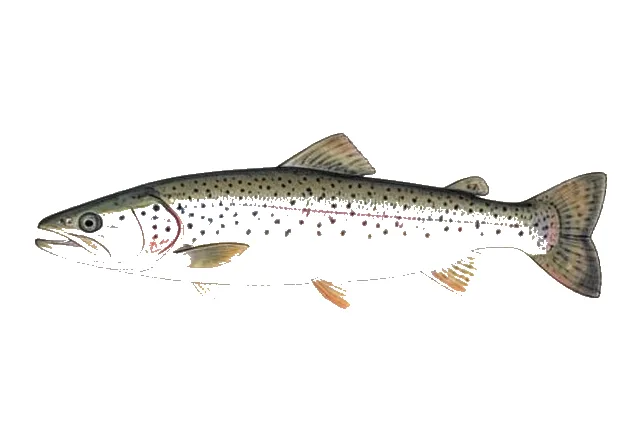
Lake Trout field guide illustration

About Lake Trout

The lake trout (Salvelinus namaycush) is a freshwater char living mainly in lakes in Northern North America. Other names for it include mackinaw, namaycush, lake char (or charr), touladi, togue, laker, and grey trout. In Lake Superior, it can also be variously known as siscowet, paperbelly and lean. The lake trout is prized both as a game fish and as a food fish. Those caught with dark coloration may be called mud hens.

Taxonomy and etymology

It is the only member of the subgenus Cristovomer, which is more derived than the subgenus Baione (the most basal clade of Salvelinus, containing the brook trout (S. fontinalis) and silver trout (S. agasizii)) but still basal to the other members of Salvelinus.

The specific epithet namaycush derives from namekush, a form of the word used in some inland Southern East Cree communities in referring to this species of fish. Other variations found in East Cree are kûkamâs[h], kûkamâw and kûkamesh. Similar cognate words are found in Ojibwe: namegos = "lake trout"; namegoshens = "rainbow trout,"literally meaning"little lake trout."

Range

From a zoogeographical perspective, lake trout have a relatively narrow distribution. They are native only to the northern parts of North America, principally Canada, but also Alaska and, to some extent, the Northeastern United States. Lake trout have been widely introduced into non-native waters in North America and into many other parts of the world, mainly Europe, but also into South America and certain parts of Asia. Although lake trout were introduced into Yellowstone National Park's Shoshone, Lewis and Heart lakes legally in the 1890s, they were illegally or accidentally introduced into Yellowstone Lake in the 1980s where they are now considered invasive. They have also notably been introduced into the Tahoe region, such as in Lake Tahoe and Donner Lake.

Description

Lake trout have a common Salmonidae body, with an elongated figure, a single dorsal and adipose fin, and lack spines on any of their fins. The pattern of lake trout is a uniform olive-grey, darker near the back, and white on the belly. They are covered in light beige or white spots along the body. The fins are yellow-ish, and may have white tips. During spawning, the belly becomes more yellow-orange, and the fins develop a red hue with more developed white edges. They have small but sharp teeth, which are more visible compared to other species of trout during non-spawning periods.

Lake trout are the largest of the chars; the record weighed almost 102 pounds (46 kg) with a length of 50 inches (130 cm), and was caught with a gillnet. 15–40-pound (6.8–18.1-kilogram) fish are not uncommon, and the average length is 24–36 inches (61–91 centimetres). The largest caught on a rod and reel according to the IGFA was 72 pounds (33 kg), caught in Great Bear Lake in 1995 with a length of 59 inches (150 cm). In the Tahoe region, the fish do not exceeded 36 pounds (16 kg), but are on average over 10 pounds (4.5 kg).

Life history

Lake trout inhabit cold, oxygen-rich waters. They are pelagic during the period of summer stratification in dimictic lakes, often living at depths of 20–60 m (66–197 ft).

The lake trout is a slow-growing fish, typical of oligotrophic waters. It is also very late to mature. Populations are extremely susceptible to overfishing. Many native lake trout populations have been severely damaged through the combined effects of hatchery stocking (planting) and over harvest. Another threat to lake trout is acidification, which can have longterm effects on their populations through both direct harm and reduced prey populations (e.g. Mysis relicta).

There are three subspecies of lake trout. There is the common lake trout (Salvelinus namaycush namaycush), the siscowet lake trout (Salvelinus namaycush siscowet), and the less common rush lake trout (Salvelinus namaycush huronicus). Some lakes do not have pelagic forage fish during the period of summer stratification. In these lakes, lake trout act as planktivores. Lake trout in planktivorous populations are highly abundant, grow very slowly and mature at relatively small sizes. In those lakes that do contain deep-water forage, lake trout become piscivorous. Piscivorous lake trout grow much more quickly, mature at a larger size and are less abundant. Notwithstanding differences in abundance, the density of biomass of lake trout is fairly consistent in similar lakes, regardless of whether the lake trout populations they contain are planktivorous or piscivorous.

In Lake Superior, common lake trout (S. n. namaycush) and siscowet lake trout (S. n. siscowet) live together. Common lake trout tend to stay in shallower waters, while siscowet lake trout stay in deeper water. Common lake trout (also called "lean"lake trout) are slimmer than the relatively fat siscowet. Siscowet numbers have become greatly depressed over the years due to a combination of the extirpation of some of the fish's deep water coregonine prey and to overexploitation. Siscowet tend to grow extremely large and fat and attracted great commercial interest in the last century. Their populations have rebounded since 1970, with one estimate putting the number in Lake Superior at 100 million. Professor of Zoology at the University of Wisconsin-Madison James Kitchell credits effective constraint of commercial fisheries and persistent sea lamprey (Petromyzon marinus) control for the successful recovery of Lake Superior's lake trout."Looking at what has happened in the lake and the results of computer simulations, it is clear that lamprey control needs to continue if Lake Superior is to keep its lake trout."

Hybrids

Lake trout are known to hybridize in nature with the brook trout (S. fontinalis); such hybrids, known as "splakes"(between a male brook and female lake trout) or the less common"brookinaw" (between a male lake and female brook trout,) are normally sterile but self-sustaining populations exist in some lakes. Splake are also artificially propagated in hatcheries, and then stocked into lakes in an effort to provide sport-fishing opportunities.

Commercial fishing

Lake trout were fished commercially in the Great Lakes until lampreys, overharvest and pollution extirpated or severely reduced the stocks. Commercial fisheries still exist in some areas of the Great Lakes and smaller lakes in northern Canada. Commercial fishing by Ottawa (Odawa) and Chippewa (Ojibwe) Indians for Lake Trout in Lake Michigan, Lake Huron and Lake Superior is permitted under various treaties and co-managed and regulated by many tribes and Great Lakes Indian Fish & Wildlife Commission (GLIFWC).

Recreational angling

When lake trout are caught and released, the experience can cause short-term physiological and behavioural stress. Blood stress markers such as cortisol, lactate, and glucose increase after capture, particularly when fish fight for long periods, are exposed to air, or are angled from deep water. Deep-water captures can also cause barotrauma (i.e., injuries caused by rapid changes in pressure), resulting in bloating or disorientation due to rapid pressure changes. These effects are more common in larger fish and in warm-water conditions.

Responses differ between ice-angling and open-water angling. During ice-angling, fish often show higher lactate and glucose levels, lower blood pH, and loss of reflexes such as orientation and equilibrium, with some mortality observed after release. In open-water, stress responses are generally brief and mild with minor mortality; gill tissues show temporary activation of hsp70 stress genes, while other metabolic processes return to normal within two days. Differences are also influenced by factors such as sex, depth, and season. Careful handling, limiting fight time, reducing air exposure, and avoiding deep-water captures can improve survival and recovery following release.

Popular culture

Geneva, New York claims the title "Lake Trout Capital of the World,"and holds an annual lake trout fishing derby. Baraga county in Michigan also hosts an annual"lake trout festival" in June.

Article text: Wikipedia contributors, Lake trout (source revision). Licensed under CC BY-SA 4.0. Retrieved 2026-10-11.
Diet and feeding

The FishTraits compilation records these diet categories for this species: invertebrates or larval fish; larger animal prey (a source category covering fish, crayfish, crabs, or frogs). These are broad categories, not a claim that every individual consumes every example in a category.

Reported feeding positions include surface or water-column feeding. The compilation combines published observations; diets can vary with age, locality, and available food.

Habitat preferences

Reported habitat associations include streams and small rivers, still-water habitats.

The source records associations with cobble, boulders, open water. An association indicates reported use, rather than an exclusive requirement.

Reproduction and parental care

The compilation reports a representative maturity age of 8 years. Its maturity field summarizes mean, median, or modal estimates, usually for females; male estimates can be used when female data are unavailable. It is not a fixed age at which every fish first breeds.

Recorded spawning months are Sep, Oct, Nov for the source’s reporting region (CA). This is a regional calendar, not a range-wide schedule.

The reproductive-guild classification includes hiding a brood without subsequent guarding.

Size and recorded longevity

FishTraits reports a maximum total length of 125 centimetres. Some entries use an estimated asymptotic length; this value should not be treated as a certified record catch.

Recorded longevity in the compilation is 20 years. Wild observations were preferred, but captive records were accepted where wild records were unavailable, and unspecified records were assumed wild. The value is not a guaranteed wild lifespan or an aquarium life expectancy.

Spawning movements

The compilation records significant spawning-related movement. Its combined migration flag covers movements within fresh water as well as between rivers and the sea; this flag alone does not establish which migration pattern applies.

Native range

Widely distributed from northern Canada and Alaska (missing in southern prairie provinces) south to New England and Great Lakes basin (Page and Burr 1991). In northwestern Montana, Lake Trout are native in Waterton Lake, Glenns Lake, Cosley Lake, and St. Mary Lake. (Snyder and Oswald 2005). In southwestern Montana, glacial relict populations of Lake Trout exist in Elk Lake and Twin Lake (Vincent 1963, Brown 1971, Synder and Oswald 2005).

Introduction history

Lake Trout have been intentionally stocked as a sport fish. In the Great Lakes, the species was stocked to restore populations within its native range that had been decimated by the sea lamprey. Kaeding et al. (1996) summarized what is known about the illegal introduction into Yellowstone Lake.

Ecological impacts

Lake Trout often lead to the demise of other trout species where it is introduced. For instance, introductions into Lake Tahoe led to the elimination of the native Lahontan cutthroat Oncorhynchus clarkii henshawi (McAffee 1966; Moyle 1976; Behnke, personal communication). Cordone and Frantz (1966) reported a drastic decline and eventual extinction of native cutthroat in Lake Tahoe after the introduction of Lake Trout. Lahontan cutthroat were abundant in the lake in 1907, with only an occasional Lake Trout reported. By 1938, the cutthroat has virtually disappeared, and by 1966, Lake Trout comprised 70% of angler catch in the lake (Cordone and Frantz 1966). Stocked Lake Trout have replaced native cutthroats in deep Rocky Mountain lakes (Benson et al. 1961). This trout has also virtually eliminated cutthroat and bull trout in Flathead Lake, Montana, and Pend Orielle Lake, Idaho. The introduction into Yellowstone Lake poses a similar threat to the native Yellowstone cutthroat trout O. c. bouvieri. The introduction of Lake Trout led to the extirpation of three of the four populations of Sunapee trout (Behnke, personal communication). Lake Trout introduced into Flaming Gorge Reservoir were found to prey heavily on the Utah chub Gila atraria (Teuscher and Luecke 1996). Predation by Lake Trout was shown to be a major factor in the decline of kokanee O. nerka in Lake Chelan, Washington (Schoen et al. 2012). Competition with and predation by nonnative species (i.e., Catostomus sp., creek chub Semotilus atromaculatus, redside shiner Richardsonius balteatus, burbot Lota lota, brown trout Salmo trutta, and Lake Trout Salvelinus namaycush) limit populations of the rare bluehead sucker Catostomus discobolus (Wyoming Game and Fish Department 2010).

Record fish

State records in 5 states

  • Idaho57.5 lb

    Priest Lake · 11/14/1971 · Lyle McClure

  • Utah53 lbs. 15 oz.

    Flaming Gorge Reservoir · 2020 · Chance Scott

  • Wisconsin47 lbs. 0 oz.

    Lake Superior · Bayfield · 09/09/1946

  • Montana42.69 lbs.

    Flathead Lake · 6/23/04 · Ruth Barber

  • Wisconsin35 lbs. 4 oz.

    Big Green Lake · Green Lake · 06/01/1957

  • Arkansas11 lbs., 5 oz.

    Greers Ferry Lake · 12/15/1997 · Clark Stevenson, Greenbrier, AR · rod and reel

Each figure is the state agency’s own certified record. The site holds record tables for 11 states so far, so a state missing here has not been read yet. It is not a state where this fish holds no record.

Range

Where it lives

Habitat

Water and movement

Water
WoRMS records this species in fresh water.
USGS NAS habitat
Freshwater
US status
Native transplant — native to part of the United States, moved to other waters inside it.
Migration
Undetermined
Pattern
Disagreement
7 published references do not agree on the pattern: Anadromous, Non-migratory, Potamodromous, Semi-anadromous. The site shows every assignment rather than picking one.

Classification

Taxonomy

Kingdom
Animalia
Phylum
Chordata
Superclass
Actinopterygii
Class
Teleostei
Order
Salmoniformes
Genus
Salvelinus
Species
Salvelinus namaycush
ITIS TSN
162002
WoRMS AphiaID
567548
GBIF key
2351327
Outside the US
ITIS also files it in Canada.

Common questions about Lake Trout

What is the scientific name of Lake Trout?
The scientific name is Salvelinus namaycush, in the family Salmonidae. Classification follows ITIS.
Does Lake Trout live in fresh water or salt water?
WoRMS records this species in fresh water.
Where has Lake Trout been recorded in the United States?
GBIF has observations in 29 states, with the most records in New Jersey, Wyoming, New York. The map shows observation records, which do not establish the complete natural range.

Closest relatives

Other Salvelinus species

Same family

More Salmonidae

Alaska Whitefish1 states
Coregonus nelsoniiSalmonidaeNativeFresh
Apache Trout5 states
Oncorhynchus apacheSalmonidaeNativeFresh
Arctic Char8 states
Salvelinus alpinusSalmonidaeNative and introducedFreshSaltBrackish
Arctic Cisco1 states
Coregonus autumnalisSalmonidaeNativeFreshSaltBrackish
Arctic Grayling16 states
Thymallus arcticusSalmonidaeNative and introducedFresh
Atlantic Salmon26 states
Salmo salarSalmonidaeNative and introducedFreshSaltBrackish
Bear Lake Whitefish2 states
Prosopium abyssicolaSalmonidaeNativeFresh
Bering Cisco1 states
Coregonus laurettaeSalmonidaeNativeFreshSaltBrackish
Blackfin Cisco6 states
Coregonus nigripinnisSalmonidaeNativeFresh
Bloater6 states
Coregonus hoyiSalmonidaeNativeFresh
Bonneville Cisco2 states
Prosopium gemmiferSalmonidaeNativeFresh
Bonneville Whitefish2 states
Prosopium spilonotusSalmonidaeNativeFresh
Broad Whitefish1 states
Coregonus nasusSalmonidaeNativeFreshBrackish
Brook Trout40 states
Salvelinus fontinalisSalmonidaeNative and introducedFreshSaltBrackish
Brown Trout41 states
Salmo truttaSalmonidaeIntroducedFreshSaltBrackish
Bull Trout8 states
Salvelinus confluentusSalmonidaeNativeFreshBrackish
Chinook Salmon18 states
Oncorhynchus tshawytschaSalmonidaeNative and introducedFreshSaltBrackish
Chum Salmon5 states
Oncorhynchus ketaSalmonidaeNativeFreshSaltBrackish
Cisco11 states
Coregonus artediSalmonidaeNative and introducedFreshSaltBrackish
Coho Salmon22 states
Oncorhynchus kisutchSalmonidaeNative and introducedFreshSaltBrackish
Cutthroat Trout18 states
Oncorhynchus clarkiiSalmonidaeNative and introducedFreshSaltBrackish
Deepwater Cisco3 states
Coregonus johannaeSalmonidaeNativeFresh
Dolly Varden9 states
Salvelinus malmaSalmonidaeNativeFreshSaltBrackish
Gila Trout2 states
Oncorhynchus gilaeSalmonidaeNative and introducedFresh

All 44 species in Salmonidae