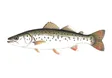
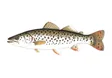
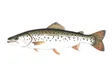
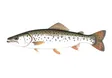
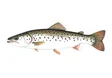
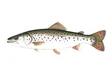
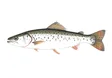
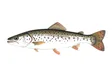
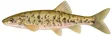
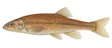
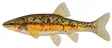
These species profiles show how members of the group differ. Their biology describes each named species, rather than every fish in the group.
The rosyside dace (Clinostomus funduloides) is a species of freshwater ray-finned fish in the family Leuciscidae, the shiners, daces and minnows. This fish is endemic to the southeastern United States.
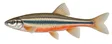
This fish is about 11 centimeters long. The lower parts of its sides are red, giving rise to its name, and the upper parts of its sides are dark green.
 Read the full species guide.
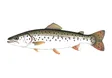
The redside dace (Clinostomus elongatus) is a North American species of freshwater ray-finned fish in the family Leuciscidae. It is a surface-feeding specialist, thus acting as a conduit for nutrient transfers between terrestrial and aquatic environments. This fish is also known as an indicator species as it is sensitive to environmental disturbances.
Taxonomy
American naturalist Jared Potter Kirtland described the redside dace in 1840. The species name elongatus is Latin for "prolonged"or"elongated", referencing the distinctive head and mouth shape.
Description
The redside dace is brightly colored, with a wide red stripe extending from the head to the dorsal fin, running along the middle of the body. A bright yellow stripe generally extends from the head to caudal fin above the red lateral stripe. The back of this fish is generally dark, ranging from green to dark blue. Distinguishing it from other minnows, this species has a very large terminal mouth and protruding lower jaw, which is an effective adaptation for capturing prey from below.
The species' maximum total length is around 120 mm (4.7 in) but 65 mm (2.6 in) is the average of adults. Age estimation with scales suggests that redside dace do not live over four years. Within their first year of life, redside dace may attain a length of 31–48 mm (1.2–1.9 in) by late summer.
United States
Redside dace are most abundant in Pennsylvania, especially in the upper parts of the Susquehanna River drainage. It is also found in some tributaries of the Laurentian Great Lakes, as well as in the Ohio River drainage and the upper parts of the Mississippi River drainage. Scattered populations exist in the states of Indiana, Michigan, Minnesota, and Wisconsin.
 Read the full species guide.
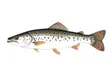
Eastern blacknose dace (Rhinichthys atratulus) is a species of ray-finned fish in the genus Rhinichthys. Its name originates from the Old French word "dars"which is the nominative form of the word"dart" in reference to their swimming pattern. The western blacknose dace (Rhinichthys obtusus) formerly was considered conspecific. While morphologically the two species are not significantly different, they are allopatric. The eastern blacknose dace is found across the southeast portion of Canada and down along the United States' east coast. It is dark brown to olive on its dorsal surface and silvery white below, the two shades separated by the darkly pigmented lateral line. In the breeding season, males develop darker pigmentation and an orange lateral line. Blacknose dace live in rocky streams and rivers where they feed upon small invertebrates and microscopic biological matter and provide forage for larger fish.
Physical description
As fry, this fish is 5 mm (3 ⁄ 16 in) long, and some of the larger eastern blacknose dace can reach slightly over 100 mm (3.9 in). They tend to live for two or three years and grow continuously during this period. They have a fusiform body shape and the mouth is in a subterminal position. The lateral line is darkly colored and has 56 to 70 scales from anterior to posterior. Above the lateral line coloration can vary between shades of dark brown and even olive, while below the lateral line coloration is lighter up until a white belly. Their caudal fin is forked, and their single dorsal fin has 8 fin rays and no spines. They have a pair of pectoral fins and a pair of abdominal ventral fins, as well as an anal fin with 7 rays. All fins are clear to yellow except males during spawning season acquire an orange to red tint in all fins and along the lateral line.
Distribution and habitat
This fish is mainly found along the southern border of Canada extending along from Manitoba to the Atlantic Ocean, south along the east coast of the United States and slightly inland to South Carolina and Georgia. Scientists hypothesize that 20,000 years ago, as the glaciers retreated, blacknose dace recolonized the region from a single refugium in modern-day Connecticut, as soon as 75 years after the ice receded.
This fish tends to inhabit headwaters, creeks, and small rivers with swiftly moving water. However, fry mature in slower moving portions of the habitats like shoals and pool margins. The species as a whole prefers cool, rocky areas and uses the stones to rest under and around. They also use overhanging vegetation and undercut banks for additional refuge. In the winter, they migrate from headwater streams into rivers and can be found in deeper water under banks.
Diet and predation
The eastern blacknose dace eats many small insects and other invertebrates including Acentria ephemerella, Telmatogetoninae, other Chironomidae, worms, algae, and small crustaceans such as young crayfish. They also feed on some plant species. Young fry forage in shallow silty water while adults move into riffles and deep eddying pools to find invertebrates.
Many larger fish feed on the eastern blacknose dace including smallmouth bass, brook trout, brown trout, and rainbow trout. They are also preyed upon by the common merganser and the great blue heron.
 Read the full species guide.