Northern Redbelly Dace

Chrosomus eos

Leuciscidae · freshwater water fish

5 minute read · Species guide

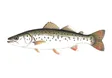
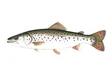
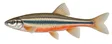
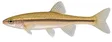
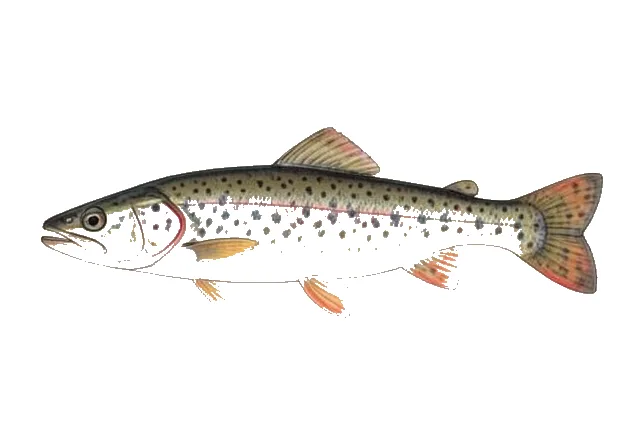
Northern Redbelly Dace field guide illustration

About Northern Redbelly Dace

The northern redbelly dace (Chrosomus eos) is a species of freshwater ray-finned fish belonging to the family Leuciscidae, which includes the daces, chubs and related fishes. These fishes are generally found in lakes and small streams in the northeastern United States and eastern Canada. Ranging from 1–3 inches, it is one of forty-four species from the minnow and carp family of Cyprinidae in these areas.

Description

The northern redbelly dace is a minnow about 2-4 inches long with two dusky, longitudinal stripes along its sides under an iridescent silver back. The top stripe often becomes broken into dots behind the dorsal fin. Small, almost invisible scales cover its body. The lower sides of its body are white, yellow, or silver. However, during the breeding season, this area becomes brilliant red on the males. The females likewise exhibit a colorful, green ventral stripe. Helpful identifying characteristics are its long coiling intestines and the black peritoneum (lining of the body cavity). Its lateral line is incomplete and consists of 70 to 90 lateral line scales.

The northern redbelly dace has thin, flexible rays called "soft-rays". It possesses a pair of pectoral fins, pelvic fins in the ventral and abdominal positions, which all are white, yellow, or silver. No adipose fin can be found after the dorsal fin on its back. The caudal fin or tail fin is notched and homocercal. This means that the tail has two lobes that are symmetrical.

Distribution and habitat

The northern redbelly dace ranges from Nova Scotia and Prince Edward Island westward curving in a narrow band through southern Canada, as well as, the northern and north-central United States. This encompasses Pennsylvania to Michigan, Wisconsin, and north through Minnesota and North East Iowa to the Peace-Mackenzie drainage in British Columbia as well as the Northwest Territories. In the United States the northern redbelly dace can be found in Maine, New Hampshire, New York, Pennsylvania, Michigan, Wisconsin, Minnesota, North and South Dakota, Nebraska, and Colorado.

The northern redbelly dace can be found in cool, quiet, boggy streams and lakes. The typical habitat conditions of small streams where the dace lives include: water supplied by clear, cool springs or seeps, absence of strong currents, effective cover like undercut banks and heavy brushy vegetation, and minimal large piscivorous fish populations. Small lake habitats also share these characteristics. Typically the lakes are clear and spring-fed with heavy vegetation (at least by shore) and few predatory fishes.

However, in states where it is vulnerable or endangered, it can only be found in extreme head waters of clear streams and spring-fed seepage pools. These locations provide a cold water habitat much like the conditions 1,000 years ago with glaciers to the north. Human activities have led to the reduction of cold-water streams and seepage, which reduces the suitable habitat for this Northern species.

Feeding

The northern redbelly dace feeds mainly on filamentous algae and diatoms, but also zooplankton and aquatic insect larvae. Their predators consist of other fish, kingfishers and water fowl especially mergansers. In small lakes where no piscivores live, the northern redbelly dace fills the niche of a planktivore. However, in larger lakes, it is restricted to the vegetation mats by shore where it must compete with other minnows for food.

Importance to humans

The northern redbelly dace has a direct economic value to humans as it is a popular baitfish used by many anglers across Ontario. Furthermore, as a minnow it is a primary consumer that feeds on algae. As such, it provides food to predators, particularly large fish and water fowl, which are game for fishers and hunters.

Conservation status

Throughout Canada, Minnesota, Wisconsin, Michigan, and the New England States, northern redbelly dace populations are considered stable. However, in areas such as Nebraska, Colorado, and South Dakota they are vulnerable following the retreat of the Wisconsin Ice Sheet.

Unfortunately, the northern redbelly dace is Endangered in several states, one of which is Massachusetts. The reasons for its decline are unknown, but possible threats include erosion and sedimentation, along with flow alterations.

Reproduction and life cycle

The northern redbelly dace reaches sexual maturity by its second or third summer and may live up to eight years. Spawning begins in the spring around May and continues into early August. Adult fish can spawn multiple times during the season. Nonadhesive eggs are laid in filamentous algae and hatch eight to ten days later at a water temperature of 21–27 °C.

Etymology of the name

The word "dace"originated in the early fifteenth century from the Old French word"darz", which means to dart. This fish was so called for its movements. Another theory traces it to the Medieval Latin word "darsus" also meaning to dart, said to be of Gaulish origin.

Article text: Wikipedia contributors, Northern redbelly dace (source revision). Licensed under CC BY-SA 4.0. Retrieved 2026-10-11.

Identification and appearance

Becker (1983); Smith (1985); Holton (1990); Page and Burr (1991). Another name is Chrosomus eos.

Native range

Atlantic, Great Lakes, Hudson Bay, upper Mississippi, Missouri, and Peace-Mackenzie River drainages, from Nova Scotia west to Northwest Territories and British Columbia, south to northern Pennsylvania, Wisconsin, Nebraska, and Colorado (Page and Burr 1991).

Introduction history

In a summary table on fishes liberated in Ohio waters, Trautman (1981) noted that 7,000 Northern Redbelly Dace from Michigan were unsuccessfully introduced into Ohio waters in October 1935, presumably as a forage fish. The report in Oklahoma is apparently based on observations of this species in bait tanks near Ft. Gibson Reservoir in Wagoner County (Heard 1959). The owner of the bait establishment said the minnows were imported from Minnesota. The retailer had noticed the dace mixed in the primarily fathead minnow bait shipments that he had been purchasing and re-selling for over a year. Although, there are no verified records from open waters, at least some individuals were likely introduced through discarded or escaped bait.

Range

Where it lives

Share of 2,122 GBIF observation records with a state location, across 18 states. The orange dots are USGS stream-survey sites where this species was caught.
0%
26.5%
Share of 2,122 GBIF observation records with a state location, across 18 states. The orange dots are USGS stream-survey sites where this species was caught.

A blank area on the dot layer usually means nobody sampled there, not that the fish is absent. Turn on “every survey site” to see where the survey looked.

The USGS stream survey caught it at 725 of its sites, in 9 states. That survey and the GBIF records are two different counts of two different things, so the site keeps them apart.

Habitat

Water and movement

Water
WoRMS records this species in fresh water.
USGS NAS habitat
Freshwater
US status
Native transplant — native to part of the United States, moved to other waters inside it.
Migration
Undetermined
Pattern
Disagreement
3 published references do not agree on the pattern: Non-migratory, Potamodromous. The site shows every assignment rather than picking one.

Classification

Taxonomy

Kingdom
Animalia
Phylum
Chordata
Superclass
Actinopterygii
Class
Teleostei
Order
Cypriniformes
Genus
Chrosomus
Species
Chrosomus eos
ITIS TSN
913993
WoRMS AphiaID
567541
GBIF key
2365385
Outside the US
ITIS also files it in Canada.

Common questions about Northern Redbelly Dace

What is the scientific name of Northern Redbelly Dace?
The scientific name is Chrosomus eos, in the family Leuciscidae. Classification follows ITIS.
Does Northern Redbelly Dace live in fresh water or salt water?
WoRMS records this species in fresh water.
Where has Northern Redbelly Dace been recorded in the United States?
GBIF has observations in 18 states, with the most records in Minnesota, Michigan, New York. The map shows observation records, which do not establish the complete natural range.

Closest relatives

Other Chrosomus species

Same family

More Leuciscidae

Alabama Shiner4 states
Cyprinella callistiaLeuciscidaeNativeFresh
Allegheny Pearl Dace19 states
Margariscus margaritaLeuciscidaeNative and introducedFresh
Altamaha Shiner1 states
Cyprinella xaenuraLeuciscidaeNativeFresh
Alvord Chub2 states
Siphateles alvordensisLeuciscidaeNativeFresh
Apalachee Shiner3 states
Pteronotropis grandipinnisLeuciscidaeNativeFresh
Arkansas River Shiner5 states
Notropis girardiLeuciscidaeNative and introducedFresh
Arroyo Chub1 states
Gila orcuttiiLeuciscidaeNative and introducedFresh
Bandfin Shiner5 states
Luxilus zonistiusLeuciscidaeNative and introducedFresh
Bannerfin Shiner5 states
Cyprinella leedsiLeuciscidaeNativeFresh
Beautiful Shiner3 states
Cyprinella formosaLeuciscidaeNativeFresh
Bedrock Shiner3 states
Notropis rupestrisLeuciscidaeNativeFresh
Bigeye Chub25 states
Hybopsis amblopsLeuciscidaeNative and introducedFresh
Bigeye Shiner17 states
Notropis boopsLeuciscidaeNative and introducedFresh
Bigmouth Chub3 states
Nocomis platyrhynchusLeuciscidaeNativeFresh
Bigmouth Shiner21 states
Notropis dorsalisLeuciscidaeNative and introducedFresh
Blackchin Shiner13 states
Notropis heterodonLeuciscidaeNativeFresh
Blackmouth Shiner3 states
Notropis melanostomusLeuciscidaeNativeFresh
Blacknose Shiner21 states
Notropis heterolepisLeuciscidaeNative and introducedFresh
Blackside Dace2 states
Chrosomus cumberlandensisLeuciscidaeNativeFresh
Blackspot Shiner5 states
Notropis atrocaudalisLeuciscidaeNativeFresh
Blacktail Shiner14 states
Cyprinella venustaLeuciscidaeNative and introducedFresh
Blacktip Shiner4 states
Lythrurus atrapiculusLeuciscidaeNative and introducedFresh
Bleeding Shiner8 states
Luxilus zonatusLeuciscidaeNativeFresh
Blotched Chub6 states
Erimystax insignisLeuciscidaeNativeFresh

All 267 species in Leuciscidae