Longnose Dace

Rhinichthys cataractae

Leuciscidae · freshwater water fish

6 minute read · Species guide

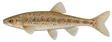
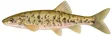
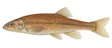
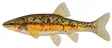
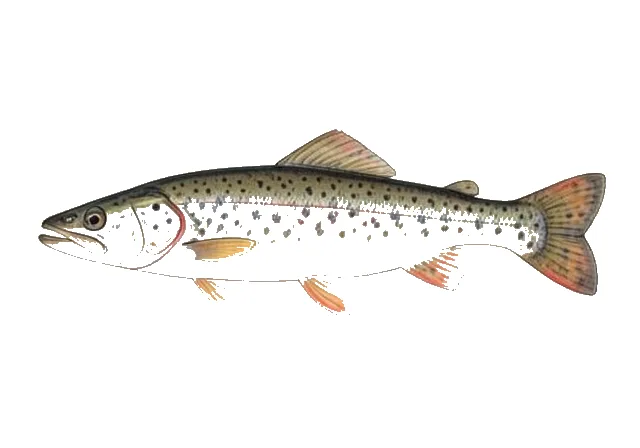
Longnose Dace field guide illustration

About Longnose Dace

The longnose dace (Rhinichthys cataractae) is a freshwater minnow native to North America. Rhinicthys means snout fish (reference to the long snout) and cataractae means of the cataract (first taken from Niagara Falls). Longnose dace are small, typically less than 100 mm and characterized by their fleshy snout that protrudes past the mouth. They are well adapted for living on the bottom of fast-flowing streams among stones. Longnose dace eat algae and aquatic insects and are important forage minnows for larger predatory fish.

Description

Longnose dace can be mistaken for suckers because of their subterminal "sucker-like" mouth. However, longnose dace (like all members of the family Cyprinidae) lack small fleshy projections, called papillae, on their mouths.

Juveniles have a black lateral line that extends from the beginning of the eye to the caudal fin that fades as the fish matures. The lateral line in juveniles is not present in all populations. In adults, the dorsal side is dark green to black, the lateral side is darkish to silvery with mottling often present, and the ventral side is pearly. Both adult males and females may have bright orange-reddish colouration at the base of pectoral, pelvic, and anal fins and on the upper lip. This colouration is typically associated with breeding males in the subspecies Rhinichthys cataractae cataractae, but the validity of this subspecies has yet to be confirmed. Museum specimens of females also show intense orange-reddish colouration at the base of the fins and upper lip, therefore colouration is not an accurate predictor of sex.

The maximum length of longnose dace is 170 mm (6.7 in), but they are usually less than 100 mm (3.9 in).

Geographic distribution

Longnose dace have the widest distribution of any cyprinid in North America, with a range reaching as far south as the Rocky Mountains in northern New Mexico and as far north as the Mackenzie River near the Arctic Circle and across the continent from the Pacific to Atlantic coast. Multiple refugia during the most recent glacial maximum may explain the broad geographic distribution of longnose dace. There were up to three possible glacial refuges during Pleistocene glaciations: the Pacific, the Mississippi and the Atlantic. Longnose dace on the Quebec peninsula likely originated only from the Atlantic refuge, in contrast to other fish species on the peninsula that originated from multiple refugia. Longnose dace in northwestern North America originated from a Pacific refuge.

Ecology

Longnose dace occur in moderately cool water streams, rivers and lakes with temperatures up to 22 °C (72 °F). Longnose dace are benthic and preferentially occupy rock and gravel substrate. During the day longnose dace hide under rocks. Longnose dace prefer shallow, fast-moving riffles in streams and rivers and the turbulent, near-shore region of lakes.

Longnose dace are opportunistic foragers. Small longnose dace (≤ 50 mm (2.0 in)) primarily consume algae and benthic invertebrates dace (> 50 mm (2.0 in)) feed on fish scales, fish eggs, terrestrial insects, and aquatic benthic macroinvertebrates, although diet varies seasonally. They are nocturnal feeders, possibly to avoid predation and/or salmonid competitors.

Longnose dace have small home ranges and high site fidelity, however there is evidence that a small proportion are able to disperse distances greater than 500 km (310 mi).

Life history

Longnose dace reach reproductive maturity at age two and have a mean lifespan of three years. Males and females have a maximum age of four and five, respectively.

Longnose dace typically spawn from May to August in water 14 to 19 °C (57 to 66 °F) and some populations are multiple spawners. Time of spawning is dependent on water temperature. Longnose dace are polygynandrous and males create and defend territories to attract females to enter and spawn. Males form a depression in the rocky substrate and vibrate to attract a female. When a female is receptive, she enters the territory and pushes her snout into substrate in a similar manner as the male. Both male and female tremble over the depression and release eggs and milt. Limited or no parental care is provided to young-of-the-year after hatching.

Anthropogenic disturbance

In southern Alberta longnose dace are exposed to organic, estrogen-like compounds. Downstream of wastewater effluent from the city of Red Deer longnose dace are larger, increase in abundance, and have larger livers but males have reduced ability to produce testosterone. Despite a morphologically healthy appearance, longnose dace in the Red Deer River are physiologically stressed. In the Oldman River, some longnose dace populations are characterized by elevated vitellogenin expression, female biased sex ratios and intersex gonads. Feminization is likely caused by estrogen-like compounds present in municipal wastewater effluent, agriculture, and cattle operations near the Oldman River, however this mechanism is not well understood. It is not known if increased vitellogenin expression and intersex gonads significantly decrease reproductive success and will impact the long term viability of longnose dace in these systems. There is not evidence of skewed sex ratios in the Bow River.

Article text: Wikipedia contributors, Longnose dace (source revision). Licensed under CC BY-SA 4.0. Retrieved 2026-10-11.
Diet and feeding

The FishTraits compilation records these diet categories for this species: algae or phytoplankton; invertebrates or larval fish; fish or frog eggs. These are broad categories, not a claim that every individual consumes every example in a category.

Reported feeding positions include bottom feeding. The compilation combines published observations; diets can vary with age, locality, and available food.

Habitat preferences

Reported habitat associations include medium to large rivers, streams and small rivers, creeks, still-water habitats.

The source records associations with cobble, boulders, bedrock. An association indicates reported use, rather than an exclusive requirement.

Reproduction and parental care

The compilation reports a representative maturity age of 2.5 years. Its maturity field summarizes mean, median, or modal estimates, usually for females; male estimates can be used when female data are unavailable. It is not a fixed age at which every fish first breeds.

Recorded spawning months are Apr, May, Jun for the source’s reporting region (NC). This is a regional calendar, not a range-wide schedule.

The reproductive-guild classification includes guarding eggs or young at a spawning substrate or nest.

Size and recorded longevity

FishTraits reports a maximum total length of 22.5 centimetres. Some entries use an estimated asymptotic length; this value should not be treated as a certified record catch.

Recorded longevity in the compilation is 5 years. Wild observations were preferred, but captive records were accepted where wild records were unavailable, and unspecified records were assumed wild. The value is not a guaranteed wild lifespan or an aquarium life expectancy.

Native range

Generally distributed above 40 N from coast to coast; occurs as far north as Arctic Circle in Mackenzie River drainage; south in Appalachian Mountains to northern Georgia and in Rocky Mountains south into Rio Grande drainage of Texas and northern Mexico (Page and Burr 1991).

Introduction history

Evidently a bait bucket release in Strawberry Reservoir in 1951 (Sigler and Miller 1963). Suspected bait bucket introduction in Wyoming (Baxter and Simon 1970) and in Kentucky (Jenkins and Burkhead 1994); possible bait bucket releases in other sites.

Ecological impacts

Longnose Dace hybridize with native speckled dace R. osculus in areas where Longnose Dace have been introduced (Sigler and Miller 1963). This hybrid has been recorded from Utah in the Provo River in 1942 and from the Strawberry Reservoir in Wasatch County in 1951 (Sigler and Miller 1963). It has also been recorded from areas where both species are native, such as, the Bear River Wyoming, Little Wood River, Idaho and Ross Fork at Fort Hall, Idaho (Sigler and Miller 1963).

Record fish

The Montana state record

  • Montana0.01 lbs

    Prickly Pear Creek · 6/29/25 · Carson Beckman

Each figure is the state agency’s own certified record. The site holds record tables for 11 states so far, so a state missing here has not been read yet. It is not a state where this fish holds no record.

Range

Where it lives

Share of 15,272 GBIF observation records with a state location, across 41 states. The orange dots are USGS stream-survey sites where this species was caught.
0%
20.2%
Share of 15,272 GBIF observation records with a state location, across 41 states. The orange dots are USGS stream-survey sites where this species was caught.

A blank area on the dot layer usually means nobody sampled there, not that the fish is absent. Turn on “every survey site” to see where the survey looked.

The USGS stream survey caught it at 4,192 of its sites, in 35 states. That survey and the GBIF records are two different counts of two different things, so the site keeps them apart.

Habitat

Water and movement

Water
WoRMS records this species in fresh water.
USGS NAS habitat
Freshwater
US status
Native transplant — native to part of the United States, moved to other waters inside it.
Migration
Undetermined
Pattern
Disagreement
4 published references do not agree on the pattern: Non-migratory, Potamodromous. The site shows every assignment rather than picking one.

Classification

Taxonomy

Kingdom
Animalia
Phylum
Chordata
Superclass
Actinopterygii
Class
Teleostei
Order
Cypriniformes
Genus
Rhinichthys
Species
Rhinichthys cataractae
ITIS TSN
163384
WoRMS AphiaID
567547
GBIF key
2359811
Outside the US
ITIS also files it in Canada, Mexico.

Common questions about Longnose Dace

What is the scientific name of Longnose Dace?
The scientific name is Rhinichthys cataractae, in the family Leuciscidae. Classification follows ITIS.
Does Longnose Dace live in fresh water or salt water?
WoRMS records this species in fresh water.
Where has Longnose Dace been recorded in the United States?
GBIF has observations in 41 states, with the most records in New Mexico, New York, Maryland. The map shows observation records, which do not establish the complete natural range.

Closest relatives

Other Rhinichthys species

Same family

More Leuciscidae

Alabama Shiner4 states
Cyprinella callistiaLeuciscidaeNativeFresh
Allegheny Pearl Dace19 states
Margariscus margaritaLeuciscidaeNative and introducedFresh
Altamaha Shiner1 states
Cyprinella xaenuraLeuciscidaeNativeFresh
Alvord Chub2 states
Siphateles alvordensisLeuciscidaeNativeFresh
Apalachee Shiner3 states
Pteronotropis grandipinnisLeuciscidaeNativeFresh
Arkansas River Shiner5 states
Notropis girardiLeuciscidaeNative and introducedFresh
Arroyo Chub1 states
Gila orcuttiiLeuciscidaeNative and introducedFresh
Bandfin Shiner5 states
Luxilus zonistiusLeuciscidaeNative and introducedFresh
Bannerfin Shiner5 states
Cyprinella leedsiLeuciscidaeNativeFresh
Beautiful Shiner3 states
Cyprinella formosaLeuciscidaeNativeFresh
Bedrock Shiner3 states
Notropis rupestrisLeuciscidaeNativeFresh
Bigeye Chub25 states
Hybopsis amblopsLeuciscidaeNative and introducedFresh
Bigeye Shiner17 states
Notropis boopsLeuciscidaeNative and introducedFresh
Bigmouth Chub3 states
Nocomis platyrhynchusLeuciscidaeNativeFresh
Bigmouth Shiner21 states
Notropis dorsalisLeuciscidaeNative and introducedFresh
Blackchin Shiner13 states
Notropis heterodonLeuciscidaeNativeFresh
Blackmouth Shiner3 states
Notropis melanostomusLeuciscidaeNativeFresh
Blacknose Shiner21 states
Notropis heterolepisLeuciscidaeNative and introducedFresh
Blackside Dace2 states
Chrosomus cumberlandensisLeuciscidaeNativeFresh
Blackspot Shiner5 states
Notropis atrocaudalisLeuciscidaeNativeFresh
Blacktail Shiner14 states
Cyprinella venustaLeuciscidaeNative and introducedFresh
Blacktip Shiner4 states
Lythrurus atrapiculusLeuciscidaeNative and introducedFresh
Bleeding Shiner8 states
Luxilus zonatusLeuciscidaeNativeFresh
Blotched Chub6 states
Erimystax insignisLeuciscidaeNativeFresh

All 267 species in Leuciscidae