Speckled Dace

Rhinichthys osculus

Leuciscidae · freshwater water fish

8 minute read · Species guide

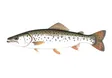
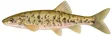
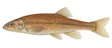
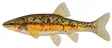
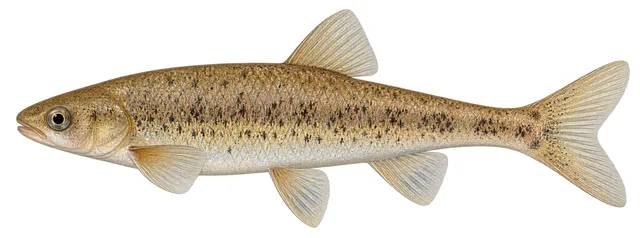
Speckled Dace field guide illustration

About Speckled Dace

The speckled dace (Rhinichthys osculus), also known as the spotted dace and the carpita pinta, is a species of freshwater ray-finned fish belonging to the family Leuciscidae, the shiners, daces and minnows. It is found in temperate freshwater in North America, from Sonora, Mexico, to British Columbia, Canada.

Speckled dace have a variety of unofficial names. Some of these include western dace, pacific dace, spring dace, and dusky dace. Dace is derived from the Middle English word that means dart.

Description

The speckled dace is normally small, usually less than 8 centimeters. They are recognized for having a thick caudal peduncle, bluntly pointed snout, small scales, and small eyes. They have inferior mouths and pharyngeal teeth that are strongly hooked and have a slight grinding surface. Typically, the teeth are seen to have a barbel at the end of each maxilla. The dorsal fin is located behind the pelvic fin and the anal fin normally has 7 rays. Speckled dace color varies, but most fish from this species that are over 3 centimetres (1.2 in), have dark speckles on the back and sides, dark blotches on side, a spot at the base of the caudal peduncle, and a stripe on the head. These fish are usually darker yellow to darker green with the belly color ranging from yellow to white. During breeding, both male and female fin bases turn orange to red, and males will often have red snouts and lips in addition.

The Foskett speckled dace, found in "harsh conditions"of the desert waters of the Great Basin spanning parts of Southeastern Oregon and Nevada, has been listed as threatened under the Endangered Species Act since 1985. From 2011 through 2016, the fish's population fluctuated from a low of 1,728 to a high of 24,888. Prior to listing, the population was estimated to be 1,500 to 2,000. In 2018, U.S. Fish and Wildlife Service officials proposed removing federal protections. Robyn Thorson, the Service's pacific region director, said in a statement;"We attribute this impressive accomplishment to our partners who have worked so hard on the recovery of the dace. This news builds on other recent successes, including two Oregon fishes that were delisted due to recovery, the Oregon chub and the Modoc sucker."

Species

Recent genetic work has elevated multiple R. osculus Subspecies to full species status, including:

Distribution

Speckled dace are the only fish native to all major Western drainage systems from Canada south to Sonora, Mexico. R. osculus have the widest geographic range of any freshwater dispersing fish in western North America. Studies show there are 3 major genetically distinct lineages in California that fit with the geologic history of California. Within these groups, there are 12 major areas they are native to in California including Death Valley, Owens Valley, eastern Sierra drainages, Surprise Valley, Klamath-trinity basin, Pit River drainage, Sacramento drainage, the Lorenzo, Pajaro, and Salinas Rivers. As well as the San Luis Obispo, Pismo, and Arroyo Grande Creeks, Morro Bay drainage, and the San Gabriel, Santa Ana and Los Angeles river basins. Studies suggest that even within the Klamath-trinity basin there are three genetically distinct groups which are named after their geographic distribution; Klamath, Trinity, and Jenny.

Canada is the northern limit of the speckled dace's distribution, and there it is found only in isolated parts of the Kettle and Granby Rivers. It is possible that, along with the Salish sucker (Catostomus sp.), the speckled dace was one of the first fish to recolonize the rivers of British Columbia following the Ice Age. It is believed that spawning in Canada occurs once a year during the summer in fish older than two years. During breeding, many males often accompany a single female who broadcasts adhesive eggs over the gravelly stream bed. Canadian populations of the fish were last sampled in 1977, and then only 400 individuals were collected. Few of the fish caught were adults, suggesting that speckled dace mortality may be high. However, not enough data is available to determine accurately whether the population is self-sustaining or in decline. The speckled dace arrived in the Los Angeles area streams about 1.9 million years ago.

Biology

Speckled dace are habitat generalists and can inhabit a variety of different types of habitats. R. osculus inhabit small springs, rushing brooks, pools in streams, rivers, and lakes. The commonality these all share, in which speckled dace need, is well-oxygenated water, deep cover such as aquatic plants, and moving water from stream current. Their feeding habits include small invertebrates, especially ones found in riffles such as larvae of hydropsychid caddisflies, mayflies, and midges. In lakes on the other hand, they tend to go for bigger prey such as flying insects at the water’s surface and zooplankton. The feeding habit all depends on seasonality as well. Breeding season for speckled dace usually happens during spring to early summer. This species also has a high potential-reproductive rate and mature in as few as two years. In lakes, they will find shallow areas for spawning or swim upstream to find the gravel edge of a riffle. Once the females release eggs onto rocks, they will hatch in about 6 days and remain in the gravel for 6–7 days. During breeding, many males often accompany a single female who broadcasts adhesive eggs. Each female produces between 450–2000 eggs in a season. 200 and 500 eggs. Research argues that when competitive interactions occur in creeks, the speckled dace will inhabit the riffles at the lower end due to their resiliency to a wide range of water temperatures.

Conservation status

Not much is known on the conservation status of speckled dace, but literature suggests most of the subspecies are not listed under the US Endangered Species Act. The Fockett spring speckled dace is the exception as it conserved under this act. This subspecies lives in a small, isolated desert spring in the Warner Basin in Oregon. In 1995, a different subgroup of speckled dace, Santa Ana speckled dace, was listed as a species of special concern by the California Department of Fish and Wildlife. Then in 1998, it was listed as a species of concern by the US Forest Service. Threats to speckled dace include water use from reduced flow during certain seasons due to irrigation and consumption uses, habitat loss potentially through hydro development, industrial land use such as agriculture, and invasive piscivorous fish. Some specific threats to the R. osculus are reduced flows in the summer and autumn due to irrigation and other consumptive uses, loss of habitat through hydro development, increased siltation and substrate embeddedness from agricultural land clearing and forestry activity, and predation by piscivorous fish.

Article text: Wikipedia contributors, Speckled dace (source revision). Licensed under CC BY-SA 4.0. Retrieved 2026-10-11.
Diet and feeding

The FishTraits compilation records these diet categories for this species: algae or phytoplankton; detritus or unidentified plant material; invertebrates or larval fish. These are broad categories, not a claim that every individual consumes every example in a category.

Reported feeding positions include bottom feeding and surface or water-column feeding. The compilation combines published observations; diets can vary with age, locality, and available food.

Habitat preferences

Reported habitat associations include medium to large rivers, streams and small rivers, creeks, still-water habitats, springs or subterranean waters.

The source records associations with sand, gravel, cobble, boulders, vegetation, organic debris, large woody material. An association indicates reported use, rather than an exclusive requirement.

Reproduction and parental care

The compilation reports a representative maturity age of 1.5 years. Its maturity field summarizes mean, median, or modal estimates, usually for females; male estimates can be used when female data are unavailable. It is not a fixed age at which every fish first breeds.

Batch or serial spawning has been reported somewhere in the species’ range. This does not establish the same spawning pattern for every population.

Recorded spawning months are Jun, Jul, Aug for the source’s reporting region (CA). This is a regional calendar, not a range-wide schedule.

The reproductive-guild classification includes guarding eggs or young at a spawning substrate or nest.

Size and recorded longevity

FishTraits reports a maximum total length of 11 centimetres. Some entries use an estimated asymptotic length; this value should not be treated as a certified record catch.

Recorded longevity in the compilation is 3.5 years. Wild observations were preferred, but captive records were accepted where wild records were unavailable, and unspecified records were assumed wild. The value is not a guaranteed wild lifespan or an aquarium life expectancy.

Identification and appearance

Moyle (1976a); Wydoski and Whitney (1979); Sublette et al. (1990); Page and Burr (1991); Bond (1994). It is considered a species complex; some subspecies are protected as endangered (Page and Burr 1991). Gilbert (1998) recognized 15 subspecies. One subspecies is R. o. nubilis from Washington and closely adjacent areas, sometimes reported as Rhinichthys nubilus (Miller 1952).

Native range

Western drainages (Pacific and endorheic) from Columbia River, British Columbia, to Colorado River, Arizona and New Mexico, and south into Sonora, Mexico (Page and Burr 1991).

Introduction history

Several transplants into parts of California during 1939 and 1940 were considered experiments to test the effects of changed environment on meristic and morphometric characters (Miller 1968). This species was intentionally stocked by Nevada Fish and Game officials in Ruby Marsh-Ruby Lake complex as forage for introduced largemouth bass Micropterus salmoides; the first introduction, in 1950, involved R. osculus robustus from a headwater of the Humboldt River, and the second, in 1951, from nearby Diamond Valley, Eureka County (La Rivers 1962; Hubbs et al. 1974). Although La Rivers (1962) recognized that R. osculus robustus was native to the Truckee River system, he concluded that the high-altitude lake had no native fishes and that small fishes present in the lake had likely arrived as a result of being stocked along with trout. Introductions of this species in other areas were probably the result of bait bucket releases (e.g., Miller 1952; La Rivers 1962). For instance, Miller (1946) indicated that the presence of Rhinichthys osculus in the Santa Clara River system (California) was possibly the result of its introduction as bait by trout fishermen.

Ecological impacts

Unknown in introduced areas. Speckled Dace are known to hybridize with least chubs Iotichthys phlegethontis (Sigler and Sigler 1987), a species under review for federal listing, and therefore present a threat to this rare species.

Range

Where it lives

Share of 19,803 GBIF observation records with a state location, across 14 states. The orange dots are USGS stream-survey sites where this species was caught.
0%
33.7%
Share of 19,803 GBIF observation records with a state location, across 14 states. The orange dots are USGS stream-survey sites where this species was caught.

A blank area on the dot layer usually means nobody sampled there, not that the fish is absent. Turn on “every survey site” to see where the survey looked.

The USGS stream survey caught it at 665 of its sites, in 10 states. That survey and the GBIF records are two different counts of two different things, so the site keeps them apart.

Habitat

Water and movement

Water
WoRMS records this species in fresh water.
USGS NAS habitat
Freshwater
US status
Native transplant — native to part of the United States, moved to other waters inside it.
Migration
Undetermined

Classification

Taxonomy

Kingdom
Animalia
Phylum
Chordata
Superclass
Actinopterygii
Class
Teleostei
Order
Cypriniformes
Genus
Rhinichthys
Species
Rhinichthys osculus
ITIS TSN
163387
WoRMS AphiaID
592846
GBIF key
2359791
Outside the US
ITIS also files it in Canada, Mexico.

Common questions about Speckled Dace

What is the scientific name of Speckled Dace?
The scientific name is Rhinichthys osculus, in the family Leuciscidae. Classification follows ITIS.
Does Speckled Dace live in fresh water or salt water?
WoRMS records this species in fresh water.
Where has Speckled Dace been recorded in the United States?
GBIF has observations in 14 states, with the most records in New Mexico, Utah, Arizona. The map shows observation records, which do not establish the complete natural range.

Closest relatives

Other Rhinichthys species

Same family

More Leuciscidae

Alabama Shiner4 states
Cyprinella callistiaLeuciscidaeNativeFresh
Allegheny Pearl Dace19 states
Margariscus margaritaLeuciscidaeNative and introducedFresh
Altamaha Shiner1 states
Cyprinella xaenuraLeuciscidaeNativeFresh
Alvord Chub2 states
Siphateles alvordensisLeuciscidaeNativeFresh
Apalachee Shiner3 states
Pteronotropis grandipinnisLeuciscidaeNativeFresh
Arkansas River Shiner5 states
Notropis girardiLeuciscidaeNative and introducedFresh
Arroyo Chub1 states
Gila orcuttiiLeuciscidaeNative and introducedFresh
Bandfin Shiner5 states
Luxilus zonistiusLeuciscidaeNative and introducedFresh
Bannerfin Shiner5 states
Cyprinella leedsiLeuciscidaeNativeFresh
Beautiful Shiner3 states
Cyprinella formosaLeuciscidaeNativeFresh
Bedrock Shiner3 states
Notropis rupestrisLeuciscidaeNativeFresh
Bigeye Chub25 states
Hybopsis amblopsLeuciscidaeNative and introducedFresh
Bigeye Shiner17 states
Notropis boopsLeuciscidaeNative and introducedFresh
Bigmouth Chub3 states
Nocomis platyrhynchusLeuciscidaeNativeFresh
Bigmouth Shiner21 states
Notropis dorsalisLeuciscidaeNative and introducedFresh
Blackchin Shiner13 states
Notropis heterodonLeuciscidaeNativeFresh
Blackmouth Shiner3 states
Notropis melanostomusLeuciscidaeNativeFresh
Blacknose Shiner21 states
Notropis heterolepisLeuciscidaeNative and introducedFresh
Blackside Dace2 states
Chrosomus cumberlandensisLeuciscidaeNativeFresh
Blackspot Shiner5 states
Notropis atrocaudalisLeuciscidaeNativeFresh
Blacktail Shiner14 states
Cyprinella venustaLeuciscidaeNative and introducedFresh
Blacktip Shiner4 states
Lythrurus atrapiculusLeuciscidaeNative and introducedFresh
Bleeding Shiner8 states
Luxilus zonatusLeuciscidaeNativeFresh
Blotched Chub6 states
Erimystax insignisLeuciscidaeNativeFresh

All 267 species in Leuciscidae