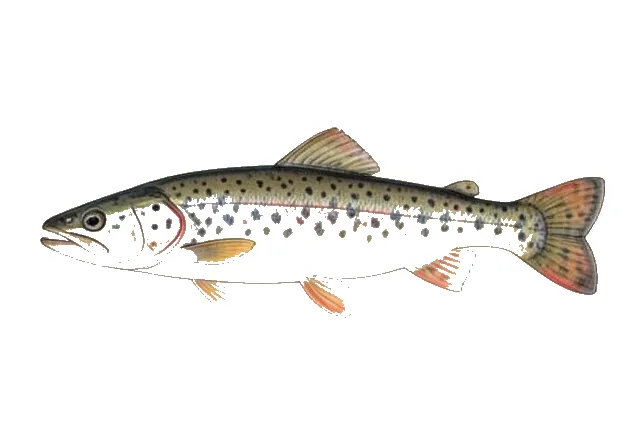
Relict dace coloration is variable, but generally dusky overall, with olive and brassy shades dorsally. An obvious speckling pattern with patches ranging from brown to green, and yellowish narrow stripes appear on the back and belly. Lower fins are often yellow, and may be a bright golden shade. The oblique mouth is terminal, and lacks horny cutting edges. The fins are rather small and rounded, with the pelvic fins being especially notable for their paddle shape. The variations on the basic cyprinid plan seem to be characteristic of desert fishes evolving in isolation, with the body adapting for midwater swimming in quiet water.
The relict dace occurs in only a handful of habitats in eastern Nevada, all of which were once covered by the prehistoric Lake Lahontan. Locations include the springs of Buttle and Ruby Valleys, and the drainage systems of Franklin Lake and Gale Lake.
Article text: Wikipedia contributors, Relict dace (source revision). Licensed under CC BY-SA 4.0. Retrieved 2026-10-11.
Diet and feeding
The FishTraits compilation records these diet categories for this species: algae or phytoplankton; invertebrates or larval fish. These are broad categories, not a claim that every individual consumes every example in a category.
Reported feeding positions include bottom feeding and surface or water-column feeding. The compilation combines published observations; diets can vary with age, locality, and available food.
Habitat preferences
Reported habitat associations include creeks, still-water habitats, springs or subterranean waters.
The source records associations with muck, bedrock, vegetation. An association indicates reported use, rather than an exclusive requirement.
Reproduction and parental care
The compilation reports a representative maturity age of 1 years. Its maturity field summarizes mean, median, or modal estimates, usually for females; male estimates can be used when female data are unavailable. It is not a fixed age at which every fish first breeds.
Batch or serial spawning has been reported somewhere in the species’ range. This does not establish the same spawning pattern for every population.
Recorded spawning months are Jun, Jul, Aug, Sep for the source’s reporting region (NV). This is a regional calendar, not a range-wide schedule.
Size and recorded longevity
FishTraits reports a maximum total length of 13 centimetres. Some entries use an estimated asymptotic length; this value should not be treated as a certified record catch.
Recorded longevity in the compilation is 5 years. Wild observations were preferred, but captive records were accepted where wild records were unavailable, and unspecified records were assumed wild. The value is not a guaranteed wild lifespan or an aquarium life expectancy.
Native range
Lakes Franklin, Gale, Waring, Steptoe and Spring basins in eastern Nevada (Page and Burr 1991).
Introduction history
The Shoshone Ponds population was intentionally introduced for conservation purposes with stock transplanted from ponds in Steptoe Valley, Nevada. The plant created an additional population of a rare species with a restricted range. The introduction of this species into Spring Valley, Nevada, may have been for mosquito control, or possibly as a curiosity (Hubbs et al. 1974). In 1942, a rancher testified that he had taken this minnow from Butte Valley to Lake Mead, where the fish was used as bait (Hubbs et al. 1974); however, we are unaware of any records of this species in Lake Mead.