Eastern Blacknose Dace

Rhinichthys atratulus

Leuciscidae · freshwater water fish

5 minute read · Species guide

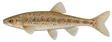
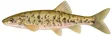
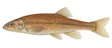
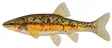
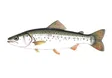
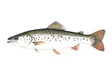
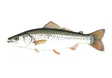
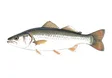
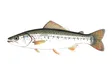
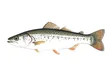
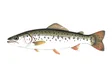
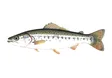
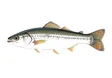
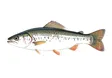
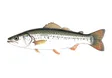
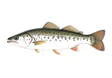
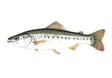
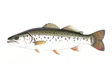
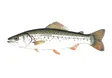
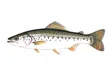
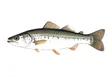
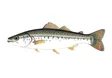
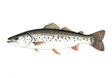
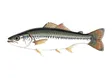
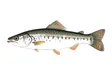
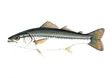
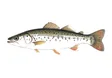
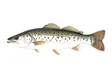
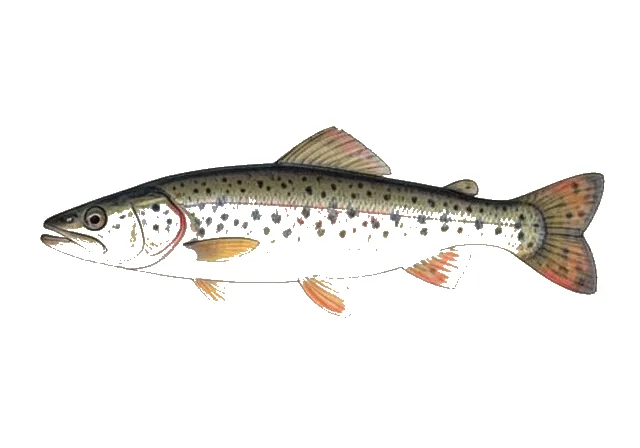
Eastern Blacknose Dace field guide illustration

About Eastern Blacknose Dace

Eastern blacknose dace (Rhinichthys atratulus) is a species of ray-finned fish in the genus Rhinichthys. Its name originates from the Old French word "dars"which is the nominative form of the word"dart" in reference to their swimming pattern. The western blacknose dace (Rhinichthys obtusus) formerly was considered conspecific. While morphologically the two species are not significantly different, they are allopatric. The eastern blacknose dace is found across the southeast portion of Canada and down along the United States' east coast. It is dark brown to olive on its dorsal surface and silvery white below, the two shades separated by the darkly pigmented lateral line. In the breeding season, males develop darker pigmentation and an orange lateral line. Blacknose dace live in rocky streams and rivers where they feed upon small invertebrates and microscopic biological matter and provide forage for larger fish.

Physical description

As fry, this fish is 5 mm (3 ⁄ 16 in) long, and some of the larger eastern blacknose dace can reach slightly over 100 mm (3.9 in). They tend to live for two or three years and grow continuously during this period. They have a fusiform body shape and the mouth is in a subterminal position. The lateral line is darkly colored and has 56 to 70 scales from anterior to posterior. Above the lateral line coloration can vary between shades of dark brown and even olive, while below the lateral line coloration is lighter up until a white belly. Their caudal fin is forked, and their single dorsal fin has 8 fin rays and no spines. They have a pair of pectoral fins and a pair of abdominal ventral fins, as well as an anal fin with 7 rays. All fins are clear to yellow except males during spawning season acquire an orange to red tint in all fins and along the lateral line.

Distribution and habitat

This fish is mainly found along the southern border of Canada extending along from Manitoba to the Atlantic Ocean, south along the east coast of the United States and slightly inland to South Carolina and Georgia. Scientists hypothesize that 20,000 years ago, as the glaciers retreated, blacknose dace recolonized the region from a single refugium in modern-day Connecticut, as soon as 75 years after the ice receded.

This fish tends to inhabit headwaters, creeks, and small rivers with swiftly moving water. However, fry mature in slower moving portions of the habitats like shoals and pool margins. The species as a whole prefers cool, rocky areas and uses the stones to rest under and around. They also use overhanging vegetation and undercut banks for additional refuge. In the winter, they migrate from headwater streams into rivers and can be found in deeper water under banks.

Diet and predation

The eastern blacknose dace eats many small insects and other invertebrates including Acentria ephemerella, Telmatogetoninae, other Chironomidae, worms, algae, and small crustaceans such as young crayfish. They also feed on some plant species. Young fry forage in shallow silty water while adults move into riffles and deep eddying pools to find invertebrates.

Many larger fish feed on the eastern blacknose dace including smallmouth bass, brook trout, brown trout, and rainbow trout. They are also preyed upon by the common merganser and the great blue heron.

Reproduction

Eastern blacknose dace spawning takes place between May and June and occurs in shallow water over gravel riffles. During this breeding season, the male develops nuptial tubercles on various parts of the body including the head and fins. His coloration also turns orange-red during this time along the lateral stripe and pectoral fins. Males of this species are nonterritorial and mate with one female. Eggs are deposited into crude nests which are depressions in the gravel created by vigorous movement during spawning. Larger females have higher fecundity and lay between 400 and 1,100 eggs. Following egg deposition, there is little to no parental care for the young.

Article text: Wikipedia contributors, Eastern blacknose dace (source revision). Licensed under CC BY-SA 4.0. Retrieved 2026-10-11.
Diet and feeding

The FishTraits compilation records these diet categories for this species: algae or phytoplankton; detritus or unidentified plant material; invertebrates or larval fish; larger animal prey (a source category covering fish, crayfish, crabs, or frogs); fish or frog eggs. These are broad categories, not a claim that every individual consumes every example in a category.

Reported feeding positions include bottom feeding and surface or water-column feeding. The compilation combines published observations; diets can vary with age, locality, and available food.

Habitat preferences

Reported habitat associations include streams and small rivers, creeks.

The source records associations with sand, gravel, cobble, boulders, bedrock. An association indicates reported use, rather than an exclusive requirement.

Reproduction and parental care

The compilation reports a representative maturity age of 1.5 years. Its maturity field summarizes mean, median, or modal estimates, usually for females; male estimates can be used when female data are unavailable. It is not a fixed age at which every fish first breeds.

Recorded spawning months are Apr, May, Jun for the source’s reporting region (NC). This is a regional calendar, not a range-wide schedule.

The reproductive-guild classification includes hiding a brood without subsequent guarding.

Size and recorded longevity

FishTraits reports a maximum total length of 10 centimetres. Some entries use an estimated asymptotic length; this value should not be treated as a certified record catch.

Recorded longevity in the compilation is 3.5 years. Wild observations were preferred, but captive records were accepted where wild records were unavailable, and unspecified records were assumed wild. The value is not a guaranteed wild lifespan or an aquarium life expectancy.

Native range

Atlantic, Great Lakes, Hudson Bay, Mississippi, and upper Mobile Bay drainages from Nova Scotia to Manitoba and south to northern Georgia and northern Alabama (Page and Burr 1991).

Introduction history

Unknown, possible bait bucket release.

Range

Where it lives

Share of 17,766 GBIF observation records with a state location, across 40 states. The orange dots are USGS stream-survey sites where this species was caught.
0%
26.3%
Share of 17,766 GBIF observation records with a state location, across 40 states. The orange dots are USGS stream-survey sites where this species was caught.

A blank area on the dot layer usually means nobody sampled there, not that the fish is absent. Turn on “every survey site” to see where the survey looked.

The USGS stream survey caught it at 5,954 of its sites, in 30 states. That survey and the GBIF records are two different counts of two different things, so the site keeps them apart.

Habitat

Water and movement

Water
WoRMS records this species in fresh water.
USGS NAS habitat
Freshwater
US status
Native transplant — native to part of the United States, moved to other waters inside it.
Migration
Migratory
Pattern

Classification

Taxonomy

Kingdom
Animalia
Phylum
Chordata
Superclass
Actinopterygii
Class
Teleostei
Order
Cypriniformes
Genus
Rhinichthys
Species
Rhinichthys atratulus
ITIS TSN
163382
WoRMS AphiaID
159985
GBIF key
2359823
Outside the US
ITIS also files it in Canada.

Common questions about Eastern Blacknose Dace

What is the scientific name of Eastern Blacknose Dace?
The scientific name is Rhinichthys atratulus, in the family Leuciscidae. Classification follows ITIS.
Does Eastern Blacknose Dace live in fresh water or salt water?
WoRMS records this species in fresh water.
Where has Eastern Blacknose Dace been recorded in the United States?
GBIF has observations in 40 states, with the most records in New York, Maryland, New Jersey. The map shows observation records, which do not establish the complete natural range.

Closest relatives

Other Rhinichthys species

Same family

More Leuciscidae

Alabama Shiner4 states
Cyprinella callistiaLeuciscidaeNativeFresh
Allegheny Pearl Dace19 states
Margariscus margaritaLeuciscidaeNative and introducedFresh
Altamaha Shiner1 states
Cyprinella xaenuraLeuciscidaeNativeFresh
Alvord Chub2 states
Siphateles alvordensisLeuciscidaeNativeFresh
Apalachee Shiner3 states
Pteronotropis grandipinnisLeuciscidaeNativeFresh
Arkansas River Shiner5 states
Notropis girardiLeuciscidaeNative and introducedFresh
Arroyo Chub1 states
Gila orcuttiiLeuciscidaeNative and introducedFresh
Bandfin Shiner5 states
Luxilus zonistiusLeuciscidaeNative and introducedFresh
Bannerfin Shiner5 states
Cyprinella leedsiLeuciscidaeNativeFresh
Beautiful Shiner3 states
Cyprinella formosaLeuciscidaeNativeFresh
Bedrock Shiner3 states
Notropis rupestrisLeuciscidaeNativeFresh
Bigeye Chub25 states
Hybopsis amblopsLeuciscidaeNative and introducedFresh
Bigeye Shiner17 states
Notropis boopsLeuciscidaeNative and introducedFresh
Bigmouth Chub3 states
Nocomis platyrhynchusLeuciscidaeNativeFresh
Bigmouth Shiner21 states
Notropis dorsalisLeuciscidaeNative and introducedFresh
Blackchin Shiner13 states
Notropis heterodonLeuciscidaeNativeFresh
Blackmouth Shiner3 states
Notropis melanostomusLeuciscidaeNativeFresh
Blacknose Shiner21 states
Notropis heterolepisLeuciscidaeNative and introducedFresh
Blackside Dace2 states
Chrosomus cumberlandensisLeuciscidaeNativeFresh
Blackspot Shiner5 states
Notropis atrocaudalisLeuciscidaeNativeFresh
Blacktail Shiner14 states
Cyprinella venustaLeuciscidaeNative and introducedFresh
Blacktip Shiner4 states
Lythrurus atrapiculusLeuciscidaeNative and introducedFresh
Bleeding Shiner8 states
Luxilus zonatusLeuciscidaeNativeFresh
Blotched Chub6 states
Erimystax insignisLeuciscidaeNativeFresh

All 267 species in Leuciscidae