Redside Dace

Clinostomus elongatus

Leuciscidae · freshwater water fish

6 minute read · Species guide

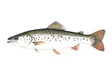
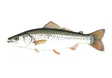
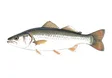
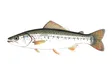
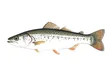
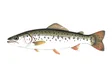
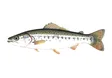
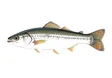
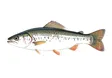
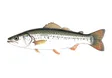
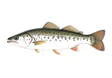
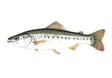
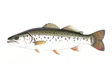
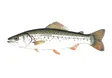
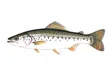
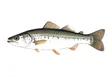
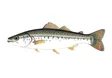
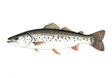
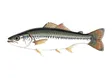
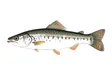
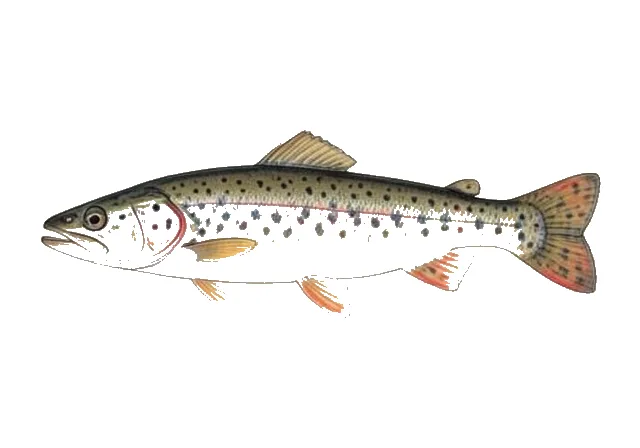
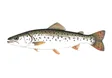
Redside Dace field guide illustration

About Redside Dace

The redside dace (Clinostomus elongatus) is a North American species of freshwater ray-finned fish in the family Leuciscidae. It is a surface-feeding specialist, thus acting as a conduit for nutrient transfers between terrestrial and aquatic environments. This fish is also known as an indicator species as it is sensitive to environmental disturbances.

Taxonomy

American naturalist Jared Potter Kirtland described the redside dace in 1840. The species name elongatus is Latin for "prolonged"or"elongated", referencing the distinctive head and mouth shape.

Description

The redside dace is brightly colored, with a wide red stripe extending from the head to the dorsal fin, running along the middle of the body. A bright yellow stripe generally extends from the head to caudal fin above the red lateral stripe. The back of this fish is generally dark, ranging from green to dark blue. Distinguishing it from other minnows, this species has a very large terminal mouth and protruding lower jaw, which is an effective adaptation for capturing prey from below.

The species' maximum total length is around 120 mm (4.7 in) but 65 mm (2.6 in) is the average of adults. Age estimation with scales suggests that redside dace do not live over four years. Within their first year of life, redside dace may attain a length of 31–48 mm (1.2–1.9 in) by late summer.

The redside dace is similar in appearance to the rosyside dace (Clinostomus funduloides), however the redside dace has a longer and more slender body with brighter red coloration on its sides. The two species are also allopatric.

United States

Redside dace are most abundant in Pennsylvania, especially in the upper parts of the Susquehanna River drainage. It is also found in some tributaries of the Laurentian Great Lakes, as well as in the Ohio River drainage and the upper parts of the Mississippi River drainage. Scattered populations exist in the states of Indiana, Michigan, Minnesota, and Wisconsin.

Canada

The distribution of redside dace is mainly limited to southern Ontario with the Two Tree River on St. Joseph Island as an exception. Most populations have been identified in streams draining into the western portion of Lake Ontario, from Pringle Creek near Oshawa to Spencer Creek near Hamilton. Smaller populations exist in the drainages of Lake Simcoe (such as the Holland River system), Lake Erie (Irvine Creek), Berczy Creek in Markham and Lake Huron (Saugeen River system).

Habitat

The species favours slow-moving, cool, and clear headwaters of river systems, with copious overhanging riparian vegetation, especially grasses, forbs, and low shrubs. A preferred stream features a succession of riffles, necessary for spawning, and pools, inhabited outside the breeding season.

Diet

The redside dace is a midwater and surface specialist, regularly consuming terrestrial insects representing families of Empididae and Formicidae and aquatic insects of Chironomidae and order Ephemeroptera.

Reproduction

Redside dace will opportunistically spawn over gravel nests called chub mounds built by creek chub (Semotilus atromaculatus), hornyhead chubs (Nocomis spp.) or stonerollers (Campostoma spp.). Spawning generally occurs in spring but the exact timing depends on location (or more specifically, latitude and climate) when water temperatures are at or near 18 °C (64 °F). During this time, males will leave pool habitat and begin staging near spawning gravel. Before spawning, males will engage in territorial displays and courtship behaviors. The act of spawning consists of multiple males gathering around a female, where both fish emit gametes simultaneously. The fertilized eggs are non-adhesive and remain in the nest, receiving no further parental care.

Management

Although globally secure with locally abundant populations, the redside dace has declined in many areas of its range; some populations have been extirpated. The redside dace is listed as endangered in Indiana and Ontario, as threatened in Michigan, and as special concern in Wisconsin. Declines in redside dace are largely attributed to habitat destruction, more specifically deforestation, urbanization, and water pollution. Due to its intolerance for modified habitat, they could be considered an indicator species. Redside dace have limited use by humans but are occasionally kept in aquaria due to its stunning appearance.

Article text: Wikipedia contributors, Redside dace (source revision). Licensed under CC BY-SA 4.0. Retrieved 2026-10-11.
Diet and feeding

The FishTraits compilation records these diet categories for this species: invertebrates or larval fish. These are broad categories, not a claim that every individual consumes every example in a category.

Reported feeding positions include bottom feeding and surface or water-column feeding. The compilation combines published observations; diets can vary with age, locality, and available food.

Habitat preferences

Reported habitat associations include streams and small rivers, creeks.

The source records associations with gravel, cobble. An association indicates reported use, rather than an exclusive requirement.

Reproduction and parental care

The compilation reports a representative maturity age of 2 years. Its maturity field summarizes mean, median, or modal estimates, usually for females; male estimates can be used when female data are unavailable. It is not a fixed age at which every fish first breeds.

Recorded spawning months are May for the source’s reporting region (WI). This is a regional calendar, not a range-wide schedule.

The reproductive-guild classification includes hiding a brood without subsequent guarding.

Size and recorded longevity

FishTraits reports a maximum total length of 12 centimetres. Some entries use an estimated asymptotic length; this value should not be treated as a certified record catch.

Recorded longevity in the compilation is 4 years. Wild observations were preferred, but captive records were accepted where wild records were unavailable, and unspecified records were assumed wild. The value is not a guaranteed wild lifespan or an aquarium life expectancy.

Identification and appearance

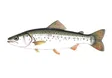
A species of freshwater ray-finned fish from the family Leuciscidae. The mouth is large, and the species lacks barbels (Trautman 1981). Clinostomus elongatus is similar to the Rosyside Dace, C. funduloides (Page and Burr 1991). Clinostomus elongatus can be distinguished from Rosyside Dace by its longer, more pointed snout, more slender body, brighter red on lower side (of adults), and smaller scales. The breeding male is steel blue on top of the body with a yellow-gold stripe along the side and bright red on the lower side while females do not have red along the side until the spawning season (Koster 1939).

Native range

Upper Susquehanna drainage, New York and Pennsylvania; Great Lakes (except Lake Superior) and Mississippi River basins from New York and southern Ontario to Minnesota and south to West Virginia, northern Kentucky, Indiana, Wisconsin, and Iowa (Page and Burr 1991).

Habitat and ecology

This species inhabits headwaters, preferring mid-water positions in the deepest parts of pools near woody debris and under overhanging structure. They also inhabit small streams in pools and slow-flowing sections with moderate gradient and alternating riffle and pool habitats (Koster 1939, McKee and Parker 1982; Page and Burr 1991, Novinger and Coon 2000; Zimmerman 2009). Healthy populations tend to be found in streams with stable spring and summer flows and greater contributions of groundwater (Reid and Parna 2017) while thermal tolerance of the fish varies by season, age, and condition (Leclair et al. 2020; Turko et al. 2020). This species primarily consumes insects (Daniels and Wisniewski 1994). The species spawns in pairs and in dense groups where females have multiple male partners (Watt et al. 2023).

Introduction history

Probable bait release.

Ecological impacts

Summary of species impacts derived from literature review. Click on an icon to find out more... The impacts of this species are currently unknown, as no studies have been done to determine how it has affected ecosystems in the invaded range. The absence of data does not equate to lack of effects. It does, however, mean that research is required to evaluate effects before conclusions can be made.

Range

Where it lives

Share of 1,519 GBIF observation records with a state location, across 16 states. The orange dots are USGS stream-survey sites where this species was caught.
0%
48.1%
Share of 1,519 GBIF observation records with a state location, across 16 states. The orange dots are USGS stream-survey sites where this species was caught.

A blank area on the dot layer usually means nobody sampled there, not that the fish is absent. Turn on “every survey site” to see where the survey looked.

The USGS stream survey caught it at 473 of its sites, in 9 states. That survey and the GBIF records are two different counts of two different things, so the site keeps them apart.

Habitat

Water and movement

Water
WoRMS records this species in fresh water.
USGS NAS habitat
Freshwater
US status
Native transplant — native to part of the United States, moved to other waters inside it.
Migration
Not migratory

Classification

Taxonomy

Kingdom
Animalia
Phylum
Chordata
Superclass
Actinopterygii
Class
Teleostei
Order
Cypriniformes
Genus
Clinostomus
Species
Clinostomus elongatus
ITIS TSN
163373
WoRMS AphiaID
1020946
GBIF key
2361178
Outside the US
ITIS also files it in Canada.

Common questions about Redside Dace

What is the scientific name of Redside Dace?
The scientific name is Clinostomus elongatus, in the family Leuciscidae. Classification follows ITIS.
Does Redside Dace live in fresh water or salt water?
WoRMS records this species in fresh water.
Where has Redside Dace been recorded in the United States?
GBIF has observations in 16 states, with the most records in New York, Ohio, Pennsylvania. The map shows observation records, which do not establish the complete natural range.

Closest relatives

Other Clinostomus species

Same family

More Leuciscidae

Alabama Shiner4 states
Cyprinella callistiaLeuciscidaeNativeFresh
Allegheny Pearl Dace19 states
Margariscus margaritaLeuciscidaeNative and introducedFresh
Altamaha Shiner1 states
Cyprinella xaenuraLeuciscidaeNativeFresh
Alvord Chub2 states
Siphateles alvordensisLeuciscidaeNativeFresh
Apalachee Shiner3 states
Pteronotropis grandipinnisLeuciscidaeNativeFresh
Arkansas River Shiner5 states
Notropis girardiLeuciscidaeNative and introducedFresh
Arroyo Chub1 states
Gila orcuttiiLeuciscidaeNative and introducedFresh
Bandfin Shiner5 states
Luxilus zonistiusLeuciscidaeNative and introducedFresh
Bannerfin Shiner5 states
Cyprinella leedsiLeuciscidaeNativeFresh
Beautiful Shiner3 states
Cyprinella formosaLeuciscidaeNativeFresh
Bedrock Shiner3 states
Notropis rupestrisLeuciscidaeNativeFresh
Bigeye Chub25 states
Hybopsis amblopsLeuciscidaeNative and introducedFresh
Bigeye Shiner17 states
Notropis boopsLeuciscidaeNative and introducedFresh
Bigmouth Chub3 states
Nocomis platyrhynchusLeuciscidaeNativeFresh
Bigmouth Shiner21 states
Notropis dorsalisLeuciscidaeNative and introducedFresh
Blackchin Shiner13 states
Notropis heterodonLeuciscidaeNativeFresh
Blackmouth Shiner3 states
Notropis melanostomusLeuciscidaeNativeFresh
Blacknose Shiner21 states
Notropis heterolepisLeuciscidaeNative and introducedFresh
Blackside Dace2 states
Chrosomus cumberlandensisLeuciscidaeNativeFresh
Blackspot Shiner5 states
Notropis atrocaudalisLeuciscidaeNativeFresh
Blacktail Shiner14 states
Cyprinella venustaLeuciscidaeNative and introducedFresh
Blacktip Shiner4 states
Lythrurus atrapiculusLeuciscidaeNative and introducedFresh
Bleeding Shiner8 states
Luxilus zonatusLeuciscidaeNativeFresh
Blotched Chub6 states
Erimystax insignisLeuciscidaeNativeFresh

All 267 species in Leuciscidae